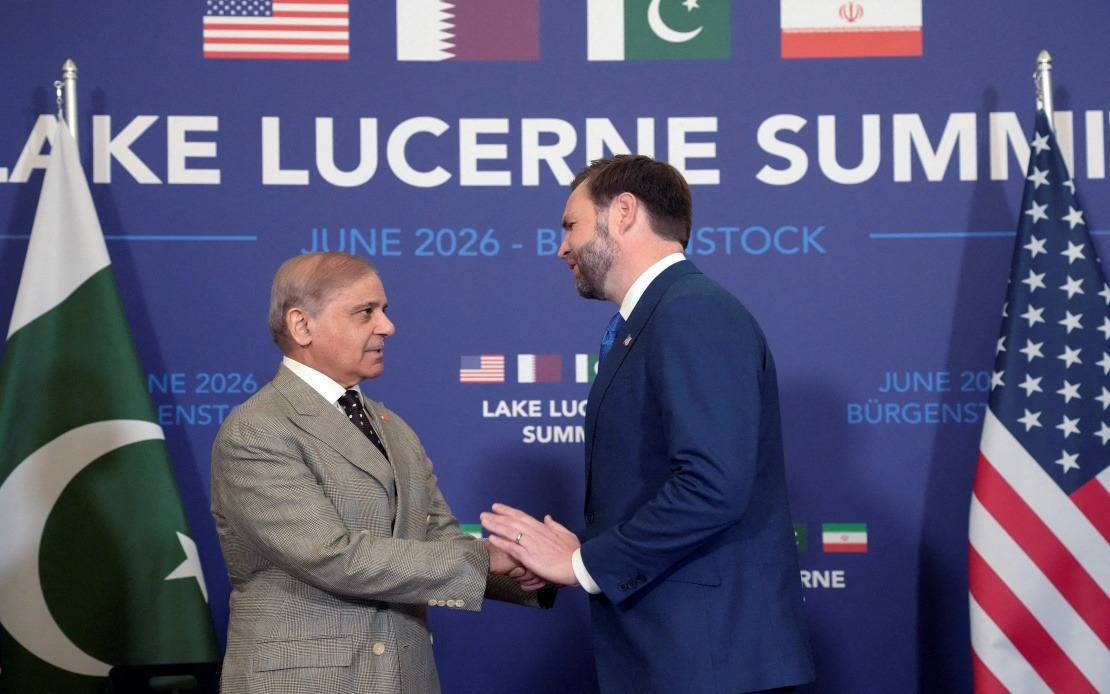
A significant diplomatic gathering unfolded in Switzerland on Sunday as high-ranking American and Pakistani officials met to discuss matters of mutual concern amid a broader international effort to resolve longstanding tensions between Washington and Tehran. Vice President JD Vance, alongside special envoys Steve Witkoff and Jared Kushner, convened with Pakistan's Prime Minister Shehbaz Sharif and Pakistan Army Chief Field Marshal Asim Munir at the Burgenstock resort, according to the White House press pool. The meeting represents a carefully choreographed diplomatic moment, with Pakistan's military and political leadership engaging directly with the Trump administration's senior representatives during a critical juncture in regional negotiations.
The gathering in the Alpine setting occurred on the margins of broader technical-level negotiations between Iran and the United States, with Pakistan and Qatar serving as crucial mediators in discussions expected to proceed behind closed doors. These technical talks follow a significant development in February when military hostilities commenced between the two nations, escalating regional tensions that have reverberated across the Middle East and affected global energy markets and shipping routes. The resumption of direct negotiations signals a potential shift toward de-escalation, though the complexity of outstanding issues ensures that progress remains uncertain.
Central to the emerging agreement is a memorandum that was signed remotely between Iran and the United States overnight into June 18, establishing a framework for resolving the military conflict that erupted on February 28. This document represents a foundation for broader negotiations, though numerous technical and political hurdles remain before a comprehensive settlement can be achieved. The memorandum provides specific timelines and commitments from both sides, suggesting a structured approach to unwinding years of escalating hostilities and restoring more stable diplomatic relations.
Among the critical provisions outlined in the preliminary agreement are commitments regarding naval blockades and maritime commerce. The United States has committed to lifting its naval blockade against Iran, while Tehran has undertaken responsibility for restoring shipping operations through the Strait of Hormuz, one of the world's most strategically vital waterways. Control over this chokepoint has long been a flashpoint for regional tensions, and any disruption to shipping there carries immediate implications for global energy prices and Southeast Asian economies dependent on reliable maritime trade routes. Malaysia, as a major trading nation and energy importer, has a direct interest in ensuring stability in this critical shipping corridor.
The nuclear dimension of the dispute represents perhaps the most contentious issue requiring resolution. Under the emerging framework, Iran commits to forgoing the acquisition of nuclear weapons, addressing a concern that has animated Western policy toward Tehran for decades. However, the nuclear programme itself remains a matter requiring separate negotiation and agreement. The parties have established a 60-day timeline for addressing these nuclear-related issues, suggesting a recognition that the current memorandum provides only a preliminary foundation for more detailed talks on this technically complex and politically sensitive matter.
For Iran, the incentive structure centers on the prospect of sanctions relief. Decades of international economic sanctions have severely constrained Iran's economy, limiting its ability to engage in normal trade, access international financial systems, and develop its economy. The lifting of anti-Iran sanctions represents the primary outcome Tehran seeks from these negotiations, and American willingness to discuss this matter signals a fundamental shift in approach. Previous administrations have maintained the sanctions regime as leverage, making any movement toward relief a notable diplomatic development.
Pakistan's role in these negotiations extends beyond mere mediation and reflects its complex position in regional geopolitics. As a nuclear-armed nation with significant influence in Afghanistan and the broader Muslim world, Pakistan maintains interests in both stabilizing its borders and managing its relationships with both Western powers and its regional neighbours. The presence of Field Marshal Asim Munir, head of Pakistan's powerful military establishment, alongside Prime Minister Shehbaz Sharif underscores the military dimension of Pakistan's concerns and its stake in regional outcomes. For Malaysia and other Southeast Asian nations, Pakistan's involvement signals how interconnected regional security architectures have become, with developments in South Asia and the Middle East increasingly affecting trade and stability across Asia.
The involvement of special envoys Witkoff and Kushner, the latter a senior Trump family member with long experience in Middle Eastern diplomacy, indicates the priority level the American administration assigns to these negotiations. The presence of Vice President Vance himself demonstrates commitment to steering discussions toward outcomes acceptable to Washington. The composition of the American delegation reflects both the political importance of achieving a deal and the desire to maintain flexibility in negotiations that have proven historically difficult.
The technical-level nature of the Sunday negotiations suggests movement beyond preliminary talks toward substantive problem-solving on specific issues. Such detailed discussions typically occur when parties have established sufficient common ground to warrant engagement on implementation details. However, the behind-closed-doors format also reflects the sensitivity of these discussions and the political risks all parties face in committing to specific terms that domestic constituencies may contest.
For regional observers including Malaysia and other Southeast Asian states, these negotiations carry implications extending beyond immediate Middle Eastern concerns. Instability in the Persian Gulf region directly affects global oil prices and shipping costs, raising import expenses for energy-dependent economies throughout Asia. Any resolution that reduces tensions has positive consequences for regional trade and investment climate. Conversely, failed negotiations could trigger renewed military escalation with unpredictable consequences for global energy markets and regional security architecture.
The timing of these talks, coinciding with the Swiss diplomatic venue, reflects a deliberate choice to employ neutral ground for sensitive negotiations. Switzerland's longstanding role as a venue for international negotiations and its diplomatic neutrality provide advantages when parties seek to discuss sensitive matters away from the glare of domestic political pressure and media scrutiny inherent in discussions held within national capitals.
Looking forward, the success of these negotiations will depend on whether parties can translate the preliminary memorandum into comprehensive agreements addressing the full range of issues requiring resolution. The 60-day timeline for nuclear discussions suggests urgency, though such timelines are frequently extended when negotiations prove more complex than anticipated. For Malaysia and the region, continued engagement with these diplomatic efforts remains important, as outcomes will ripple across Asia through energy markets, shipping patterns, and broader geopolitical stability.