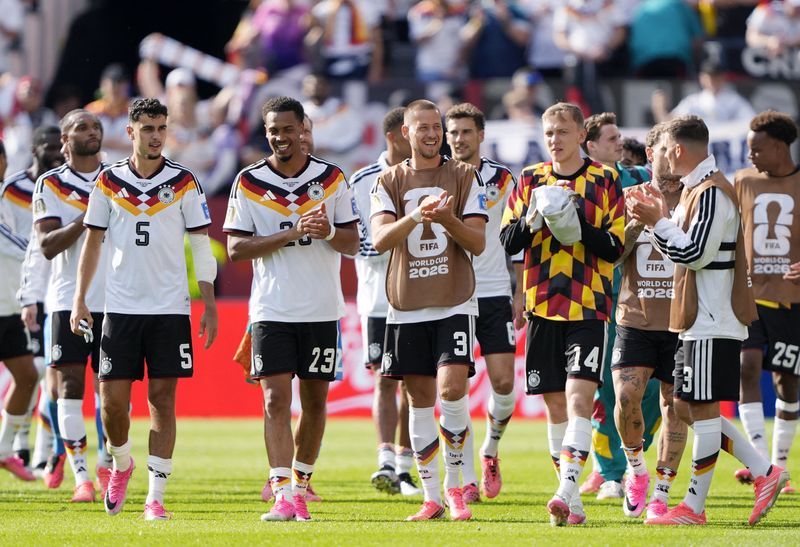
Deniz Undav proved to be Germany's most decisive weapon off the bench on Saturday, firing two clinical finishes to overturn an early deficit and deliver his side a crucial 2-1 victory over Ivory Coast in their World Cup Group E encounter. The result propels Julian Nagelsmann's team to the knockout rounds with one group match still remaining, marking their first knockout berth since claiming the trophy nine years earlier.
Played before more than 100,000 spectators in Toronto, a city with substantial German heritage, the contest unfolded as a back-and-forth affair that showcased the attacking prowess of both African and European football. Germany dominated possession and created numerous opportunities in the opening period, only to find themselves frustrated by marginal offside decisions and the resolute defending of their opponents. The West Africans, meanwhile, countered with direct, incisive raids that exposed gaps in the Germans' backline and demonstrated why they remain a formidable force in African football.
Franck Kessie handed Ivory Coast an unexpected lead in the first half when he converted a rebound following Amad Diallo's initial shot. The move originated from a sweeping cross delivered by Yan Diomande down the left flank, a familiar attacking pattern that caught Germany's defence momentarily off guard. The goal vindicated Ivory Coast's willingness to press forward aggressively despite being the underdog, and it left Germany chasing the game as the first forty-five minutes drew to a close. The hosts had fashioned eight attempts on goal by halftime without finding the net, a situation that tested their collective composure and resolve.
Two disallowed German goals in the opening period exemplified the razor-thin margins that often decide tight matches. Aleksandar Pavlovic rose to meet a short corner in the 25th minute but was penalised for fouling goalkeeper Yahia Fofana, a decision that drew audible protest from the German supporters. Later, Jamal Musiala's finish was ruled out for a foul on Odilon Kossounou during the build-up, leaving the Germans to reflect on what might have been had those efforts stood. Such fine details often prove decisive at the tournament's highest level, and Nagelsmann would have been acutely aware that his team needed to maintain discipline and precision.
The breakthrough for Germany arrived in the 68th minute when Undav arrived as a substitute to level the score with a controlled volley, demonstrating the composure and technical quality that has defined his recent form. The versatile forward has accumulated nine goals in his previous eight appearances for club and country, a remarkable tally that underscores his current form and value to the side. His levelling goal provided an immediate psychological lift, signalling that Germany's dominant spell would eventually translate into tangible reward.
Undav's second goal, arriving shortly thereafter, proved decisive and ultimately settled the contest in Germany's favour. Receiving the ball on the turn, he executed a deft movement before striking a low drive that left Fofana with no realistic chance of prevention. The two-goal haul showcased Undav's versatility and predatory instinct in the penalty area, qualities that have made him an increasingly important asset for the national team's attacking ambitions. His impact from the bench demonstrated how strategic substitutions can fundamentally alter the trajectory of a match, a principle that effective teams understand and exploit ruthlessly.
Ivory Coast refused to capitulate entirely and mounted late pressure in search of an equaliser. Simon Adingra fashioned a promising position deep in the German half but struggled to engineer a clear shooting opportunity, squandering what might have been a crucial moment. When Germany broke quickly in response, Fofana was forced into a crucial defensive block to prevent Nathaniel Brown from extending the lead, ensuring the final stages remained tense and competitive. Despite the setback, Ivory Coast's attacking threat never fully dissipated, and their ability to test Germany consistently suggests they remain competitive despite sitting third in the group standings.
The result leaves Germany atop Group E with six points and guaranteed passage to the knockout phase, one of the primary objectives for a team of their calibre and ambitions. Ivory Coast, despite their spirited display, remain on three points after two fixtures, leaving their knockout hopes contingent on results in their final group match. Their seven-goal streak across consecutive tournament matches represents the longest such sequence in their World Cup history, a testament to their attacking intent even when results have not favoured them.
The group will conclude with Germany facing Ecuador in New Jersey on Thursday, while Ivory Coast travel to Philadelphia to confront Curacao. For the Germans, securing qualification early affords Nagelsmann the luxury of rotation and tactical adjustment without the burden of immediate pressure, a significant advantage as the tournament progresses into its decisive phase. Ivory Coast, meanwhile, must deliver a victory against Curacao whilst hoping Ecuador slip up against Germany, a scenario that would require considerable fortune but remains mathematically possible given the fluid nature of World Cup group dynamics.
Undav's emergence as a match-winning substitute carries broader implications for Germany's structural flexibility and attacking depth. Rather than relying solely on established stars, Nagelsmann has identified a player capable of changing games through intelligent positioning and technical execution. This kind of squad versatility often proves invaluable in knockout football, where matches are decided by marginal moments and the capacity to influence proceedings from limited opportunities.