Vietnamese law enforcement has moved decisively against an illegal food import operation that circumvented biosecurity regulations to distribute over 10,000 metric tonnes of frozen chicken feet throughout the country. Hanoi police announced charges against Nguyen Thi To Loan, 47, and Trang Tuyet Ngoc, 45, following an investigation that uncovered how the pair orchestrated a four-year smuggling network spanning multiple provinces. The operation represents a significant breach of Vietnam's agricultural safety protocols and highlights vulnerabilities in the nation's cold-chain monitoring and customs enforcement.
Nguyen Thi To Loan directly managed ABF Food Import-Export JSC based in Ninh Binh Province, while Trang Tuyet Ngoc held a senior position at An Binh Group. Between 2023 and 2026, the pair's company imported 339 shipping containers of frozen chicken feet, all originating from countries grappling with active poultry disease outbreaks. Vietnamese law contains strict provisions prohibiting the domestic sale of such products; imports from disease-affected regions are permitted solely for processing and subsequent re-export. This regulatory framework exists to prevent contaminated food from entering the consumer supply chain and potentially sparking health crises.
Instead of adhering to these requirements, Loan orchestrated a distribution scheme that diverted the entire shipment to the domestic market. Working through their network, the two women supplied the frozen chicken feet to food-service establishments across five provinces, including major urban centres like Hanoi and industrial hubs such as Quang Ninh. The scope of the operation demonstrates how thoroughly the pair had embedded their products into Vietnam's commercial food system. According to police investigations, no import duties were paid on the consignments, representing an additional financial crime alongside the biosecurity violations.
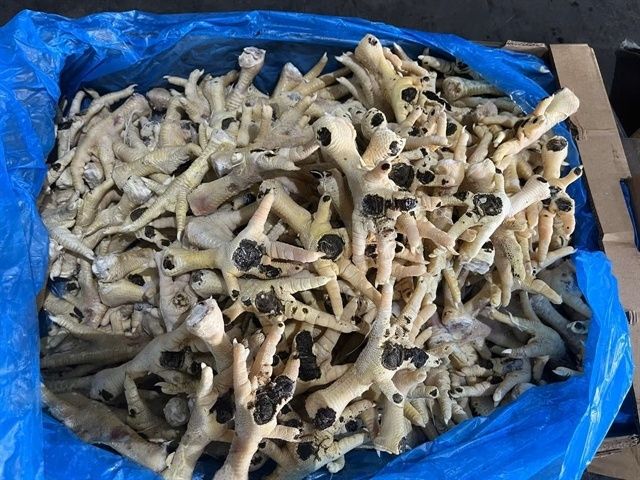
Authorities estimate the total value of imported goods exceeded VNĐ347 billion, equivalent to approximately US$13 million. This valuation underscores the commercial scale of the smuggling network rather than a minor operation. When customs officials discovered the scheme and executed raids on cold-storage facilities linked to the operation, they uncovered evidence of the full scope of the breach. The raids themselves revealed stark conditions that deepened public health concerns surrounding the operation. At the An Viet 2 freezer facility in Hanoi's Quang Minh Industrial Zone, investigators discovered over 1,000 metric tonnes of the imported chicken feet, including approximately 260 metric tonnes that had already expired. These deteriorated stocks displayed visible mould and pronounced odours indicative of advanced decomposition, yet had been staged for further distribution to commercial food buyers.
A subsequent raid at the THL cold-storage warehouse in Lang Son province yielded an additional 1,030 metric tonnes of frozen chicken feet. The discovery of such extensive stockpiles stored in ostensibly refrigerated facilities suggests the operation had been gradually expanding its market penetration across northern Vietnam. The presence of expired and visibly contaminated products positioned for sale compounds the health threat posed by the smuggling network. Had these deteriorated stocks reached food-service operators and ultimately consumers, the consequences could have ranged from foodborne illness outbreaks to serious public health emergencies.
Both suspects have reportedly confessed to all charges levelled against them, streamlining the legal proceedings. Hanoi police have formally charged Nguyen Thi To Loan and Trang Tuyet Ngoc under Article 188 of the 2015 Penal Code, which addresses smuggling offences. The confessions suggest the evidence gathered during the investigation proved compelling and that the pair recognised the strength of the prosecution's case. Nevertheless, authorities emphasise that the investigation remains active and ongoing.
Police are continuing their work to identify additional individuals and organisations embedded within the broader smuggling network. The operation's longevity and scale suggest that peripheral actors—including customs intermediaries, transportation providers, cold-storage operators, and commercial buyers—may have been aware of or tacitly facilitated the illegal distribution scheme. Establishing the full extent of complicity throughout the supply chain will determine whether further charges are warranted. This aspect of the investigation carries particular significance for understanding how systematic food safety violations can persist within regulatory systems, and where enforcement gaps permitted such an extensive operation to flourish.
For Malaysian readers, this case offers cautionary insight into transnational food security risks. Vietnamese poultry products, including processed chicken, feature prominently in Southeast Asian trade networks and occasionally reach Malaysian markets through legitimate and illegitimate channels. The exposure of such a large-scale smuggling operation underscores the importance of rigorous import verification and cold-chain integrity checks. Vietnamese regulatory authorities have historically engaged in cooperation with Malaysian counterparts on agricultural product standards, yet this case demonstrates how determined smugglers can circumvent multilayered oversight mechanisms. Malaysian food safety officials are likely to intensify scrutiny of Vietnamese poultry imports and may implement additional verification protocols to prevent comparable breaches from entering the country.