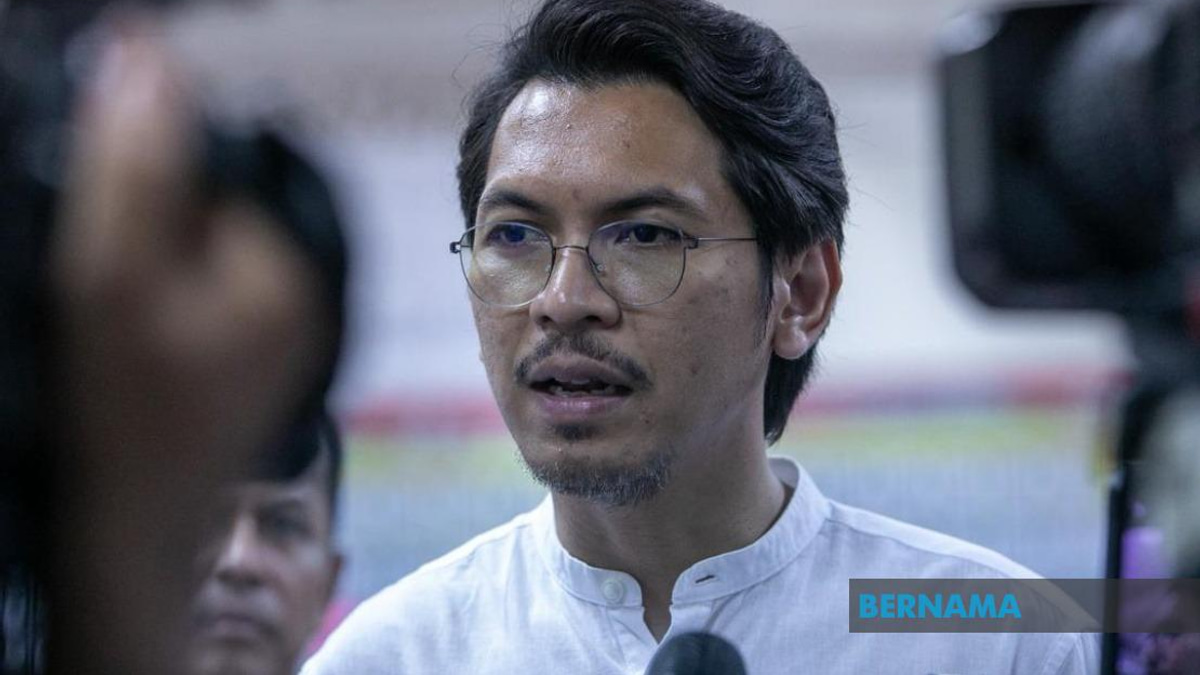
Political analyst and former Umno Youth leader Khairy Jamaluddin has offered a candid assessment of PAS's strategic position, suggesting the Islamic party faces a hard ceiling on support unless it can successfully cultivate relationships with moderate political forces that command different voter demographics. His observation touches on a fundamental challenge facing Malaysia's Islamist movement as it seeks to expand its footprint beyond constituencies where religious conservatism traditionally dominates.
According to Khairy's analysis, PAS appears to view the appointment of Hamzah Zainudin to a leadership position within Parti Wawasan Negara as a deliberate mechanism to bridge the gap between its core support base and a broader electorate. This strategic calculation reflects recognition that the party's existing coalition partners and traditional messaging may have exhausted their capacity to mobilise new voters, particularly among urban, non-Muslim, and younger demographic segments that remain skeptical of overtly religious political platforms.
The observation carries particular weight given Khairy's recent trajectory. As someone who spent years navigating Umno's internal politics and youth leadership, he has firsthand knowledge of how Malaysia's major Malay-Muslim parties calculate electoral strategy and coalition mathematics. His willingness to publicly articulate this assessment suggests either genuine concern about PAS's political isolation or an attempt to signal to opposition factions that the Islamic party faces structural limitations that moderates should exploit.
PAS's core support base has historically concentrated in rural Kelantan and Terengganu, though significant gains in the 2022 general election expanded its representation across multiple states. However, translating protest votes and Umno defections into durable electoral coalitions remains a different proposition entirely. The party's explicit religious positioning appeals intensely to committed adherents but simultaneously creates headwinds in multiethnic urban areas where voters prioritise economic management and religious pluralism over Islamisation agendas.
The introduction of Hamzah Zainudin into Parti Wawasan Negara's orbit reflects PAS's recognition that it cannot wield majority power in the foreseeable future without allies whose legitimacy extends beyond religious constituencies. A former federal politician, Hamzah brings institutional credibility and broader networking capacity than PAS can independently mobilise. By positioning him prominently in a separate vehicle, PAS effectively creates a cultural translation layer between its messaging and fence-sitting voters uncomfortable with direct association with Islamic movements.
This manoeuvre resembles strategies employed by conservative parties in other Muslim-majority democracies. In Indonesia and Pakistan, Islamist movements have frequently established ostensibly independent but strategically aligned organisations to capture centrist or pragmatic voters without explicitly linking them to hardline agendas. The approach requires careful brand management—the moderate vehicle must maintain sufficient independence to retain credibility, while remaining sufficiently coordinated to deliver electoral outcomes beneficial to the primary Islamist partner.
For Malaysian voters and observers, Khairy's commentary illuminates an uncomfortable truth about the country's political landscape: parties organised primarily around theological or ethnic identity face inherent expansion constraints. The mathematics of Malaysian democracy mean that no single communal bloc constitutes an unambiguous majority, forcing even ideologically committed movements to negotiate with partners whose bases diverge significantly from their own. PAS's search for moderate allies reflects less a change in conviction than pragmatic adaptation to electoral realities.
The timing of Khairy's remarks also warrants consideration. As someone outside formal power structures at present, he can articulate observations that current office-holders might find diplomatically inconvenient. Yet his comments are unlikely to remain merely theoretical—they signal to other political actors that PAS's current position contains vulnerabilities that strategic opponents might exploit by accelerating fragmentation of non-Muslim or urban Malay support.
Parti Wawasan Negara itself represents an attempt to capture political space occupied by Malaysians sceptical of both entrenched communal politics and explicitly religious movements. Its emergence alongside PAS's strategic recalibration suggests both parties recognised a shared interest in reaching voters alienated by conventional political categories. Whether this partnership succeeds depends substantially on whether Hamzah Zainudin can establish independent credibility or whether the arrangement simply becomes a transparent subsidiary of PAS priorities.
The broader implications extend beyond internal PAS calculations. Khairy's assertion that PAS has hit a support ceiling challenges the narrative of inexorable Islamist ascendancy in Malaysian politics promoted by the party itself. It suggests that despite significant electoral gains, deeper structural factors limit how far explicitly religious mobilisation can extend in Malaysia's heterogeneous society. This assessment potentially encourages opposition parties to develop counter-strategies rather than assuming inevitable PAS electoral dominance.
Moreover, the commentary underscores how Malaysia's coalition-dependent political system requires constant negotiation and strategic repositioning. No party, regardless of its ideological clarity or support intensity, can govern without assembling combinations of partners whose bases differ fundamentally. This reality imposes discipline on political movements, forcing them to moderate rhetoric, accept compromise, and maintain relationships with ideological adversaries when electoral mathematics demand it.
As PAS pursues its moderate alliance strategy, the outcomes will become evident through electoral performance and policy positions adopted by the Hamzah-led vehicle. Should Parti Wawasan Negara succeed in capturing significant non-traditional PAS voter cohorts while maintaining coordination with the parent movement, the model becomes replicable. Conversely, if the moderate partner dilutes PAS's policy influence or fractures coalition discipline, it may demonstrate that Malaysia's political divisions remain too fundamental for theological parties to bridge through subsidiary structures.