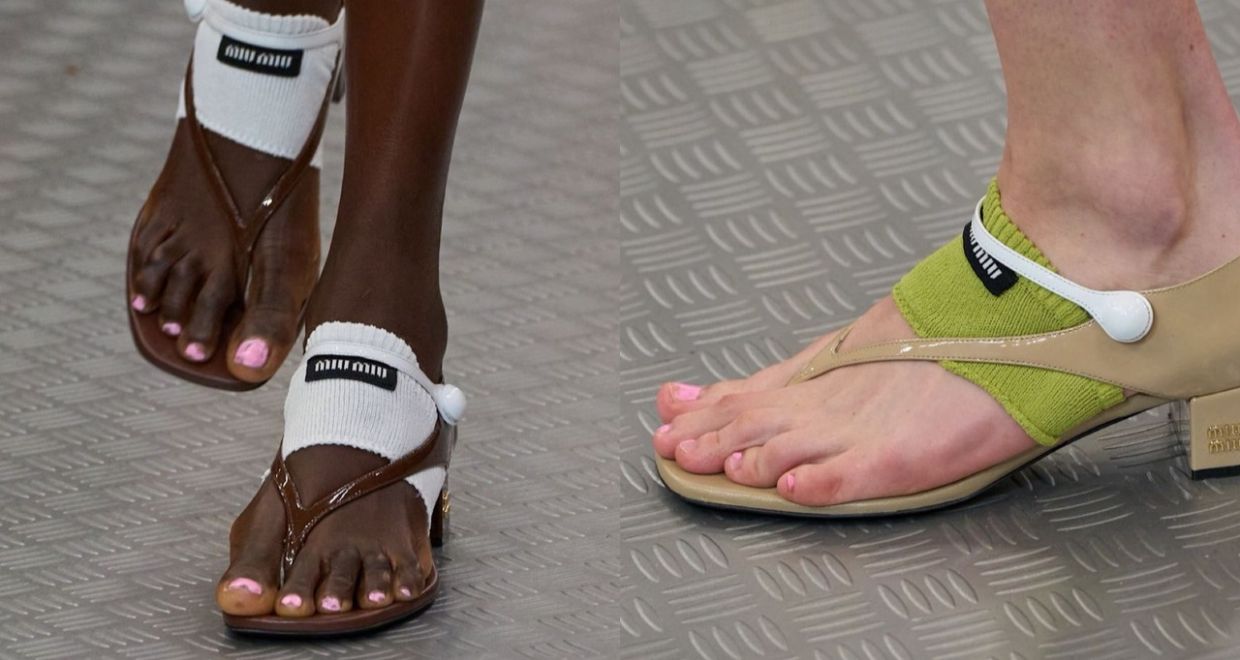
Fashion retailers across Asia are championing an unexpected solution to the age-old summer dilemma: when barefoot feels too casual but full socks feel stifling. Open-toe socks, a hybrid design that covers the top and arch of the foot while leaving toes exposed, are rapidly gaining traction as the season's defining accessory. The style sits comfortably between the extremes of complete exposure and complete coverage, appealing to consumers seeking practicality without sacrificing aesthetics during the hottest months.
The trend has accelerated dramatically in South Korea, where an unusually early heat wave shifted consumer demand toward lightweight summer footwear. Online fashion platforms reported striking sales performance: retailers noted an 80 percent surge in summer shoe categories—including mules, slides, and flip-flops—between May 31 and June 7 compared to the same period last year. The growth extends specifically to socks designed for pairing with flip-flops, with transaction values skyrocketing 1,664 percent from May 14 to June 14, while search interest climbed an even steeper 3,227 percent.
The surge in interest tracks directly to runway influence and celebrity endorsement. Luxury label Miu Miu introduced an unconventional sock design in its 2025 Spring/Summer collection, abandoning traditional full-foot coverage in favour of a partial wrap around the arch. The approach challenged conventional sock design and caught fashion media attention. South Korean actor Cha Jung-won amplified the trend by sharing social media content pairing sky-blue flip-flops with beige knit leg warmers, demonstrating how the accessory translates from runway concept to real-world styling.
Unlike their winter predecessors, contemporary open-toe socks prioritise breathability and visual impact over thermal insulation. Manufacturers have reimagined the category using sheer, mesh, and loosely knitted fabrics that allow air circulation while providing the coverage consumers desire. This material innovation proves crucial in tropical and subtropical climates, where traditional socks would trap unwanted heat. The result functions less as a warming layer and more as a deliberate styling statement—an accent piece that transforms otherwise basic summer footwear into curated, intentional looks.
Fashion retailers articulate a clear positioning argument for the category. Officials from major online platforms explain that open-toe socks operate as a "summer cheat code" for elevating flip-flops, sandals, and ballerina flats beyond their everyday status. The socks fill a genuine aesthetic gap: bare feet may feel insufficiently styled for certain occasions, while conventional socks clash entirely with summer shoe silhouettes. The open-toe design removes both obstacles, offering visible styling potential without the thermal penalty of full coverage.
Beyond aesthetics, the category delivers genuine functional benefits relevant to tropical and monsoon-affected regions. The socks protect the upper foot and arch from friction and chafing caused by flip-flop straps, addressing a common comfort issue that intensifies during extended wear in humid weather. During monsoon seasons common throughout Southeast Asia, consumers can layer the socks with rain boots, reducing skin irritation from prolonged moisture exposure and providing protection without requiring full-weight winter socks. This practical utility strengthens the accessory's appeal across climates where summer footwear dominates for extended periods.
Styling guidance from fashion authorities emphasizes accessible entry points and sophisticated application techniques. For first-time adopters, neutral tones—grey, black, and white—present low-risk foundations that complement established summer wardrobes. Grey socks paired with black flip-flops or ballerina flats harmonize naturally with denim, Bermuda shorts, and satin skirts. Consumers confident in bolder choices can select vivid colours including yellow, pink, or sky blue, with deliberate mismatching between socks and shoes reading as intentionally cool rather than accidental.
The styling philosophy extends beyond footwear choices to complete outfit composition. Fashion editors recommend maintaining visual balance by keeping the remainder of the ensemble understated. Since open-toe socks and their complementary shoes naturally command attention, supporting pieces should remain familiar and restrained—a simple T-shirt and shorts, or a basic shirt and skirt. This restraint creates proportion in the overall look and prevents the ensemble from feeling over-styled. Notably, visible patterns on socks such as dots or florals pair particularly effectively, suggesting that open-toe socks work as legitimate vehicles for pattern and colour rather than neutral foundations.
The emergence of open-toe socks reflects broader fashion industry trends toward comfort-conscious design and the blurring of traditional category boundaries. Rather than accepting existing categories as fixed, designers and retailers are experimenting with hybrid solutions that address consumer pain points—thermal discomfort, aesthetic dissatisfaction, and functional limitations. The trend demonstrates how regional climate variations and seasonal shifts can generate distinctive fashion moments, with South Korea's heat wave catalyzing wider Asian interest in experimental footwear approaches.
For Malaysian and Southeast Asian consumers navigating hot, humid climates year-round, open-toe socks represent a particularly relevant innovation. The region's consistently warm weather and monsoon seasons create an extended market for summer footwear solutions, yet traditional sock options remain thermally inappropriate. The open-toe category fills this void, offering visible styling potential, practical functional benefits, and breathable material construction simultaneously. As fashion retailers continue expanding awareness and product availability across Asia, the trend appears positioned to move beyond novelty status toward establishment as a flexible summer wardrobe staple.
Social media amplification continues accelerating adoption beyond South Korea. The visual nature of the accessory and its sharp contrast to conventional footwear styling makes it inherently shareable content. Fashion editors and influencers across Asia increasingly feature open-toe socks in summer lookbooks and styling guides, normalizing the aesthetic and demonstrating versatile application across different occasions and preferences. As inventory increases and price points stabilize with broader market acceptance, the trend shows every indication of sustaining momentum through the summer season and potentially establishing itself as a recurring fashion cycle element.