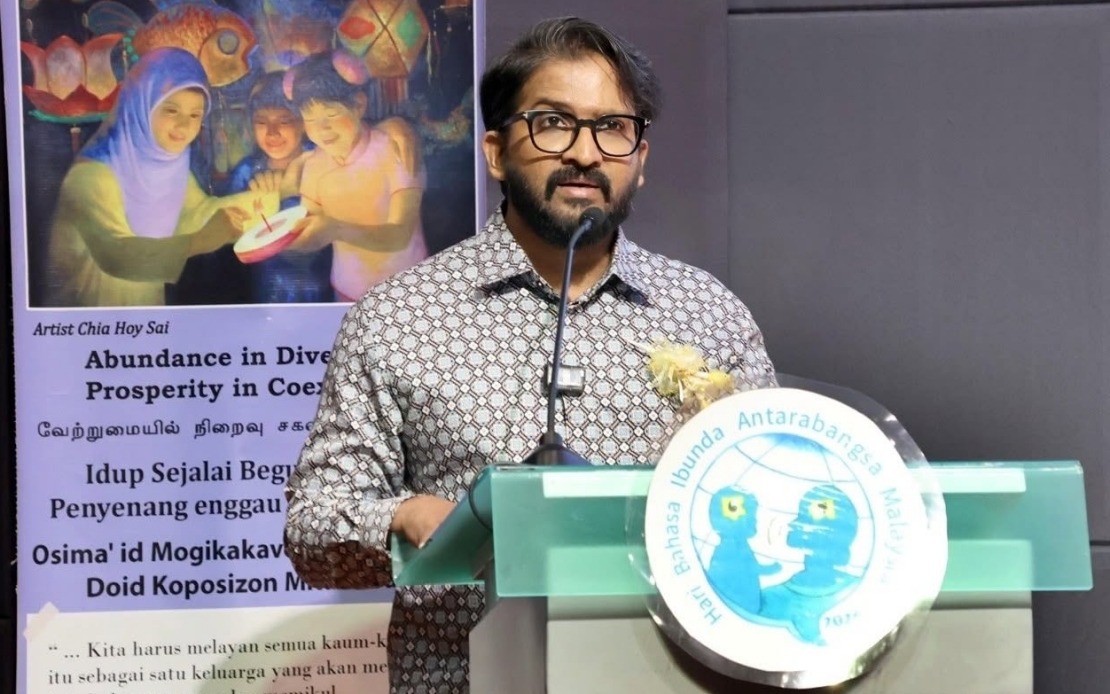
Deputy National Unity Minister R. Yuneswaran has made a compelling case for strengthening mother-tongue proficiency across Malaysia, arguing that deeper engagement with one's own linguistic heritage serves as an antidote to the divisive 3R issues that regularly convulse the nation's social media landscape. Speaking in a Facebook post on June 21, Yuneswaran suggested that the persistent eruptions of contentious discussions centred on race, religion, and royalty stem fundamentally from inadequate mutual understanding of each other's historical narratives, languages, and cultural frameworks.
The Deputy Minister's intervention arrives at a moment when Malaysian society continues grappling with how to maintain cohesion amid increasing polarisation. His perspective reframes what might initially seem like a narrow educational agenda into something far more ambitious—a nation-building strategy rooted in linguistic and cultural respect. Rather than viewing the learning of mother tongues as an obstacle to national unity, Yuneswaran positions it as a prerequisite for genuine understanding that makes unity meaningful rather than merely imposed.
Language, in Yuneswaran's formulation, transcends its conventional role as a mere instrument for transmitting information. Instead, he emphasises that language carries embedded within it an entire universe of identity, cultural memory, and community values. This perspective has significant implications for Malaysian policymakers. When young people lose connection to their mother tongue, they simultaneously sever their link to the philosophical and ethical foundations that their communities have developed over generations. This severing creates a vacuum that may be filled by shallow, sensationalist rhetoric—precisely the kind that flourishes on social media platforms where nuance often disappears.
The linguistic mosaic of Malaysia encompasses roughly 130 distinct languages, a figure that Yuneswaran explicitly highlights as a source of national strength rather than fragmentation. This framing proves essential in the Malaysian context, where plurality has sometimes been portrayed as inherently destabilising. Instead, Yuneswaran argues for a paradigm where Malaysia's linguistic diversity becomes something to cultivate deliberately, similar to how a gardener tends to different plant species to create a thriving ecosystem. The metaphor is apt: just as biodiversity strengthens ecological resilience, cultural and linguistic diversity—properly nurtured—strengthens social resilience.
A critical dimension of Yuneswaran's argument addresses a widespread misconception that has influenced educational policy debates in Malaysia for decades. He explicitly states, drawing on his own experience as someone who attended both Chinese and national school streams, that mastering one's mother tongue creates no impediment to learning Bahasa Malaysia or acquiring proficiency in English or other international languages. This assertion merits serious consideration, given that Malaysian education has sometimes been structured around an implicit zero-sum logic where investing in mother-tongue education supposedly diverts resources and attention from the national language.
Yuneswaran's personal testimony carries particular weight precisely because of his own multilingual journey. By positioning himself as someone who has successfully navigated multiple linguistic streams, he models an approach to language acquisition that treats it as cumulative rather than competitive. When a child becomes truly proficient in their mother tongue, cognitive linguists increasingly demonstrate that this foundation actually facilitates the acquisition of additional languages. The neural pathways involved in mastering grammatical structures, semantic fields, and communicative nuance in one language transfer productively to others.
The National Unity Ministry's mandate under the 13th Malaysia Plan explicitly tasks it with strengthening nation-building through a tripartite framework: understanding, respect, and the willingness to learn about one another. Yuneswaran's mother-tongue proposal aligns squarely with this mandate. Without understanding, respect remains hollow and performative. Without respect, understanding generates resentment rather than connection. And without genuine willingness to engage with another culture on its own terms—including through its language—both understanding and respect become brittle.
The surge of 3R-related conflict on social media platforms reflects a deeper crisis of interpretation. When individuals lack grounding in their own cultural and linguistic traditions, they become vulnerable to radical reinterpretation of their identity by online actors with explicit political agendas. A person who genuinely understands the historical richness and philosophical complexity of their own religious tradition, for instance, becomes far less susceptible to inflammatory reductionist narratives about it. Similarly, a young person steeped in their community's literary and intellectual heritage develops critical tools to evaluate claims about their own history.
For Southeast Asian readers, particularly those in Malaysia and neighbouring countries with comparable linguistic diversity, Yuneswaran's intervention offers a model for thinking beyond the false dichotomy between national integration and cultural preservation. Countries across the region have struggled with this tension—whether supporting mother-tongue education in schools, media, and public life somehow undermines national cohesion. What Yuneswaran articulates is that authentic national unity actually requires, rather than precludes, robust engagement with subnational cultural identities.
The mechanism by which mother-tongue proficiency addresses 3R issues operates on multiple levels. Intellectually, when young Malaysians develop sophisticated command of their own language, they gain access to the sophisticated discussions—philosophical, ethical, historical—that their communities have conducted across generations. This intellectual inheritance provides resources for nuanced thinking. Emotionally, strong connection to one's own heritage fosters the self-confidence that makes genuine respect for others' heritage more achievable. A person secure in their own identity proves far more capable of affirming another's identity simultaneously.
Implementing Yuneswaran's vision would require substantive shifts in how Malaysia approaches education, media, and cultural policy. It would mean recognising that Bahasa Malaysia need not be strengthened through the attenuation of other languages. It would require investment in mother-tongue literacy programmes, in media content in minority languages, in celebrating multilingual excellence rather than treating it as a complication. For Malaysian policymakers, the Deputy Minister's argument suggests that the path to greater social harmony runs not through enforced homogeneity but through deliberate cultivation of the conditions in which genuine pluralism can flourish.
Ultimately, Yuneswaran's intervention redefines language policy as fundamentally an issue of social cohesion rather than merely educational efficiency or cultural preservation. When people feel their languages are valued and supported, they develop stronger emotional investment in the broader national project. Conversely, when linguistic communities perceive their languages as under threat or marginalised, resentment accumulates beneath the surface until it erupts, often through precisely the kinds of social media conflicts he seeks to prevent. By championing mother-tongue proficiency as a positive good in its own right, Yuneswaran positions linguistic diversity not as an obstacle to overcome but as a resource to develop.