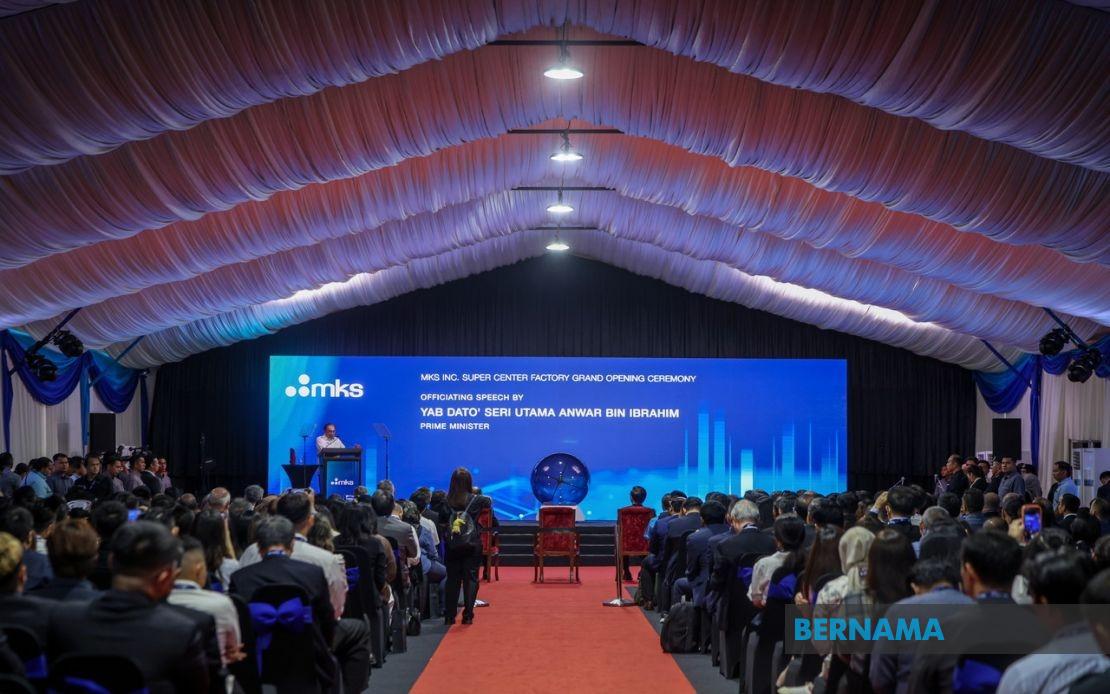
Datuk Seri Anwar Ibrahim has underscored how Malaysia's deliberate pursuit of diplomatic even-handedness is generating tangible economic rewards, insulating the nation from geopolitical tensions while positioning it as a trusted partner for countries across competing blocs. Speaking at the opening of a technology manufacturing facility in Penang on June 20, the Prime Minister articulated a vision of Malaysia as a strategic intermediary, deliberately cultivating relationships with powers including the United States, China, India, and Russia without surrendering sovereign independence or compromising core principles.
The approach reflects a pragmatic recalibration of Malaysia's foreign policy, one that acknowledges the reality of a multipolar world where smaller nations need not choose between rival superpowers. Rather than aligning rigidly with any single camp, Malaysia has designed a framework that permits simultaneous engagement with the Trump administration, Beijing, New Delhi, and Moscow—each relationship yielding distinct economic and strategic benefits. This balancing act has become increasingly valuable as great-power competition reshapes global trade, investment flows, and technology partnerships.
Anwar highlighted the tangible manifestations of this strategy, pointing to Petroliam Nasional Bhd's recent commercial agreement in Turkmenistan as exemplary of how neutrality translates into opportunity. Petronas, Malaysia's national petroleum corporation, has historically leveraged the nation's diplomatic standing to secure energy contracts and upstream partnerships across regions that might otherwise regard foreign investment with suspicion. By maintaining a reputation for reliable, non-ideological engagement, the corporation gains access to hydrocarbon assets and markets that competitors from aligned nations might find restricted.
The Prime Minister's remarks must be understood within the context of Malaysia's historical foreign policy tradition, rooted in the doctrine of non-alignment articulated at the nation's founding. This heritage provides intellectual and political legitimacy for Anwar's approach, grounding contemporary strategy in principles that preceded the Cold War and remain relevant in an era of renewed great-power rivalry. Malaysia, alongside other ASEAN members, has consistently rejected pressures to take sides in disputes between China and the United States, insisting instead on preserving space for autonomous decision-making on security and economic matters.
Yet the practical challenge lies in demonstrating that such neutrality yields concrete benefits, not merely abstract diplomatic consistency. Anwar's invocation of the presidential visit from Donald Trump last year and ongoing engagements with other capitals signals an attempt to prove that Malaysia's non-aligned posture attracts rather than repels investment and cooperation from multiple quarters. In an era when countries are increasingly pressured to choose between American and Chinese spheres of influence—whether in technology standards, supply chain dependencies, or security partnerships—Malaysia's insistence on autonomy requires constant reinforcement through economic wins and high-level diplomatic theatre.
The technology sector opening where Anwar made these remarks is particularly significant, occurring in Penang, a state that has positioned itself as a leading semiconductor and electronics manufacturing hub within Southeast Asia. Penang Chief Minister Chow Kon Yeow's presence underscored the devolved nature of Malaysia's economic strategy, with state governments playing active roles in attracting foreign direct investment. MKS, the company inaugurating its facility, represents the type of mid-tier manufacturing enterprise that characterizes Malaysia's diversification beyond resource extraction into higher-value industrial production.
The emphasis on maintaining independence while engaging all parties carries particular resonance for Malaysian business communities, which benefit from access to markets and technology across geopolitical divides. Companies operating within Malaysia's borders increasingly find themselves navigating American export controls on advanced semiconductors, Chinese preferential purchasing arrangements, and Indian market entry requirements—all simultaneously. A government that can credibly claim non-alignment status helps domestic firms and foreign investors operating in Malaysia argue for exemptions, partnerships, or preferential treatment across these competing regulatory regimes.
Anwar's framing also addresses anxieties within ASEAN about whether the bloc might be forced to fragment along geopolitical lines. Southeast Asian nations collectively depend on both American security guarantees and Chinese economic investment, creating structural contradictions that Malaysia's non-aligned posture helps navigate. By demonstrating that neutrality is economically rewarding rather than costly, Anwar provides a model that other ASEAN members might reference when resisting external pressure to declare unambiguous allegiances.
The strategic approach does entail risks and complexities that Anwar's public statements necessarily downplay. Maintaining credible non-alignment requires navigating situations where the interests of major powers genuinely conflict—as in Taiwan, Ukraine, or South China Sea disputes—and articulating positions that others may perceive as insufficiently committed. Countries invested in particular outcomes may view Malaysia's balanced stance as evasion rather than principle. Additionally, as technological competition between the United States and China intensifies, companies and governments increasingly demand that nations choose sides on critical standards, supply chains, and security architecture.
Despite these complexities, the Prime Minister's articulation of economic opportunity flowing from diplomatic independence reflects an assessment that Malaysia's position in global affairs remains valuable precisely because it maintains flexibility. The nation's membership in ASEAN, historical relationships across the Muslim world, geographic location astride crucial sea lanes, and technical capacity in manufacturing and energy sectors collectively create demand for Malaysia's partnership regardless of geopolitical alignment. By cultivating this demand through active engagement and credible neutrality, Malaysia's leadership seeks to convert diplomatic positioning into sustained economic advantage for the nation and its people.