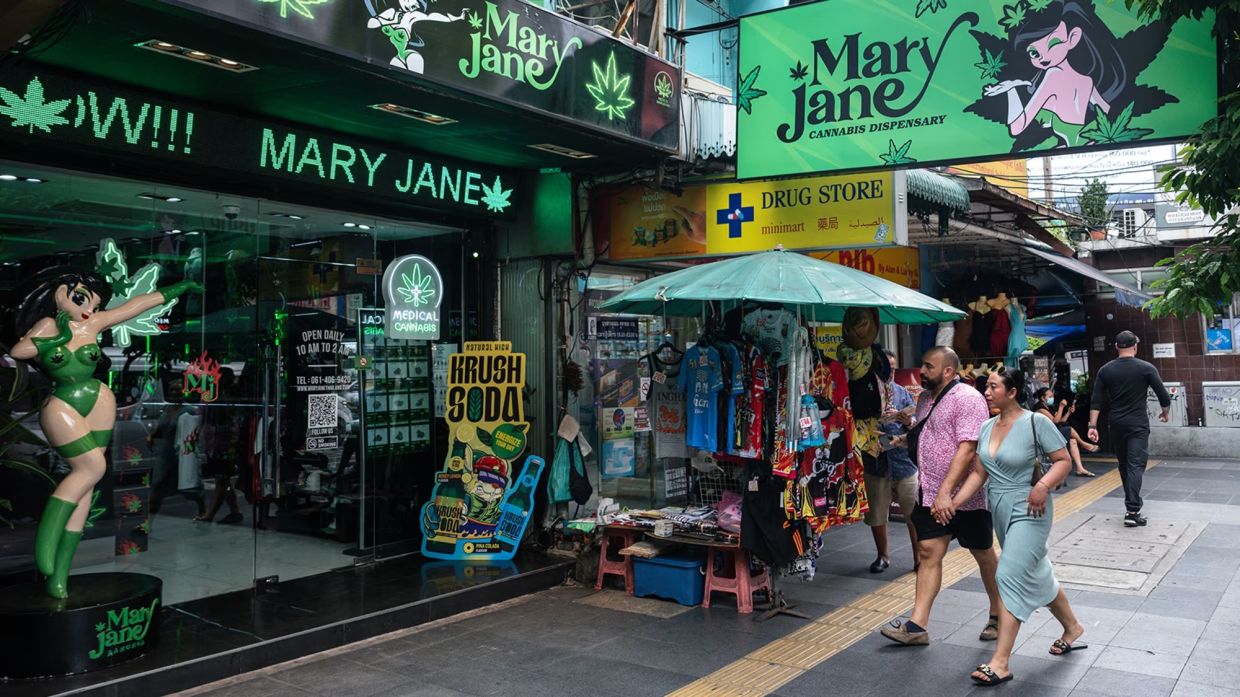
Thailand's evolving approach to cannabis regulation has reached a critical juncture, with lawmakers examining whether the plant should be reclassified as a controlled narcotic while a comprehensive regulatory framework is finalised. A significant policy discussion held on June 18 before the House Public Health Committee, chaired by Sakoltee Phattiyakul, highlighted the fundamental tensions between public health protection and economic interests that have characterised the country's cannabis regime since liberalisation began three years ago.
Since cannabis was formally decriminalised in June 2022, Thailand has operated a fragmented regulatory system that treats the plant and its derivatives differently depending on their form and intended use. The Department of Thai Traditional and Alternative Medicine currently classifies cannabis as a controlled herb under the Protection and Promotion of Thai Traditional Medicine Wisdom Act 1999, while cannabis extracts containing more than 0.2 per cent THC remain designated as narcotics. This dual classification has created the very legal ambiguities and enforcement difficulties that government officials, health professionals and civic organisations are now attempting to resolve.
A new cannabis and hemp bill is in development through multiple government agencies working in concert: the Department of Thai Traditional and Alternative Medicine, the Food and Drug Administration, the Department of Health Service Support and the Office of the Permanent Secretary for Public Health. The draft legislation was submitted to the Cabinet under the previous administration but languished without parliamentary consideration before the government dissolved. Under the current public health minister's direction, the bill is undergoing public consultation hearings scheduled to conclude by late July, with resubmission to the Cabinet anticipated thereafter. This timeline suggests a legislative outcome may be feasible within months rather than years, though political will and consensus among competing interests remain uncertain.
The medical and public health establishment has mounted a coordinated case for temporary reclassification. Dr Tewan Thaneerat, the deputy director-general overseeing traditional medicine, acknowledged persistent concerns since liberalisation, noting that in June 2025 the Public Health Ministry issued three regulatory orders to govern research, sales, processing and exports in alignment with international standards. However, these administrative measures have proved insufficient to contain the proliferation of unregistered cultivation and informal sales channels. Ekkapop Sittiwantana, deputy chairman of the committee representing the People's Party, argued explicitly that cannabis should revert to narcotics classification temporarily until the dedicated cannabis law is enacted, emphasising the necessity of requiring proper plant registration to eliminate the loopholes exploited by quasi-legal operators.
Associate Professor Dr Smith Srisont, representing a coalition of medical doctors, academics and harm-reduction advocates, presented evidence that despite the technical distinction between THC-rich extracts and cannabis flowers in the legal code, the practical consequences of widespread plant availability have already manifested in community health. His analysis underscored a critical regulatory weakness: whereas cannabis flowers are classified as controlled herbs, other plant parts escape criminal liability when cultivated, creating de facto permission for certain cultivation and processing activities that circumvent oversight. This fragmentation means that enforcement agencies face significant practical and jurisdictional confusion when determining whether particular conduct violates law.
The Food and Drug Administration provided reassurance regarding its licensing and inspection mechanisms, which cover production facilities, processing plants, imports, and retail sales through certified outlets. Officials reported that initial testing of cannabis-based products showed most inspections resulted in satisfactory compliance with labelling and composition standards. However, they candidly acknowledged that the fundamental problem persists at the distribution level: many sales occur through channels never brought into the formal licensing system. This distinction between regulatory capacity and regulatory reach indicates that Thailand possesses adequate administrative infrastructure but lacks either the political determination or the enforcement resources to compel universal participation.
The cannabis industry and its supporting civil society networks offered a countervailing perspective grounded in economic sustainability and fairness. The Thai Cannabis Future Network argued that licensed operators face existential pressure from black market competition, illegal imports, and the perpetual uncertainty created by legislative limbo. Beyond commercial concerns, the network raised allegations of unofficial demands for personal benefits or improper pressure linked to licensing decisions by government officials, as well as complaints that medical prescriptions required for legitimate cultivation remain prohibitively expensive for farmers or are allegedly traded in commercial venues unrelated to healthcare delivery. These allegations, if substantiated, suggest that regulatory capture and corruption are complicating implementation of even the existing framework.
The network further contended that cannabis possesses cultural and economic value extending beyond pharmaceutical applications and should not be confined exclusively to mainstream medical channels. This position reflects a broader Thai perspective that views cannabis as connected to traditional agriculture and indigenous knowledge systems rather than merely as a recreational or medicinal commodity. The network's demand for a lawmaking process incorporating broad public participation, rather than processes perceived as favouring large institutional investors, reflects anxieties common across Southeast Asia regarding how regulatory frameworks can entrench economic advantages for established players at the expense of smallholders and community enterprises.
Committee chairman Sakoltee Phattiyakul concluded the meeting by directing officials to compile comprehensive registries of licensed cannabis retailers in Bangkok and FDA-certified cannabis products for detailed examination. He flagged that cannabis has become excessively accessible and signalled that any new legislation must incorporate restrictions on the proximity of cannabis shops to schools and educational facilities, addressing concerns about youth exposure. His commitment to reviewing both the Public Health Ministry's bill and alternative proposals from the public sector indicates openness to considering multiple regulatory architectures, though no guarantee of reconciling the competing visions.
The deeper question facing Thailand is whether its political system can construct durable cannabis policy that genuinely balances economic development for farmers and legitimate businesses, respect for traditional uses, and evidence-based public health safeguards. Regional observers note that Thailand's experience will influence cannabis policy discussions across Southeast Asia, where several jurisdictions contemplate their own regulatory frameworks. The unresolved tension between temporary reclassification as a narcotic and permanent establishment of a dedicated cannabis law reflects the broader challenge of moving beyond reactive crisis management toward coherent, participatory policy design. Whether the forthcoming legislative process can satisfy farmers, health authorities, business operators and public safety advocates simultaneously remains the defining uncertainty.

%22%2F%3E%3C%2Fpattern%3E%3C%2Fdefs%3E%3Crect%20width%3D%22100%25%22%20height%3D%22100%25%22%20fill%3D%22url(%23ph2dkjhg)%22%2F%3E%3Crect%20width%3D%22100%25%22%20height%3D%22100%25%22%20fill%3D%22url(%23ph2dkjhp)%22%2F%3E%3Ctext%20x%3D%2250%25%22%20y%3D%2250%25%22%20text-anchor%3D%22middle%22%20dominant-baseline%3D%22central%22%20fill%3D%22rgba(255%2C255%2C255%2C0.95)%22%20font-family%3D%22Georgia%2C%20'Times%20New%20Roman'%2C%20serif%22%20font-weight%3D%22700%22%20font-size%3D%22272%22%20letter-spacing%3D%22-0.02em%22%3EAnwar%3C%2Ftext%3E%3C%2Fsvg%3E)