President Prabowo Subianto's ambitious free nutritious meal initiative, designed to combat childhood stunting across Indonesia, is encountering significant resistance from its intended beneficiaries over persistent quality and delivery issues. A growing chorus of mothers, activists, and civil society organisations are questioning whether the multi-billion-rupiah scheme is achieving its stated objectives, with some recipients paradoxically indicating they would rather relinquish the programme altogether than continue receiving substandard meals. The controversy reveals deeper tensions between government ambition and ground-level implementation, raising fundamental questions about resource allocation and accountability in a nation where adequate child nutrition remains a critical public health priority.
The quality crisis came into sharp focus when Nesti Nagari from Kediri in East Java received what she described as an unidentifiable clumped white paste purportedly intended as nutritious sustenance for her eight-month-old infant. Her social media post documenting the meal, which she ultimately fed to her chickens, resonated widely across Indonesian online platforms, garnering over eleven thousand engagements within twenty-four hours. The incident exemplifies a pattern of complaints that have accumulated since the programme's rollout, suggesting systemic failures in meal preparation standards rather than isolated lapses. Nagari's subsequent decision to reject the meals entirely, despite her family's eligibility, underscores how quality failures undermine programme participation among populations the government aims to serve.
Diah Farika, a breastfeeding mother in Semarang, Central Java, has similarly encountered recurring disappointments with meal composition since enrolling in May. Her documented complaints about nutritionally imbalanced portions, unripe fruit, and inadequate serving sizes met dismissive responses from the nutrition fulfillment service units (SPPG) responsible for preparation. These kitchen operators appear defensive about criticism, potentially reflecting defensive institutional cultures resistant to external feedback. Farika's willingness to support programme suspension pending kitchen inspections by the National Nutrition Agency (BGN) reflects a pragmatic calculation: temporary disruption to enable proper oversight seems preferable to ongoing distribution of substandard meals that mothers lack confidence in.
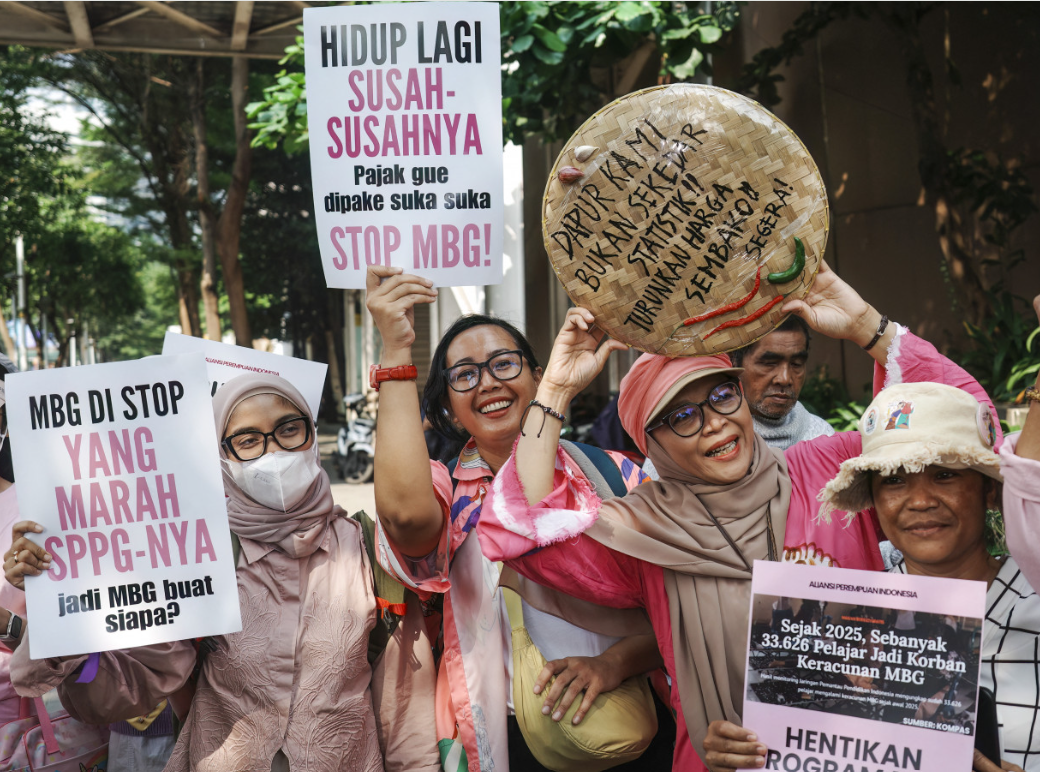
Beyond individual complaints, organised civil society has mobilised around programme failures. Dozens of women's rights activists convened under the Indonesian Women's Alliance banner in Central Jakarta, demanding government action to halt and comprehensively review operations. This organised pressure signals that quality concerns transcend anecdotal grievances, touching broader anxieties about how government resources are deployed and whether intended beneficiaries genuinely benefit. The participation of advocacy groups elevates what initially appeared as individual maternal dissatisfaction into a question of programme legitimacy and governance.
Programme operators and investors now confront an existential uncertainty following recent corruption allegations involving former BGN leadership. The agency's incoming administration responded by freezing network expansion at approximately twenty-seven thousand kitchens and halting new growth. This conservative posture, while addressing accountability concerns, has alarmed investors who collectively report investing hundreds of billions of rupiah establishing SPPG infrastructure and now seek government assurances regarding investment recovery. Several facilities experienced temporary closures in early June when funding delays disrupted operations, amplifying stakeholder anxiety about programme sustainability and stoking concerns among operators about continued viability.
MBG Watch, an independent oversight platform established by civil society organisations, has become a focal point for systematic programme evaluation. Researcher Isnawati Hidayah from the Center of Economic and Law Studies (CELIOS) articulated a crucial accountability question: what do massive government expenditures actually deliver and whose interests predominate? This interrogation gains urgency considering the budget controversy surrounding the initiative. Originally allocating Rp 335 trillion (approximately US$18.74 billion), policymakers subsequently reduced this to Rp 268 trillion following public scrutiny about affordability and implications for education funding. The debate reflects genuine resource competition within constrained budgets, where nutrition assistance programmes necessarily compete with educational priorities.
CELIOS analysis identified a fundamental targeting problem: approximately thirty-four percent of current beneficiaries, representing roughly sixty-one million children and pregnant women, fall outside priority assistance categories. These include households already economically secure or possessing adequate nutritional access, suggesting resources reach populations with lower relative need. This misdirection contradicts the programme's stunting-reduction objectives and wastes resources better deployed toward genuinely disadvantaged populations. Such inefficiency fuels scepticism about programme management and fortifies arguments for comprehensive evaluation before expansion.
Responding to mounting criticism, the BGN has initiated corrective measures, including beneficiary pool narrowing by removing recipients capable of meeting nutritional needs independently. By mid-June, officials had eliminated coverage across seventy-six Java schools, affecting over thirty-nine thousand beneficiaries. Deputy head Agustina Arumsari characterised this refocusing as necessary concentration of resources toward populations genuinely requiring government support. Simultaneously, the agency implemented austerity measures terminating daily kitchen incentives during non-operational periods and reviewing underperforming facilities. These steps acknowledge implementation failures while attempting to restore programme credibility.
The emerging consensus among beneficiaries, activists, and oversight bodies suggests the programme's underlying concept enjoys support, but execution quality and targeting accuracy require substantial remediation. Mothers consistently articulate that quality improvement, not programme elimination, represents their preferred outcome. This nuance matters significantly for policymakers: the objection centres on poor implementation rather than conceptual opposition to nutritional assistance. The willingness of informed beneficiaries to accept temporary suspension for comprehensive evaluation, rather than continuing with degraded services, reflects surprising maturity in public reasoning about resource priorities and programme effectiveness. This perspective deserves consideration as the BGN contemplates whether aggressive expansion or strategic consolidation better serves Indonesia's stunting-reduction objectives. The programme ultimately succeeds or fails based on whether meals genuinely improve children's nutritional status, and that question remains inadequately answered amid current quality controversies.