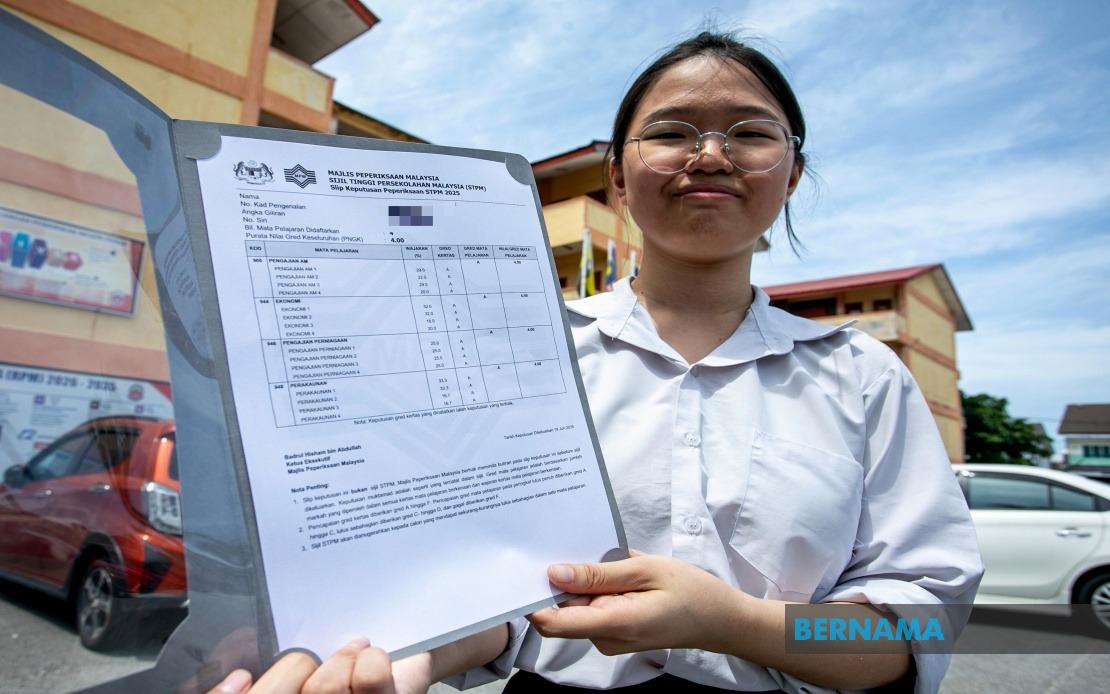
Yong Xin Yi, a 20-year-old from SMK Jalan Tasek in Ipoh, has become a standout success story in the 2025 Sijil Tinggi Persekolahan Malaysia (STPM) examination by earning four A grades and achieving a perfect Cumulative Grade Point Average of 4.00. The student's accomplishment places her among only five scholars from her school to reach this milestone, highlighting how methodical preparation and unwavering commitment can yield exceptional results in one of Malaysia's most rigorous tertiary entrance examinations.
The foundation of Xin Yi's success rests on a remarkably consistent study regimen that she maintained throughout her examination preparation. Every weekday evening, between 5:00 pm and 10:00 pm, she dedicated herself to revising course material and consolidating what she had learned during the school day. This five-hour window of focused study, repeated day after day, created the cumulative knowledge base necessary to master the demanding STPM curriculum. What distinguishes her approach is not simply the quantity of hours invested, but the strategic timing and intentionality behind when and how that revision occurred.
Crucially, Xin Yi emphasised that classroom attention formed the bedrock of her learning strategy, operating as an essential complement to her evening study sessions. She recognised that absorbing the teacher's explanations in real time significantly reduced the cognitive burden during independent revision later. When instructors present material directly, students can ask immediate clarifying questions and benefit from expert pedagogical approaches; this front-loaded understanding means that evening revision transforms into reinforcement rather than initial comprehension. This insight reveals a sophisticated understanding of how to optimise the learning process, moving beyond the common assumption that success derives solely from hours spent studying at home.
Homework completion represented another non-negotiable element of Xin Yi's academic discipline. Rather than viewing assignments as tedious obligations, she treated them as essential tools for mastering content. By completing every piece of work set by teachers, she ensured that she engaged repeatedly with key concepts and developed practical problem-solving skills. This incremental approach to learning, where each assignment builds on previous knowledge, proved far more effective than sporadic or last-minute cramming sessions that characterise some students' examination preparation.
Among her four subjects—General Studies, Principles of Accounting and Economics—General Studies presented the greatest challenge. This subject demands not merely factual knowledge but also sophisticated written expression, familiarity with specific essay formats, and deep understanding of how examiners award marks. Recognising this weakness early, Xin Yi strategically allocated additional attention to General Studies, working deliberately to transform a potential vulnerability into demonstrated competence. This adaptive approach demonstrates maturity in academic self-assessment and willingness to invest extra effort where it was most needed.
Beyond personal discipline, Xin Yi acknowledges that her achievement reflects the foundational support provided by her parents. As an only child whose mother works as a clerk and whose father is employed in mobile phone sales, she grew up in a household where education was clearly valued and encouraged. The emotional reinforcement and belief in her capabilities that her parents consistently offered proved as important as the material resources they provided. She explicitly credits their sacrifices and encouragement as driving forces behind her success, understanding that academic excellence rarely emerges in isolation from family backing.
Xin Yi's motivation extends beyond personal achievement into family advancement. She articulates a desire to leverage her educational success to improve her family's circumstances and to repay her parents' dedication through future accomplishments. This sense of purpose—connecting her study efforts to broader family aspirations—likely sustained her commitment during moments when motivation might otherwise have flagged. Such intrinsic motivation, tied to deeply felt personal values, generally proves more durable than external rewards alone.
Her future trajectory points toward Universiti Putra Malaysia, where she intends to pursue an undergraduate degree in economics. This choice was not made arbitrarily but emerged from systematic consideration of her personal interests and assessment of career opportunities within the economics sector. She recognises that the field offers expansive professional pathways and recognises her own aptitude for the subject based on her STPM performance. Her aspiration to become an economist reflects a realistic appraisal of her strengths and the economic landscape's demand for qualified professionals.
Xin Yi's achievement carries broader significance for Malaysian secondary education. Her success demonstrates that within the STPM framework, consistent application of proven study methods can produce outstanding results accessible to students from non-affluent backgrounds. She did not require expensive private tuition or supplementary schools to reach this standard, relying instead on school instruction, disciplined personal effort, and parental encouragement. Her story thus challenges assumptions that top examination performance depends primarily on resources unavailable to average Malaysian families, offering encouragement to other students navigating similar educational pathways.