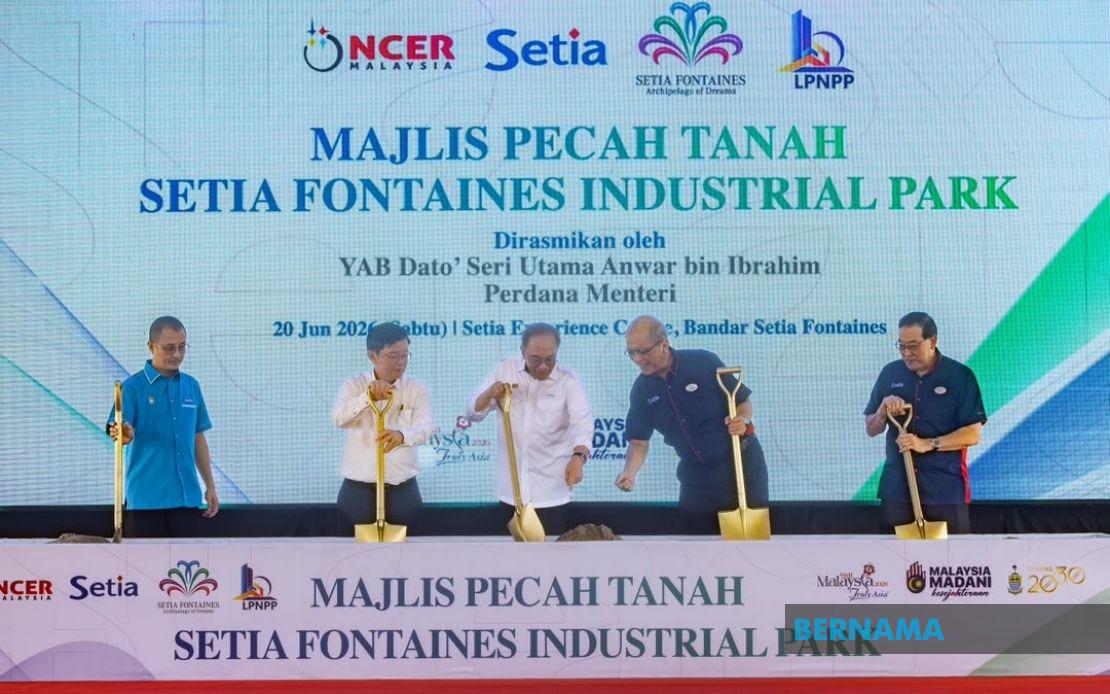
Prime Minister Datuk Seri Anwar Ibrahim has issued a direct call for inclusive development, insisting that major projects approved by government-linked entities and private corporations must actively generate opportunities for middle- and lower-income communities. Speaking at the groundbreaking ceremony for the Setia Fontaines Industrial Park in Bandar Setia Fontaines, Kepala Batas on June 20, Anwar framed equitable wealth distribution as fundamental to Malaysia's long-term stability and prosperity, cautioning policymakers and investors alike that prosperity confined to elite segments of society inevitably breeds resentment and social fracturing.
The Prime Minister's remarks reflect growing concerns within government circles that Malaysia's economic growth, whilst impressive in headline statistics, risks masking deeper structural inequalities. Anwar specifically referenced major institutional investors including Khazanah Nasional Berhad, Permodalan Nasional Berhad, and the Employees Provident Fund, signalling that even state-owned enterprises must be held accountable for their contribution to inclusive development. His message extended beyond these entities to encompass the entire private sector, establishing a clear expectation that corporate expansion projects should be designed with deliberate consideration for how benefits trickle down beyond shareholders and senior management.
The underlying concern driving Anwar's intervention is straightforward but consequential: without intentional mechanisms ensuring that lower-income groups gain tangible advantages from development, the trajectory points toward a more divided nation. His warning that "opportunities for lower-income groups become increasingly constrained" captures a real phenomenon visible across developing economies where rapid capital accumulation benefits narrow circles whilst the broader population sees only marginal improvements in living standards. This dynamic creates a sustainability problem for investment itself, as social tension and reduced consumer purchasing power eventually dampen economic dynamism.
Crucially, Anwar reframed how Malaysia should evaluate its economic success. Rather than celebrating impressive growth rates and rising foreign direct investment in isolation, the Prime Minister insisted that development metrics must ultimately be judged by whether ordinary citizens across all socioeconomic strata experience material improvements in their circumstances. This represents a subtle but significant shift in official discourse, moving beyond neoliberal growth-focused frameworks toward acknowledgment that legitimacy of development depends on demonstrable, broad-based benefit distribution.
The Setia Fontaines Industrial Park project itself exemplifies the principles Anwar articulated. Located in Seberang Perai, the development is positioned as a vehicle for balancing economic expansion across Penang. The mainland portion of the state has historically lagged behind the island's development trajectory and the southern region's growth patterns, creating regional disparities within the state itself. By concentrating industrial investment in this area, authorities aim to catalyse employment generation and capital formation in a relatively underserved zone, though Anwar's comments suggest scrutiny will be applied regarding whether benefits genuinely accrue to local residents or simply create low-wage service jobs whilst management and technical positions favour outsiders.
The industrial park also represents Malaysia's strategic pivot toward higher-value manufacturing and technology sectors. Rather than remaining dependent on back-end manufacturing and low-skill assembly work, the facility is designed to attract companies operating in advanced technology domains. This positioning aligns with Malaysia's broader competitiveness strategy, seeking to escape the middle-income trap by moving up the value chain. However, this upgrading trajectory creates an educational imperative that Anwar explicitly highlighted: workers cannot benefit from high-quality employment opportunities if they lack requisite technical qualifications.
Anwar therefore emphasised the critical role of collaboration between industry, technical and vocational institutions, and universities including Universiti Sains Malaysia. The rationale is straightforward but often neglected: capital investment and infrastructure are insufficient if the labour market cannot supply appropriately skilled personnel. When sophisticated industrial facilities operate in regions where the workforce lacks necessary competencies, companies either import talent from elsewhere, negating local employment benefits, or invest in training programs that prove costly and time-consuming. Conversely, when educational institutions proactively align curriculum and training with evolving industry requirements, local workers can compete for premium positions.
The technological dimension of Anwar's remarks warrants particular attention for Malaysian policymakers and businesses. He noted that technology evolves within one- or two-year cycles, meaning that training programs must operate in genuine partnership with institutions keeping pace with industrial transformation. This observation reflects a real challenge facing Malaysia's skills development ecosystem: traditional vocational training often lags industry demands, producing graduates whose qualifications are outdated before they complete their courses. Bridging this gap requires sustained communication and collaboration, with universities and vocational colleges maintaining close relationships with employers to continuously update curricula.
For Southeast Asian readers, Anwar's intervention carries broader implications beyond Malaysia's borders. Many regional economies face similar tensions between impressive growth statistics and persistent inequality. Indonesia, Thailand, and Vietnam have all experienced rapid development concentrated in capital cities and special economic zones whilst rural and peripheral regions lag significantly. The framework Anwar proposes—mandatory consideration of how development benefits middle- and lower-income groups—could serve as a model for other governments seeking to navigate the tradeoff between attracting investment and ensuring equitable distribution of its benefits.
The government's approach also signals that approvals for major projects will increasingly incorporate social inclusion criteria alongside financial viability. This represents a potential recalibration of Malaysia's investment approval processes, where considerations beyond pure profitability might influence whether developments receive authorization. Companies planning significant projects will need to demonstrate not merely that they generate returns for shareholders and government but that they create pathways for ordinary Malaysians to participate meaningfully in economic gains.
Anwar's emphasis on preventing a "growing divide" reflects particular urgency in contemporary Malaysia, where income inequality has attracted increasing scholarly and public attention. The Gini coefficient and wealth concentration metrics indicate that Malaysia's middle class, whilst larger than many regional peers, has plateaued or contracted in recent years, with gains accruing disproportionately to higher-income segments. By framing inclusive development as essential rather than aspirational, Anwar signals that addressing this trend constitutes a policy priority warranting concrete action rather than rhetorical commitment.
Moving forward, the rhetoric Anwar articulated at the Setia Fontaines groundbreaking will require translation into specific institutional mechanisms and approval frameworks. Vague injunctions that development must benefit lower-income groups lack enforceability and measurable impact unless accompanied by concrete requirements, monitoring systems, and accountability structures. Whether government agencies and private investors will operationalize this principle or treat it as symbolic language remains to be determined, but the Prime Minister's emphasis establishes clear normative expectations that inclusive development represents Malaysia's official policy direction.