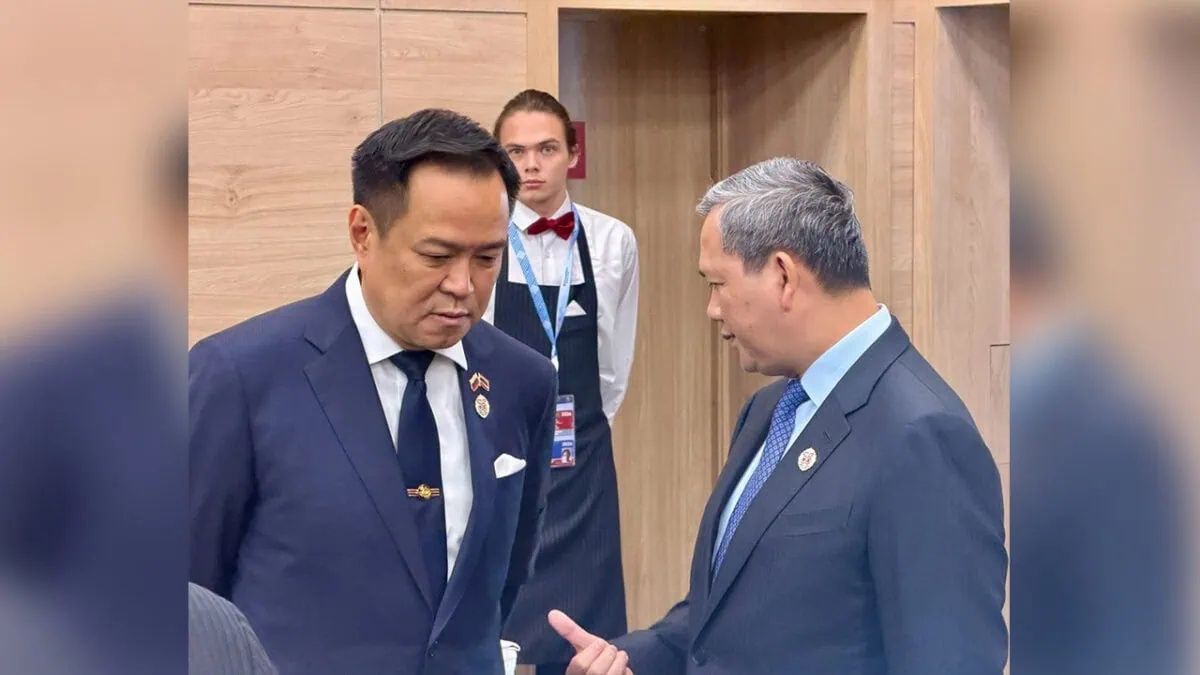
Cambodian Prime Minister Hun Manet has pressed Thailand to move forward with appointing leadership for its Joint Boundary Commission and resuming border survey operations that have languished for years, signalling Phnom Penh's determination to advance territorial negotiations despite regional tensions. The call came during a sideline exchange with Thai Prime Minister Anutin Charnvirakul at an Asean-Russia engagement in Kazan, Russia, where the two leaders briefly discussed their countries' complex border relationship away from formal conference settings.
Mamet's public statement on the conversation underscores Cambodia's strategic positioning on boundary matters: a commitment to resolving disputes through peaceful channels while simultaneously pressing for tangible progress on stalled mechanisms. In a Friday social media post, the Cambodian premier characterised the meeting as an informal discussion and reiterated his nation's dedication to addressing border challenges in line with international law and existing agreements. This careful framing reflects the diplomatic sensitivity surrounding Cambodia-Thailand border issues, which have periodically threatened regional stability and remain politically charged in both capitals.
The specific reference to Point Three of a Joint Statement signed on 27 December 2025 indicates that Cambodia views recent agreements as binding commitments requiring immediate implementation. By publicly naming this provision, Hun Manet appears to be creating accountability while maintaining the appearance of cordial bilateral relations. Thailand's failure to appoint a JBC chief represents, from Cambodia's perspective, a failure to honour these commitments, and publicly articulating this complaint at an international forum elevates the matter beyond routine diplomatic exchanges.
Cambodia has adopted what observers describe as a dual-track approach to border management. On maritime disputes, Phnom Penh is actively pursuing compulsory conciliation procedures under the UN Convention on the Law of the Sea, a mechanism that both nations have agreed to engage in. This legal pathway provides Cambodia with an international forum for advancing its maritime claims. Simultaneously, on land boundaries, Cambodia continues to favour bilateral negotiations through the JBC and other established agreements, preferring direct talks over internationalised dispute resolution—at least for now.
Thai Prime Minister Anutin's account of the Kazan encounter, while confirming the substance of Hun Manet's description, emphasised the brevity and informality of their interaction. His characterisation of the meeting as merely "pulling each other aside by the elbow" reflects Thailand's preference for downplaying the significance of border discussions in public statements. This divergence in how the two leaders framed the exchange—Cambodia treating it as a substantive engagement requiring public commitment, Thailand describing it as a fleeting conversation—reveals different messaging strategies aimed at domestic audiences.
Anutin's reported response to questions about reopening border checkpoints—that Thai citizens would object—hints at the domestic political constraints both governments face. Public opinion in Thailand remains sensitive to border sovereignty issues, and reopening crossings without perceived progress on demarcation could invite domestic criticism. This explains why Thailand's official position, as articulated by Anutin, emphasises commitment to international frameworks including UNCLOS, the JBC, and the General Border Committee, while avoiding specific timelines or concrete commitments.
The maintenance of calm rhetoric from both sides masks underlying tensions about territorial demarcation that have persisted for decades. The JBC, originally established to facilitate surveys and demarcation, has struggled with inconsistent commitment from both nations, leading to the accumulation of unresolved boundary segments. By urging Thailand to appoint a JBC chief, Cambodia is essentially calling for renewed institutional commitment that has been lacking. The apparent stalling likely frustrates Cambodian policymakers who view decisive demarcation as the only permanent solution to recurring border friction.
For Malaysia and other Southeast Asian nations, the Cambodia-Thailand border situation carries broader implications for regional stability and the credibility of Asean's conflict prevention mechanisms. Both countries are Asean members committed to the principle of peaceful settlement of disputes, yet the slow progress on border demarcation demonstrates the difficulty of translating such principles into concrete outcomes. Malaysia itself has ongoing maritime boundary discussions with several neighbours, making the Cambodia-Thailand experience relevant as a case study in managing complex territorial negotiations within Asean.
The Kazan meeting represents a continuation of patient diplomacy rather than a breakthrough, with both leaders essentially reaffirming positions already established in earlier agreements. The significance lies not in new developments but in the persistence of dialogue during a period when other regional tensions are escalating. Hun Manet's public call for Thailand to move faster on JBC leadership and demarcation work suggests Cambodia may be preparing to intensify pressure if progress remains stalled, potentially through more aggressive use of international legal mechanisms or diplomatic escalation at regional forums.
The exchange also reflects the broader pattern of Cambodia's assertive foreign policy under Hun Manet's leadership. Since assuming office, he has demonstrated a willingness to pursue national interests more directly than his predecessor, whilst maintaining the appearance of adhering to international norms and established frameworks. On the Thailand border issue, this translates into public calls for implementation of existing agreements, subtle pressure tactics disguised as peaceful commitment, and strategic use of international law as leverage. Thailand, meanwhile, appears to be managing the border issue through cautious incrementalism, avoiding dramatic steps that might provoke domestic opposition or invite international scrutiny.
The reference to UNCLOS and compulsory conciliation procedures in Cambodia's approach deserves attention, as it signals Phnom Penh's willingness to internationalise aspects of the dispute if bilateral progress stalls further. While land boundaries remain the primary concern given their direct impact on communities, maritime demarcation involving potential resource rights adds economic dimension to the negotiations. This explains Cambodia's emphasis on dual-track mechanisms—maintaining bilateral options whilst preserving the option of international arbitration.
Moving forward, observers should monitor whether Thailand appoints a new JBC chief and resumes survey activities, as this would signal responsiveness to Cambodian pressure and potential acceleration of demarcation work. Equally significant will be the tenor of subsequent public statements from both governments, which may indicate whether the Kazan conversation represents genuine momentum or merely polite diplomatic exchange. Regional stability partly depends on how effectively Cambodia and Thailand can translate their rhetorical commitment to peaceful resolution into measurable progress on the ground.