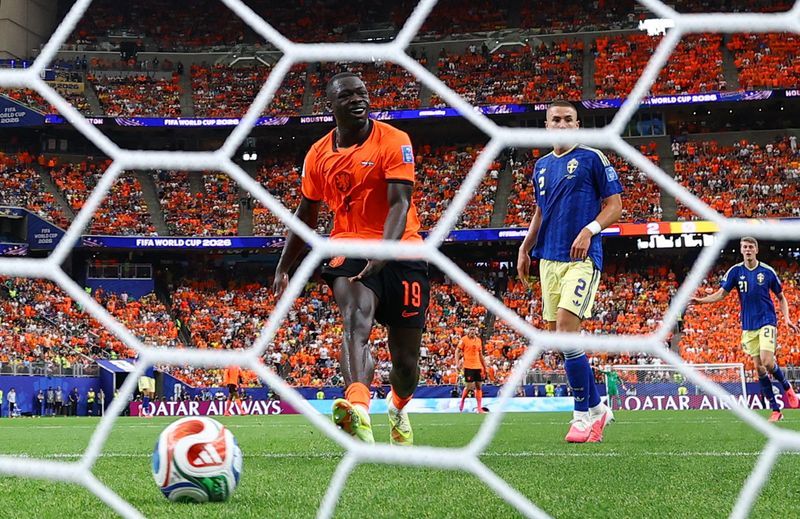
The Netherlands delivered a commanding 5-1 victory over Sweden on Saturday, a performance that vindicated Ronald Koeman's selection gamble and offered the Dutch camp genuine optimism about their attacking options for the remainder of the tournament. The contrast with their opening match against Japan, a frustrating 2-2 draw in Dallas the previous week, could hardly have been starker. Where Koeman faced considerable criticism for his in-game adjustments during that opening fixture, his team selection for the Sweden encounter proved decisively vindicated on the pitch, offering a masterclass in how decisive personnel changes can transform a team's trajectory within the span of a single week.
At the heart of this reversal stood Brian Brobbey, the 24-year-old striker who has spent much of his recent career battling for recognition at international level. His clinical finishing in the opening 17 minutes, when he struck twice against the Swedish defence, immediately signalled that Koeman's faith in starting him upfront had been thoroughly rewarded. These two goals were not merely statistical contributions; they represented a crucial demonstration of composure and movement in the penalty area at precisely the moment when the tournament demanded such ruthlessness. For a player who has endured repeated spells on the periphery of the Dutch setup, the performance constituted a statement of intent that few analysts would have anticipated just days earlier.
Brobbey's path to prominence has been characterised by uncertainty and false starts. Having languished outside Koeman's plans during the qualifying campaign for the 2026 World Cup, his recall to the squad in March marked a significant reversal of fortune. Yet prior to Saturday's explosion of finishing prowess, questions persisted about whether his previous experience at club level had sufficiently developed his all-round game to warrant sustained involvement at the highest competitive level. The nature of his brace against Sweden—delivered with an assurance that belied his relative unfamiliarity in such a central attacking role for the national team—suggested that doubts about his readiness may have been premature.
Much of Brobbey's recent development must be attributed to his stint in English football. A season at Sunderland in the Premier League has visibly elevated multiple aspects of his performance, as he acknowledged in conversations with media representatives at the Dutch training camp. His own assessment of his evolution proved remarkably candid: beyond the traditional strikers' obsession with physical dominance and aerial prowess, Brobbey has developed genuine subtlety in his movement off the ball. His ability to time runs beyond opposing defenders, to identify pockets of space in congested areas, and to operate effectively when dropping deeper to create opportunities for teammates—these refined aspects of his game represent the genuine progress that separated his earlier form from his current offering.
The broader context for Brobbey's emergence involves the looming transition within Dutch attacking football. Memphis Depay remains the emblematic figure of Netherlands football, his status as the national team's all-time leading goalscorer reflecting decades of contribution and consistency. However, Depay's recent injury problems have created both a practical necessity and a strategic opportunity for the Dutch to identify and develop his eventual successor. Brobbey's performance against Sweden has dramatically accelerated this transition timeline, pushing him into serious consideration as a legitimate contender to inherit the central attacking role that has been Depay's domain.
The supporting cast available to whoever occupies that lead striker position strengthens the case for sustained confidence in the Dutch attacking shape. Cody Gakpo's presence on the left flank provides intelligent movement and creative capacity, while Denzel Dumfries' overlapping runs from right-back offer width and additional goal-threatening opportunities. The inclusion of Crysencio Summerville as a newcomer to the squad adds further tactical flexibility and unpredictability to the attacking arsenal. These complementary elements suggest that whoever assumes primary responsibility for finishing created chances will operate within a coherent system designed to maximize efficiency.
Koeman's decision to deploy Brobbey as his lead attacker appears to have identified a crucial mismatch between Swedish defensive preparation and the 24-year-old's particular skillset. The manner in which he exploited space in the opening minutes demonstrated not merely finishing quality but also positional awareness and timing—the hallmarks of a player whose recent development has genuinely transformed his functionality within a top-level system. His sharpness contrasted markedly with Depay's current physical status, as the latter continues his recovery from injury layoffs that have inevitably affected his match fitness and explosive power.
The immediate implication of Saturday's result extends beyond merely securing three points and consolidating the Netherlands' group position. Rather, Koeman now possesses concrete evidence that one of his long-standing selection dilemmas may have a viable resolution. For Malaysian and Southeast Asian football observers monitoring Dutch progress, Brobbey's emergence represents the kind of player development narrative that captures international interest—a previously marginalised talent suddenly discovering form and relevance at precisely the moment when circumstances aligned to provide opportunity.
The Netherlands' position atop Group F reflects not only superior execution against Sweden but also the underlying quality of their attacking options when fully engaged. Brobbey's dual contribution to their crushing superiority reinforces the sense that Koeman's tactical framework is beginning to function with the coherence and coordination that their opening week suggested was missing. Whether the striker can sustain this form through the tournament's knockout phases remains an open question, but Saturday provided substantial grounds for believing that the succession question around the Depay role has moved substantially closer to resolution.