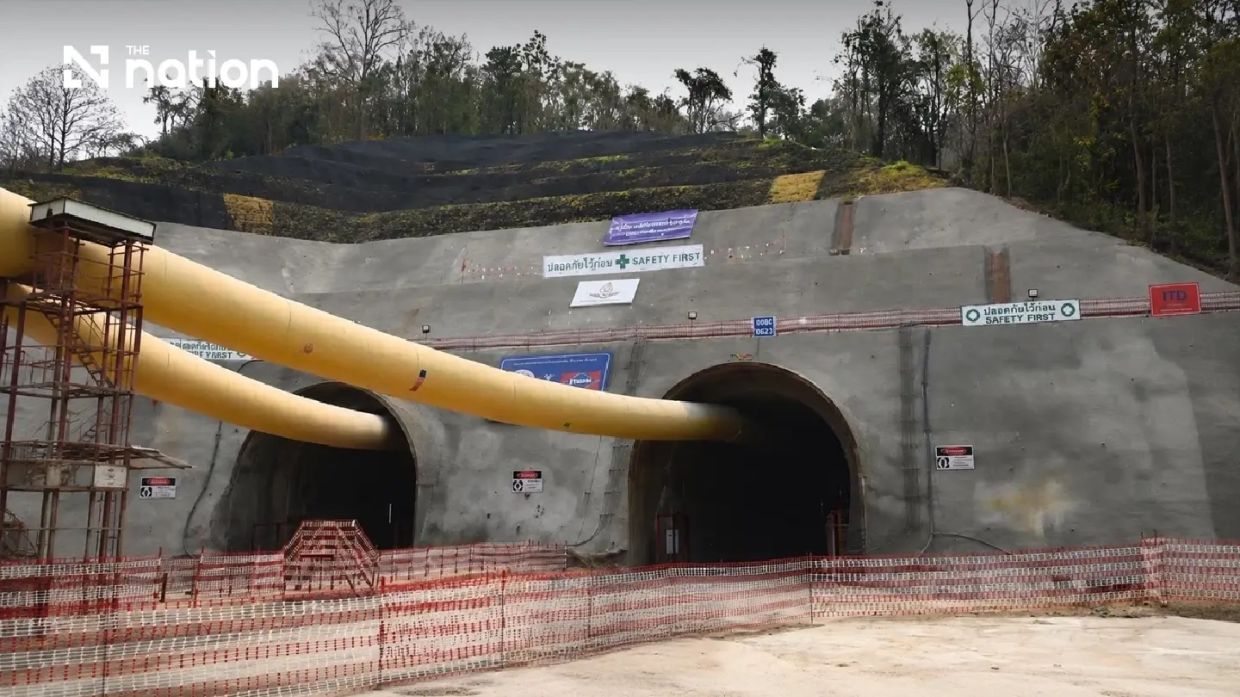
A construction accident at the Doi Luang railway tunnel in Chiang Rai province claimed two lives and left seven workers injured on Saturday evening, marking another tragic setback for Thailand's ambitious rail infrastructure expansion. The incident unfolded at approximately 8.35pm as workers were engaged in installing waterproofing systems within the tunnel, prompting immediate intervention from project authorities and government officials overseeing the State Railway of Thailand's Den Chai-Chiang Rai-Chiang Khong railway development.
Deputy Transport Minister Siripong Angkasakulkiat disclosed that preliminary investigations suggest rocks dislodged from the tunnel wall triggered the structural failure. Initial reports had pointed toward complications in the shotcrete work area, though officials emphasised that comprehensive assessments were still underway to determine the precise sequence of events and contributing factors. The discrepancy between early accounts and revised findings underscores the complexity of accident reconstruction in deep underground construction environments, where visibility and access constraints complicate immediate fact-gathering.
Medical response proved swift, with all casualties transported to hospital facilities. Among the injured, three sustained serious injuries requiring extended treatment, while four others suffered minor trauma. The immediate containment measures implemented by project management successfully prevented secondary incidents, and Deputy Minister Siripong confirmed that the accident zone had been cordoned off to ensure worker safety and facilitate the investigation process. The project's dedicated safety unit assumed operational control of the site, instituting close monitoring protocols while the State Railway's Special Projects and Construction Department mobilised resources for detailed scene inspection.
The Doi Luang tunnel represents a substantial engineering undertaking, stretching 3.4 kilometres through the Chiang Saen district and already fully excavated at the time of the collapse. This underground passage forms a critical component of Contract 3 within the broader Chiang Rai-Chiang Khong railway segment, a THB19.385 billion construction package that encompasses approximately 87 kilometres of track work, three primary stations, three additional halts, signalling infrastructure, and telecommunications systems. The scale and complexity of this particular contract reflect the technical demands of Thailand's ongoing railway modernisation agenda.
The construction consortium executing this contract—the CKST-DC3 Joint Venture—brings together three substantial Thai construction firms: CH. Karnchang Public Company Limited, Sino-Thai Engineering & Construction Public Company Limited, and Chiangmai Construction Co., Ltd. This collaboration represents a typical structure for major infrastructure projects in Southeast Asia, pooling local expertise and capital to manage technically demanding work. However, the accident raises critical questions about safety protocols and supervision standards across contracted railway construction sites in Thailand, particularly in complex underground environments where hazards multiply.
The Den Chai-Chiang Rai-Chiang Khong railway line sits within Thailand's broader connectivity vision, aiming to strengthen transportation links between the country's northern provinces while potentially facilitating cross-border commerce with Laos through the Chiang Khong terminus. For Malaysian observers, the incident carries relevance beyond immediate Thai concerns, as similar infrastructure projects are underway throughout Southeast Asia, with Malaysian contractors and workers frequently engaged on regional railway developments. The safety standards and oversight mechanisms evident in Thai construction sites provide cautionary context for comparable projects across the region.
The waterproofing installation phase in which the accident occurred represents a critical juncture in tunnel construction, protecting the underground infrastructure against groundwater infiltration and structural degradation over its operational lifespan. Workers undertaking such tasks face multiple simultaneous hazards—unstable rock formations, heavy equipment operation, and confined space constraints—all of which demand rigorous safety management and continuous environmental monitoring. The collapse suggests that either monitoring systems failed to detect imminent danger, or workers lacked adequate protective measures to withstand sudden geological shifts.
Thailand's railway sector has witnessed previous safety incidents during ongoing infrastructure expansion, prompting periodic government reviews and contractor accountability discussions. This latest tragedy arrives at a time when Thailand continues pursuing ambitious rail projects spanning conventional lines, light rail systems, and high-speed corridors. Each fatality on such projects inevitably prompts scrutiny of whether safety investments align with project timelines and cost pressures—an ongoing tension in rapidly developing regional infrastructure industries.
Government authorities have committed to comprehensive investigation findings, with Deputy Minister Siripong indicating that detailed reports would be released as inquiries progressed. The Transport Ministry's involvement suggests this accident will trigger formal safety protocol reviews and potentially revised contractor guidelines. For workers on similar Thai construction projects, the incident underscores workplace vulnerabilities that persist despite regulatory frameworks theoretically governing site safety standards.
The geographical focus on Chiang Rai province also highlights development disparities within Thailand, as northern regions increasingly receive infrastructure investment aimed at integration with national and regional networks. While such projects promise economic benefits for local communities, they simultaneously expose workers to occupational risks that demand unwavering commitment to safety excellence. For Malaysia's construction and railway sectors, monitoring how Thai authorities address this incident's root causes and implement corrective measures offers valuable lessons applicable to domestic and regional project management practices.
%22%2F%3E%3C%2Fpattern%3E%3C%2Fdefs%3E%3Crect%20width%3D%22100%25%22%20height%3D%22100%25%22%20fill%3D%22url(%23ph3iugkg)%22%2F%3E%3Crect%20width%3D%22100%25%22%20height%3D%22100%25%22%20fill%3D%22url(%23ph3iugkp)%22%2F%3E%3Ctext%20x%3D%2250%25%22%20y%3D%2250%25%22%20text-anchor%3D%22middle%22%20dominant-baseline%3D%22central%22%20fill%3D%22rgba(255%2C255%2C255%2C0.95)%22%20font-family%3D%22Georgia%2C%20'Times%20New%20Roman'%2C%20serif%22%20font-weight%3D%22700%22%20font-size%3D%22151%22%20letter-spacing%3D%22-0.02em%22%3EBezzecchi%3C%2Ftext%3E%3C%2Fsvg%3E)