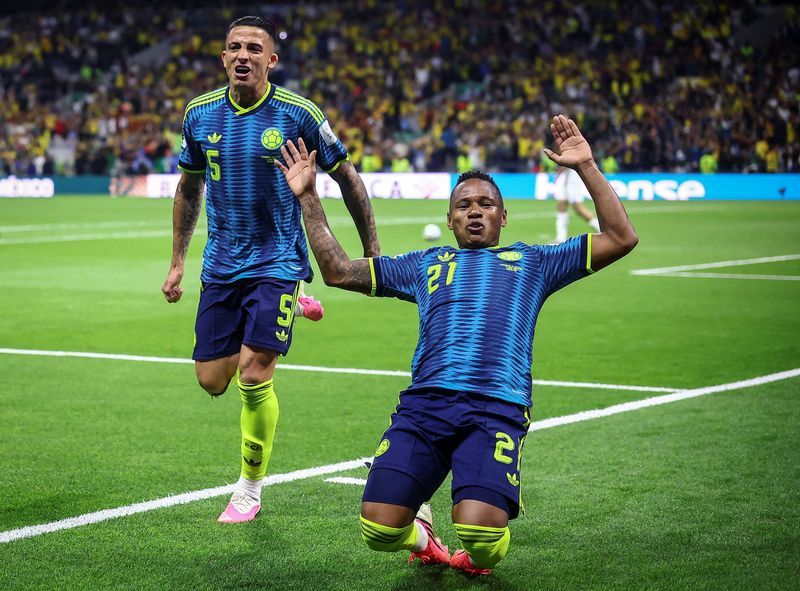
Colombia will attempt to strengthen their grip on Group K when they take on a buoyant DR Congo side on Tuesday, hoping to build on their 3-1 victory over Uzbekistan in their campaign opener. Nestor Lorenzo's team recognise, however, that they face opponents who have already demonstrated they can unsettle tournament heavyweights, having held Portugal to a 1-1 draw in a performance that surprised many observers and injected genuine confidence into the Congolese camp.
The South American outfit's opening match revealed both their attacking potency and some defensive frailties worth monitoring. Although the scoreline against Uzbekistan appeared convincing, Colombia struggled considerably during the second half when their Central Asian opponents repeatedly exploited gaps in the back line. Lorenzo's coaching staff will have spent considerable time since then addressing these vulnerabilities, knowing that a more disciplined defensive display will be essential against a side built specifically to punish such lapses through rapid counterattacking movements.
A victory for Colombia would mathematically secure their passage to the Round of 32 and potentially guarantee top spot in Group K, particularly if Portugal stumble against Uzbekistan simultaneously. This makes Tuesday's encounter strategically crucial for the tournament trajectory, as winning teams often gain considerable momentum and favourable knockout-stage matchups. The psychological edge of early progression cannot be understated, especially for a squad seeking to make a serious tournament impact.
The focal point of Colombia's attacking play has been Bayern Munich's Luis Diaz, who provided both a goal and an assist against Uzbekistan while earning the player-of-the-match accolade for his energetic displays leading the Colombian charge. His direct running style and willingness to take on defenders proved especially effective against more cautious Asian opposition, though DR Congo's structured defensive approach will present an entirely different examination of his capabilities. Lorenzo will hope that Diaz can again be the catalyst for victory, though the opposition's experience in compact defensive organisations suggests his impact may be more limited than in the tournament opener.
Another dimension Lorenzo wishes to develop involves increased influence from captain James Rodriguez, who remained relatively peripheral during the Uzbekistan encounter as the team's attacking rhythm instead flowed through Diaz's direct runs. Rodriguez's technical excellence and ability to unlock defences through intricate passing combinations have long distinguished him as Colombia's orchestrator, yet he failed to impose himself on the opening match in the manner expected. Against DR Congo's deep-lying defensive shape, Rodriguez's creative distribution and through-ball accuracy could prove more valuable than pure pace and power.
DR Congo have arrived in Mexico City as genuine contenders for an upset, backed by the confidence generated from their Portuguese draw and the historic significance of their tournament return. The Central Africans had not appeared at a World Cup for nearly fifty years, having last participated as Zaire in 1974, making their 1-1 stalemate against a Portuguese team widely regarded as title challengers an extraordinary achievement. This result has fundamentally altered perceptions of Sebastien Desabre's squad and provided tangible evidence that their approach deserves serious respect.
Yoane Wissa's opening-match goal holds particular symbolic weight, as it represented DR Congo's first World Cup goal in half a century, breaking a remarkable drought that extended back decades. Beyond the statistical significance, Wissa's finish demonstrated that Desabre's side possesses clinical finishing ability, not merely defensive solidity. The Congolese coach has constructed an approach prioritising disciplined shape and lethal transitions, allowing opposition possession while remaining perpetually dangerous during turnovers when attacking space opens through direct passing and swift movement.
Lorenzo has already signalled awareness of the tactical examination DR Congo will impose, explicitly warning his players about the Congolese preference for transition football and long-ball distributions designed to exploit spaces in the advanced third. The Argentine manager described the forthcoming contest as "a very difficult match," acknowledging that while DR Congo's direct style differs fundamentally from Uzbekistan's approach, the challenge posed by their compact defensive structure and counter-attacking efficiency should not be underestimated. This tactical diversity across consecutive matches requires Colombia to demonstrate the adaptability and intelligence that characterises successful tournament campaigns.
Lorenzo additionally noted that his team's excessive possession against Uzbekistan sometimes worked counterintuitively, with Colombian players occasionally dribbling backwards or failing to convert possession into genuine attacking opportunities. This observation highlights a critical vulnerability that DR Congo may attempt to exploit: if Colombia become too possession-focused while struggling to translate that dominance into clear chances, the Congolese quick-break system becomes more dangerous as it feeds off such sterile passages of play. The coach emphasised the requirement for greater clinical efficiency in the final third, suggesting his players must transform their opportunities more ruthlessly.
Geographical and demographic factors also favour Colombia's prospects, as thousands of Colombian supporters have already transformed Mexico City's Estadio Azteca into an extended home ground during the Uzbekistan match. With the team's tournament base established in Guadalajara, a significant travel distance from the capital, Colombian fans in Mexico have created an atmospheric advantage that Lorenzo's squad can harness throughout their Group K campaign. This home-away-from-home environment, replicated by Latin American diaspora communities across Mexico, provides psychological and emotional support that can genuinely influence match outcomes, particularly when facing opponents unfamiliar with tournament-level pressure and expectation.
The challenge confronting Colombia remains substantial nonetheless. DR Congo have announced themselves as genuine tournament disruptors, combining defensive discipline with threatening transitional football in a manner that prevents opponents from imposing their preferred rhythm. Colombia must therefore demonstrate both the attacking invention to break down a disciplined shape and the defensive solidity necessary to minimise counter-attacking threats. The balance between these competing requirements will ultimately determine whether Colombia move confidently toward knockout football or whether DR Congo pull off another shock result that reshapes Group K's complexion entirely.