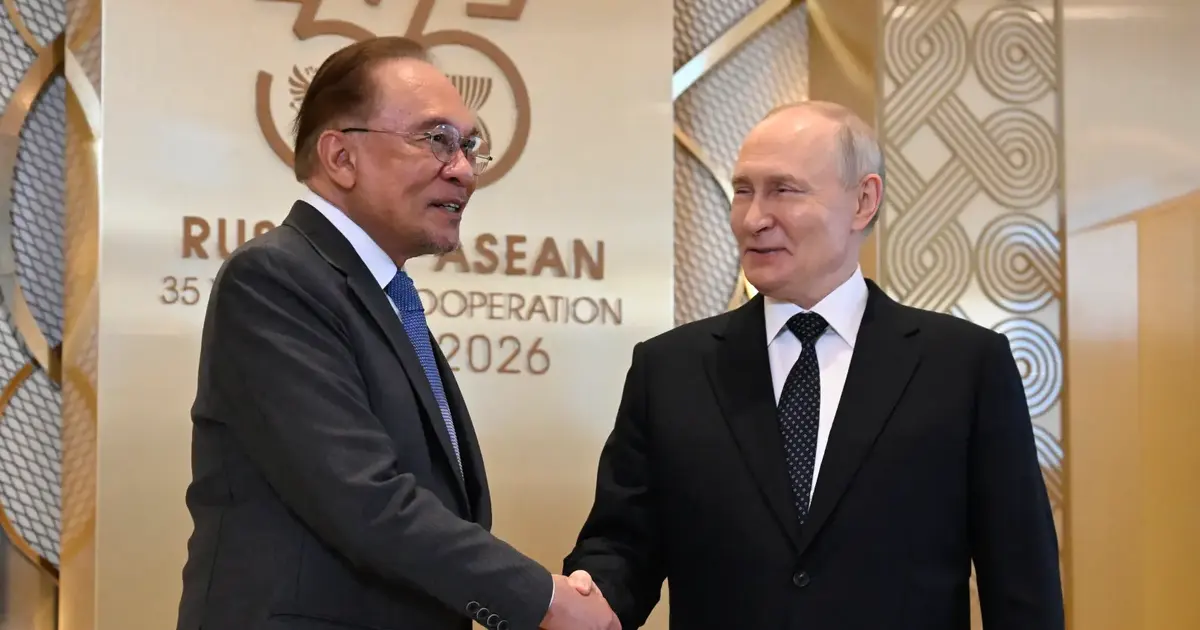
Prime Minister Anwar Ibrahim has announced that Russia, through President Vladimir Putin, has committed to supplying Malaysia with oil and gas supplies extending across the next two decades. This long-term arrangement represents a significant bilateral agreement aimed at securing Malaysia's energy needs while diversifying its supply chain beyond traditional sources in the Middle East and other established partners.
The supply commitment reflects Moscow's interest in maintaining commercial relationships with Southeast Asian economies despite geopolitical tensions affecting its global position. For Malaysia, the arrangement addresses ongoing concerns about energy security and price volatility in international markets. By locking in a supplier relationship with one of the world's largest energy producers, the nation can better plan its industrial and domestic energy requirements with greater predictability.
Beyond energy cooperation with Russia, Anwar Ibrahim's broader diplomatic initiative encompasses a complementary strategy involving Central Asia. The Prime Minister has indicated that his visit to Turkmenistan will serve multiple strategic purposes, primarily aimed at strengthening Malaysia's commercial position across the Asian continent. This two-pronged approach suggests Malaysian policymakers recognise the value of engaging multiple partners simultaneously to build resilience into supply chains and export networks.
Turkmenistan's position as a significant energy producer in its own right makes it an important counterpart in Malaysia's regional strategy. The Central Asian nation possesses substantial natural gas reserves and has previously sought to expand its trade relationships beyond Russia and China. Malaysia's engagement with Turkmenistan could potentially unlock opportunities for Malaysian businesses operating in energy sectors, infrastructure development, and related industries across the resource-rich Central Asian region.
The export-focused component of Anwar Ibrahim's engagement strategy targets major developed economies in East Asia—specifically China, Japan, and South Korea. These three nations represent collectively the world's second, third, and fourth largest economies respectively, and they maintain substantial demand for Malaysian goods ranging from electronics and semiconductors to palm oil, petrochemicals, and manufactured products. Enhanced market access in these countries could significantly boost Malaysia's export revenues and create additional employment opportunities across multiple sectors.
China's position as the largest buyer of Malaysian exports makes expansion within that market particularly valuable. The relationship between Kuala Lumpur and Beijing has remained commercially robust despite periodic diplomatic considerations. Japan and South Korea, meanwhile, represent high-value markets where Malaysian premium products and services command competitive pricing. Both nations maintain strict quality standards that require Malaysian suppliers to continuously innovate and improve their offerings, ultimately strengthening the country's competitive position globally.
The timing of these diplomatic manoeuvres reflects Malaysia's awareness that geopolitical realignments are reshaping global trade patterns. As Western nations implement sanctions on Russia and shift supply chains away from traditional sources, alternative arrangements become increasingly valuable for countries seeking to maintain neutral positions while safeguarding their economic interests. Malaysia's approach of engaging Russia commercially while simultaneously deepening ties with East Asian economic powerhouses demonstrates pragmatic balancing of competing interests.
Energy security remains a persistent challenge for Southeast Asian nations experiencing rapid economic growth. Malaysia's manufacturing sector, particularly electronics and petrochemicals, depends heavily on stable and affordable energy supplies. The long-term Russian supply commitment provides a foundation for industrial planning while the diversification strategy ensures the nation does not become overly dependent on any single supplier. This balanced approach reflects lessons learned from global energy crises that have periodically disrupted regional economies.
The Central Asian dimension of Malaysia's strategy also carries implications for regional infrastructure and connectivity. Turkmenistan and neighbouring Central Asian nations lie along potential trade corridors connecting Southeast Asia to Europe and the Middle East. By cultivating stronger relationships with these countries, Malaysia positions itself to benefit from transit trade opportunities and potential involvement in major development projects spanning the Asian continent.
For Malaysian businesses, these diplomatic initiatives create concrete opportunities across multiple sectors. Energy companies may explore partnerships for resource development and marketing, while traders and exporters can leverage government-backed initiatives to penetrate new markets. Logistics and transportation companies could benefit from enhanced trade flows resulting from expanded commercial relationships with Central Asia and reinforced positions in East Asia.
The geopolitical context underlying these arrangements cannot be overlooked. Malaysia's willingness to engage Russia despite international pressure demonstrates its commitment to non-aligned principles and independent foreign policy. Simultaneously, maintaining and strengthening ties with major East Asian economies ensures the nation remains plugged into the region's economic mainstream and benefits from the continued growth trajectory of China, Japan, and South Korea.
%22%2F%3E%3C%2Fpattern%3E%3C%2Fdefs%3E%3Crect%20width%3D%22100%25%22%20height%3D%22100%25%22%20fill%3D%22url(%23ph4zavbg)%22%2F%3E%3Crect%20width%3D%22100%25%22%20height%3D%22100%25%22%20fill%3D%22url(%23ph4zavbp)%22%2F%3E%3Ctext%20x%3D%2250%25%22%20y%3D%2250%25%22%20text-anchor%3D%22middle%22%20dominant-baseline%3D%22central%22%20fill%3D%22rgba(255%2C255%2C255%2C0.95)%22%20font-family%3D%22Georgia%2C%20'Times%20New%20Roman'%2C%20serif%22%20font-weight%3D%22700%22%20font-size%3D%22272%22%20letter-spacing%3D%22-0.02em%22%3EASEAN%3C%2Ftext%3E%3C%2Fsvg%3E)