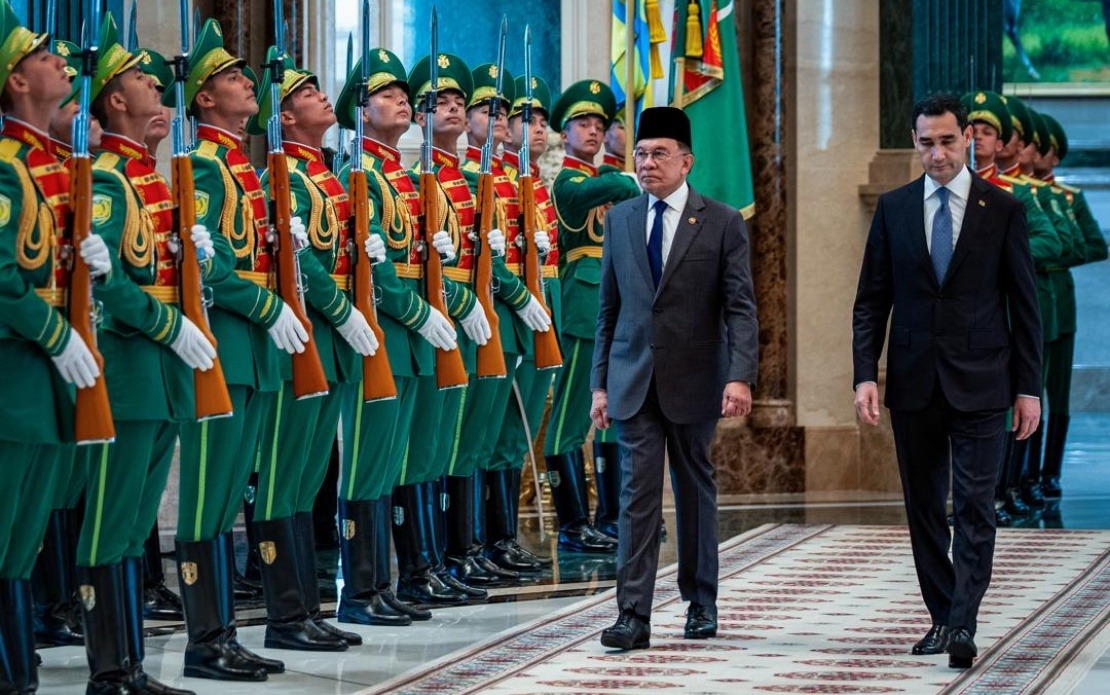
Prime Minister Datuk Seri Anwar Ibrahim was formally received with full ceremonial honours at the Turkmenistan Presidential Palace in Ashgabat on June 19, in a significant diplomatic moment that underscores Malaysia's expanding engagement with Central Asia under his leadership. The reception marked his first official visit to Turkmenistan since becoming Malaysia's 10th Prime Minister in November 2022, undertaken at the formal invitation of Turkmenistan President Serdar Berdimuhamedov.
The state ceremony itself demonstrated the importance both nations are placing on bilateral relations. Anwar was welcomed with a full guard of honour, while military and ceremonial protocols were observed with the simultaneous playing of Malaysia's and Turkmenistan's national anthems, a traditional diplomatic gesture signifying mutual respect between sovereign states. Such formalities are typically reserved for high-level state visits and reflect the priority given to strengthening ties between Kuala Lumpur and Ashgabat.
Following the ceremonial reception, the Prime Minister participated in formal introductions with Turkmenistan's Cabinet ministers and senior government officials, after which he presented members of the Malaysian delegation to President Berdimuhamedov. This structured approach to the visit reflects standard diplomatic protocol for official state engagements, allowing both sides to establish personal connections at the ministerial level that often facilitate future cooperation on specific sectoral issues.
The diplomatic agenda progressed with a private bilateral meeting between Anwar and Berdimuhamedov, followed by broader negotiations involving both delegations. These discussions centred on matters of mutual strategic interest and mechanisms to deepen bilateral cooperation across sectors. The two-day visit, which commenced on June 18, was designed to allow sufficient time for substantive engagement beyond ceremonial functions, indicating the Malaysian government's commitment to substantive partnership development.
This visit carries particular significance for Malaysia's strategic positioning in Central Asia, a region increasingly important for energy security, trade diversification, and geopolitical balance. Turkmenistan, a major energy producer with vast natural gas reserves, represents a potential avenue for Malaysia to explore alternative energy partnerships and diversify its trade relations beyond traditional partners. The Central Asian republics have historically maintained limited diplomatic profiles in Southeast Asia, making Anwar's visit an attempt to elevate bilateral relations and create frameworks for sustained engagement.
Under Anwar's premiership, Malaysia has demonstrated renewed interest in expanding diplomatic outreach across diverse regions. This approach contrasts with previous administrations and reflects a foreign policy orientation aimed at strengthening Malaysia's international position through multilateral engagement. Central Asia's growing strategic importance—particularly given its energy resources, emerging market potential, and geopolitical significance in the broader Asian landscape—makes diplomatic visits to nations like Turkmenistan increasingly valuable.
The timing of this inaugural visit also suggests coordination with Malaysia's broader diplomatic calendar and strategic planning. As Malaysia navigates complex regional dynamics in Southeast Asia while maintaining relationships with major powers, engagement with Central Asian nations represents a pragmatic expansion of Malaysia's diplomatic footprint. Turkmenistan's geographic position as a bridge between Asia and the Caspian region adds to its strategic value for Malaysian foreign policy considerations.
From Turkmenistan's perspective, welcoming Malaysia's premier signals openness to expanding its engagement with Southeast Asian economies. Both nations share interests in strengthening South-South cooperation frameworks and exploring complementarities in trade, investment, and cultural exchange. The formal nature of the reception reflects Turkmenistan's appreciation for direct engagement with Southeast Asian political leaders, an area where diplomatic relations have historically been underdeveloped despite mutual potential.
The visit also provides opportunities for exploring specific sectors where collaboration could yield mutual benefits. Energy cooperation, given Turkmenistan's hydrocarbon reserves and Malaysia's energy requirements, stands as an obvious area for discussion. Beyond energy, discussions likely touched on bilateral trade expansion, educational exchanges, cultural diplomacy, and potential participation in regional multilateral forums where both nations maintain interests.
For Malaysian observers, this visit demonstrates the current administration's commitment to deepening Malaysia's global engagement beyond the Association of Southeast Asian Nations and traditional partnership structures. The diplomatic machinery was clearly mobilized to ensure this inaugural visit proceeded with appropriate ceremonial weight, signalling to the international community Malaysia's seriousness about cultivating relationships across diverse geopolitical spaces.
Moving forward, the foundations laid during this June visit will likely determine the trajectory of Malaysia-Turkmenistan relations in coming years. Successful diplomatic visits typically generate follow-up mechanisms, such as joint commissions, working groups on specific sectoral cooperation, and reciprocal visits at equivalent levels. These institutional frameworks gradually transform single visits into sustained bilateral relationships, potentially yielding tangible benefits in trade, investment, and strategic coordination.
The broader context of this visit reflects Malaysia's evolving foreign policy under Anwar's leadership, characterized by active diplomatic engagement across multiple regions and an emphasis on strengthening bilateral relationships that serve Malaysia's economic and strategic interests. As Malaysia continues navigating regional complexities and global power dynamics, expanding partnerships with energy-rich Central Asian nations represents a prudent diversification strategy that complements its existing diplomatic architecture.