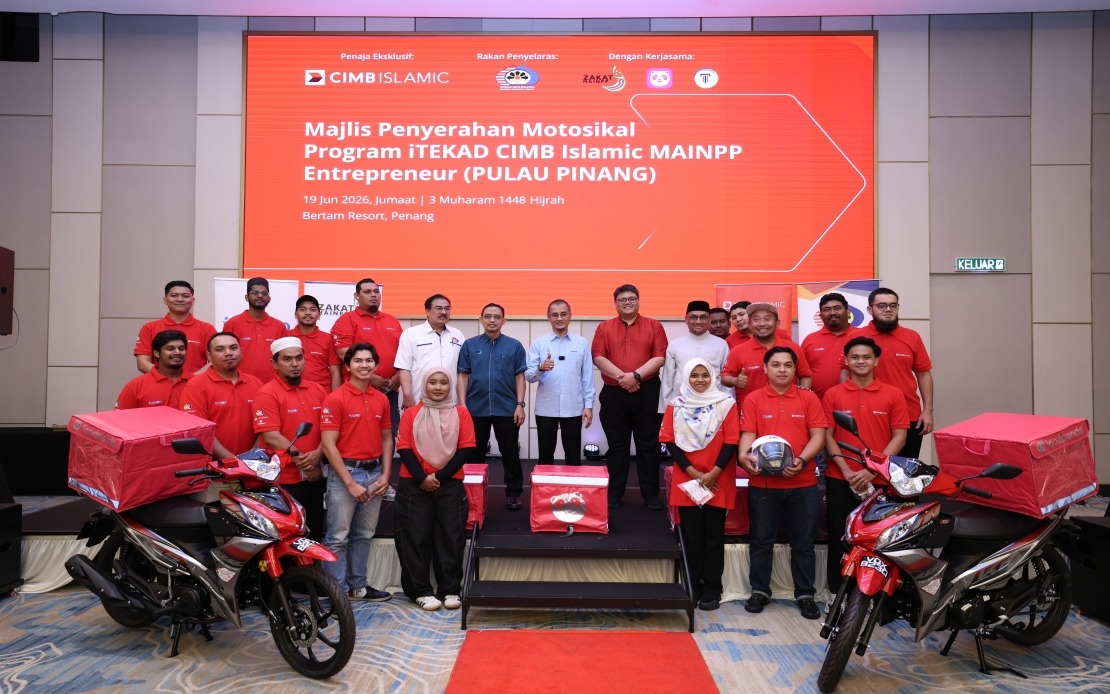
Twenty beneficiaries have been handed over motorcycles as part of the iTEKAD CIMB Islamic-MAINPP Entrepreneur programme, a collaborative initiative designed to lift disadvantaged communities out of poverty through structured employment and self-employment pathways. The handover ceremony took place at Bertam Resort in Kepala Batas, Penang, marking a significant milestone in zakat-driven community development in the northern state.
The programme represents a partnership between CIMB Islamic Bank Berhad and the Penang Islamic Religious Council, commonly known as MAINPP, working in conjunction with several implementation partners including the Malaysian Youth Foundation, Taylor's Community, and foodpanda Malaysia. This multi-stakeholder approach reflects a growing recognition among financial institutions and government bodies that poverty alleviation requires coordinated effort rather than isolated interventions. According to Penang Deputy Chief Minister I Datuk Dr Mohamad Abdul Hamid, who also serves as MAINPP president, the synergy between these organisations demonstrates how zakat funds can be deployed strategically for maximum social impact.
The initiative is underpinned by a RM400,000 matching grant arrangement that pools resources across public and private sectors. CIMB Islamic Bank Berhad contributed RM200,000 through its Wakalah Zakat fund, while Bank Negara Malaysia provided an equivalent sum. This dual funding mechanism ensures both institutional commitment and government backing, signalling the priority placed on asnaf welfare within Penang's development framework. The size of the seed fund relative to the number of beneficiaries suggests a comprehensive approach to participant welfare beyond simply providing equipment.
The selection process itself was rigorous and designed to identify candidates with genuine entrepreneurial potential. Initially, MAINPP received 151 applications from interested parties, a figure that underscores strong community demand for such programmes. From this pool, candidates underwent intensive screening that included formal interviews and a week-long residential Entrepreneurship Camp held from May 31 to June 3, 2026. This bootcamp element signals that the programme views preparation and mindset development as equally important as asset provision. Only 20 participants succeeded in this evaluation process, suggesting that programme designers prioritised quality of selection over quantity of beneficiaries.
Each selected participant receives not merely a motorcycle but an integrated support package encompassing both tangible and intangible assets. Beyond the vehicle itself, recipients are provided with delivery equipment compatible with foodpanda Malaysia's logistics network, positioning many beneficiaries for immediate entry into the gig economy as food delivery operators. Alongside these physical assets, participants receive structured training in basic financial management, work discipline, and foundational entrepreneurship principles. This combination addresses a critical gap in many poverty-alleviation schemes: the absence of complementary soft skills training that helps beneficiaries manage newly acquired productive assets effectively.
The programme aligns with the Penang Islamic Religious Development Agenda 2030, commonly referred to as APAI2030, which takes a holistic view of community welfare. Rather than viewing asnaf development in isolation, APAI2030 encompasses education, economic opportunity, family support systems, and youth engagement. This integrated framework suggests that the iTEKAD programme is not merely a one-off asset transfer but part of a longer-term vision for improving living standards across multiple dimensions of asnaf life. For Malaysian policymakers and development agencies monitoring best practices in zakat utilisation, this alignment between programmes and broader strategic agendas offers a replicable model.
The choice of motorcycles as the primary productive asset is particularly strategic for the Malaysian context. Two-wheelers represent an affordable yet efficient transport solution in a country with established ride-sharing and delivery markets. By equipping beneficiaries with motorcycles and connecting them to foodpanda Malaysia's platform, the programme offers immediate income-generation pathways without requiring participants to establish entirely new businesses from scratch. This reduces both the financial and psychological barriers to entrepreneurship, as participants begin earning through established digital platforms rather than navigating unstructured informal markets.
Penang Deputy Chief Minister Mohamad articulated a vision of the programme transcending temporary relief and instead functioning as a catalyst for sustained life transformation. He emphasised that the assistance provided should serve as a launchpad for building stable livelihoods rather than merely addressing immediate consumption needs. This distinction reflects a broader shift in development thinking away from handouts toward approaches that build human capital and create pathways toward economic self-sufficiency. For Malaysian asnaf groups, such framing is crucial because it positions beneficiaries as agents of their own development rather than passive recipients of charity.
The involvement of foodpanda Malaysia as an implementation partner deserves particular attention. The digital logistics company brings access to a functioning marketplace and customer base, solving a critical challenge that many informal entrepreneurs face: how to reach customers reliably. By integrating programme beneficiaries directly into an established platform economy, the collaboration removes friction from market entry. This approach also allows programme administrators to monitor participant progress and provide ongoing support based on actual performance data.
From a Malaysian economic perspective, the iTEKAD programme exemplifies how zakat funds, traditionally viewed as charitable obligations, can function as development capital when deployed strategically. The RM400,000 seed fund demonstrates how public and private institutions can co-invest in social outcomes while maintaining financial sustainability. With 20 beneficiaries each receiving equipment and training, the per-beneficiary investment remains modest enough to be scalable, yet comprehensive enough to provide genuine opportunity.
The rigorous selection process and residential bootcamp also suggest that programme designers understand the gap between providing assets and building capability. Many asset-transfer programmes falter because beneficiaries lack not just equipment but also business discipline, financial literacy, and resilience. By mandating participation in structured training before asset handover, iTEKAD attempts to address this readiness gap explicitly. This approach contrasts with simpler distribution models and may generate more sustainable outcomes, though long-term monitoring data will be necessary to validate this hypothesis.
Looking forward, the success of this Penang-based initiative will likely influence how other states and Islamic religious authorities structure their own asnaf development programmes. If the 20 motorcycle recipients successfully establish sustainable livelihoods, the model provides a template for scaling across Malaysia's diverse asnaf populations. The involvement of Bank Negara Malaysia also signals that the central bank views financial inclusion and zakat optimization as part of its development mandate, a perspective that may encourage other financial institutions to develop similar partnerships.
Ultimately, the iTEKAD CIMB Islamic-MAINPP Entrepreneur programme illustrates how contemporary poverty alleviation in Malaysia combines traditional Islamic giving mechanisms with modern digital platforms and rigorous capacity-building approaches. For the twenty selected participants, the motorcycles represent more than transportation; they embody an institutional commitment to their economic mobility and a structured pathway out of poverty.