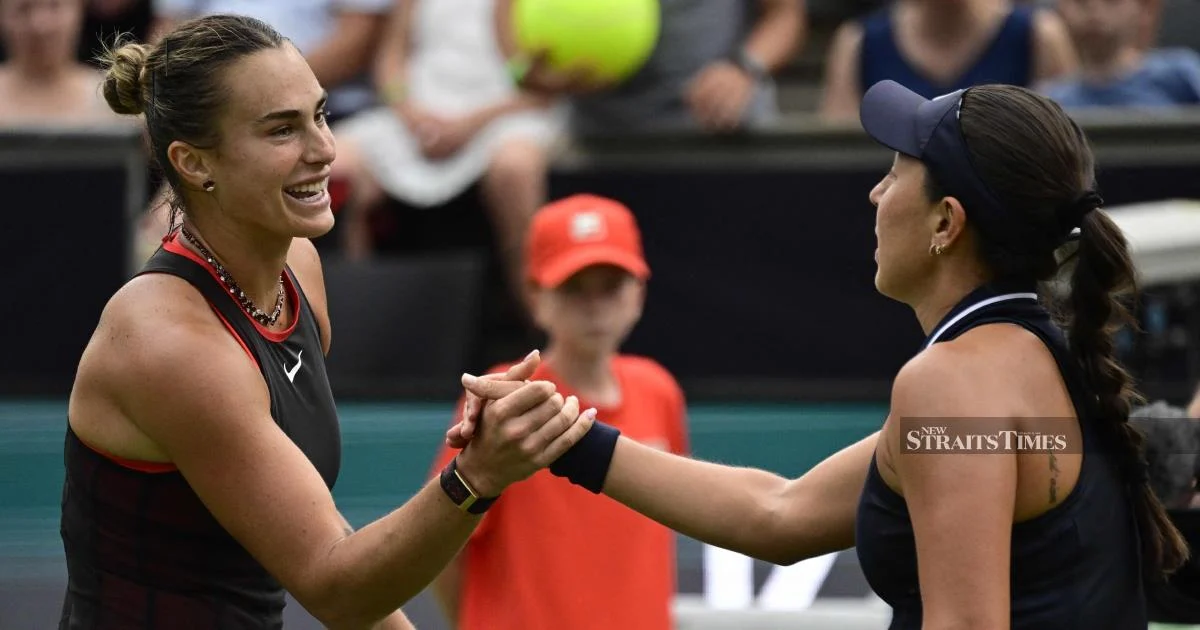
Jessica Pegula produced a commanding display of resilience at Berlin's elite grass-court tournament, outmaneuvering world number one Aryna Sabalenka 6-2, 6-7 (4-7), 6-0 in a hard-fought semi-final encounter. The American's comprehensive victory on grass, one of the sport's most unpredictable surfaces, propels her into the final—a stage she has reached just once before at this prestigious event.
The match unfolded in three distinct chapters, each revealing different dimensions of Pegula's tactical acumen. Opening proceedings saw the American seize control with aggressive baseline play and precision serving, overwhelming Sabalenka's typically formidable game to claim the first set 6-2. That early dominance suggested a potential runaway victory, yet grass-court tennis rarely unfolds in predictable fashion, as the second set would brutally demonstrate.
Sabalenka, holder of the world's top ranking and a two-time Australian Open champion, mounted a fierce counterattack in the second set that pushed Pegula to the brink. The tension culminated in a closely contested tiebreaker that hinged on fine margins and fluctuating momentum. Ultimately, Sabalenka's clutch serving and aggressive shot-making enabled her to edge past Pegula 7-4 in that crucial tiebreaker, forcing the contest into a decisive third set and reigniting hopes of a comeback.
However, Pegula refused to crumble under pressure. Rather than showing signs of capitulation after squandering what appeared a path to victory, the American composed herself and delivered an almost perfect third set. Her service game became virtually impenetrable, her return of serve sharpened considerably, and her court positioning forced Sabalenka into increasingly desperate patterns of play. The final set became a procession, with Pegula dismantling her opponent's resolve to complete the 6-0 whitewash and seal her passage to the final.
This victory carries particular significance for Pegula's career trajectory on grass. Historically known more as a hard-court competitor, her ability to navigate the technical challenges of grass-court tennis—where movement becomes more difficult, serve becomes more valuable, and rhythm proves harder to establish—demonstrates growing versatility at the sport's highest level. Her previous Berlin final appearance demonstrated her capability on this surface, yet backing it up with another run to the championship match suggests this may represent a genuine evolution in her all-surface credentials.
Sabalenka's defeat marks a rare stumble for the Belarusian star, whose dominance across multiple surfaces has defined the current era of women's tennis. Though she began majestically in Berlin, her inability to sustain that level through two complete sets against Pegula indicates that even the world's elite face vulnerability when facing opponents hitting with precision and conviction. The loss also raises questions about whether a demanding recent schedule—touring professionals often compete across multiple tournaments in quick succession—may have left her slightly fatigued during the crucial moments.
For Southeast Asian tennis enthusiasts, Pegula's advancement offers intriguing narrative possibilities. Her steadily rising profile and increasingly impressive tournament runs reflect the depth of emerging American talent, challenging the dominance long enjoyed by other nations. Her game style—built on consistency, intelligent shot selection, and mental resilience rather than raw power—offers a template that younger regional players might study as they develop their own competitive approaches.
The Berlin tournament itself represents one of the WTA Tour's most competitive grass-court events, attracting the world's elite players to Germany's capital during the traditional build-up to Wimbledon. Pegula's advancement ensures at least one American will contest the championship, continuing a tradition of strong American representation at tournaments across the continent. Her path through the draw has avoided some early-round complications, suggesting momentum and confidence heading into the final match.
Pegula's recent tournament performances have established her among the WTA's most consistently reliable competitors across different surfaces and conditions. While she may not always command headlines dominated by players with more aggressive, explosive playing styles, her steady accumulation of victories and deep runs in major events quietly builds a compelling career resume. This Berlin semi-final victory adds another significant achievement to that growing collection, positioning her as a genuine contender for tournament titles whenever conditions suit her methodical, pressure-based approach.
Looking ahead to the final, Pegula will face an opponent emerging from the other semi-final, with both players seeking to claim one of professional tennis's most coveted grass-court trophies. Her dominant third-set performance suggests she has identified tactical approaches capable of neutralizing even the world's top-ranked player, a realization that may prove invaluable as she pursues that elusive Berlin title.