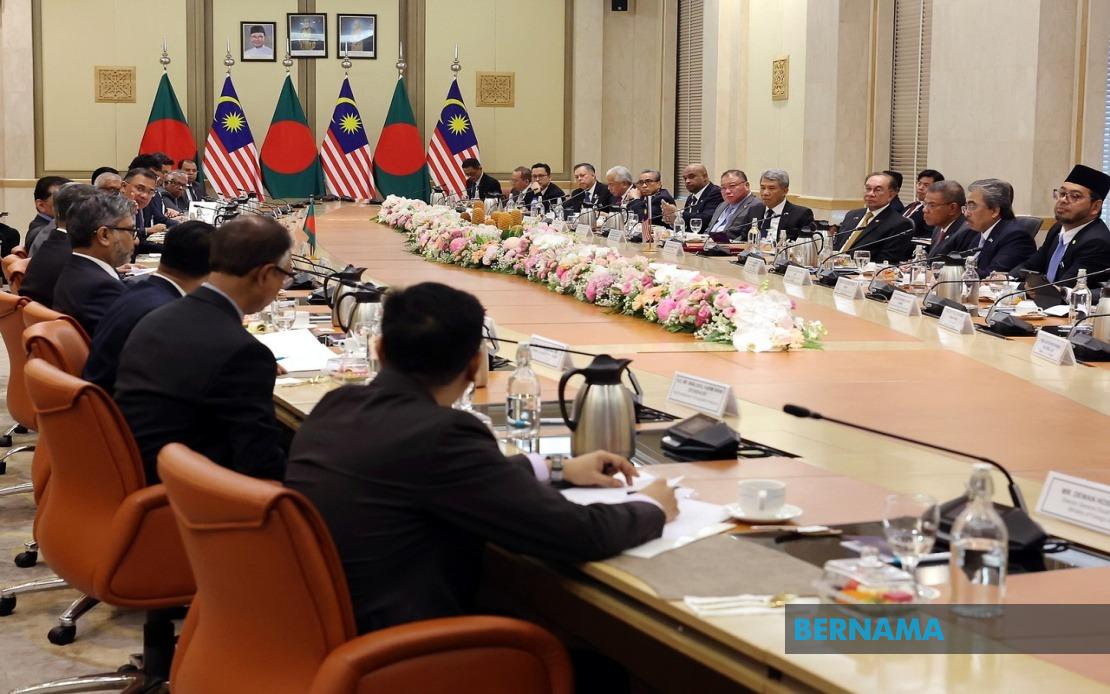
Prime Minister Datuk Seri Anwar Ibrahim has called for Malaysia and Bangladesh to deepen their partnership by moving into cutting-edge sectors such as artificial intelligence, renewable energy and semiconductor manufacturing. The announcement came during a joint press conference in Putrajaya with visiting Bangladesh Prime Minister Tarique Rahman, whose two-day official visit marks a significant opportunity for both nations to recalibrate their economic relationship. The emphasis on emerging technologies reflects a broader regional trend in Southeast Asia, where countries are seeking to position themselves within global supply chains for future-critical industries.
While acknowledging that traditional sectors like agriculture will continue to play an important role in bilateral relations, Anwar stressed that the two nations must prioritise collaboration in areas that will shape economic competitiveness over the coming decades. His remarks indicate a recognition that Malaysia and Bangladesh, despite their geographical separation and different stages of industrialisation, share complementary strengths in technology development and manufacturing capacity. For Bangladesh, participation in Malaysia's semiconductor ecosystem and digital economy could provide pathways to upgrade its industrial base, whilst Malaysia gains access to Bangladesh's large talent pool and growing technology sector.
The artificial intelligence sector represents perhaps the most transformative opportunity outlined in the partnership discussion. Both nations face similar challenges in deploying AI solutions across healthcare, agriculture and manufacturing. By establishing joint research initiatives and knowledge-sharing frameworks, Malaysia and Bangladesh could develop AI applications tailored to Southeast Asian contexts, rather than simply importing Western or Chinese technological standards. This collaborative approach aligns with the broader ASEAN vision of ensuring that artificial intelligence development benefits the region rather than concentrating wealth and capability in distant innovation hubs.
Energy cooperation takes on particular urgency given regional climate commitments and the transition away from fossil fuels. Malaysia's expertise in liquefied natural gas and renewable energy projects, coupled with Bangladesh's urgent need for diversified energy sources to fuel industrial growth, creates natural complementarities. Joint ventures in solar, wind and hydrogen technologies could establish both nations as clean energy producers within South and Southeast Asia. The energy sector also offers employment opportunities and technological know-how transfer, particularly valuable for Bangladesh's industrial workforce development.
The semiconductor dimension of the proposed partnership is strategically significant at a time when global chip supply chains face disruption and major economies are investing heavily in domestic semiconductor capacity. Malaysia already hosts major semiconductor manufacturing and design operations, providing established infrastructure and expertise. Expanding this sector through Bangladesh partnerships could involve training programmes, backward integration into component manufacturing, or the establishment of design centres. Given geopolitical tensions affecting chip supplies from China and Taiwan, diversifying semiconductor production across the region reduces systemic risk for both nations and their neighbours.
Beyond sector-specific cooperation, the agreements signed during Rahman's visit provide institutional scaffolding for deeper engagement. The Memorandum of Understanding on Cultural Cooperation reflects recognition that people-to-people ties strengthen economic relationships. Exchange programmes, educational partnerships and cultural initiatives help build the social capital necessary for sustained business collaboration. The two Exchanges of Notes addressing counter-terrorism research and investment promotion signal complementary security and economic interests, demonstrating that bilateral relations encompass both traditional and contemporary security challenges.
Investment facilitation remains a cornerstone of the expanded partnership. Both nations have worked to streamline processes for business registration, intellectual property protection and repatriation of profits. These procedural improvements matter enormously for small and medium-sized enterprises considering cross-border operations. A Malaysian technology startup seeking to establish research operations in Bangladesh, or a Bangladeshi manufacturer wishing to access Malaysian markets, benefits directly from clearer regulatory frameworks and faster bureaucratic processing.
The timing of this partnership expansion reflects Malaysia's strategic positioning within multiple regional architectures. As a member of ASEAN and the Organisation of Islamic Cooperation, Malaysia sits at the intersection of Southeast Asian and South Asian development initiatives. Bangladesh, similarly positioned as a bridge between South Asia and the Bay of Bengal region, represents a natural partner for initiatives that span these geographies. Their cooperation potentially influences how other nations in both regions approach technology partnerships and industrial collaboration.
For Malaysian businesses, the enlarged cooperation framework opens doors in Bangladesh's growing market of over 170 million people and rapidly expanding manufacturing sector. Malaysian expertise in logistics, financial services and digital infrastructure positions the country as an attractive source of technology and management practices. Conversely, Bangladeshi manufacturers seeking to upgrade operations can draw upon Malaysian experience in productivity improvement and quality management systems developed over decades of industrial development.
The semiconductor and advanced manufacturing focus reflects both nations' recognition that commodity-based competition will increasingly disadvantage them relative to larger economies. By concentrating on high-value, technology-intensive sectors, Malaysia and Bangladesh position their workforces for better-paying employment and create resilience against commodity price fluctuations. This strategic shift also supports both nations' aspirations to join the ranks of upper-middle-income countries and eventually high-income economies.
Regional observers will watch how these commitments translate into concrete joint ventures and research initiatives. The history of bilateral cooperation agreements suggests that success depends on identifying specific, funded projects rather than broad proclamations. Whether Malaysia and Bangladesh establish joint AI research institutes, launch semiconductor training centres, or develop renewable energy projects will determine whether this visit represents genuine partnership deepening or largely rhetorical alignment. The establishment of clear timelines, dedicated funding and accountability mechanisms will be essential indicators of commitment from both sides.

%22%2F%3E%3C%2Fpattern%3E%3C%2Fdefs%3E%3Crect%20width%3D%22100%25%22%20height%3D%22100%25%22%20fill%3D%22url(%23ph9pgng)%22%2F%3E%3Crect%20width%3D%22100%25%22%20height%3D%22100%25%22%20fill%3D%22url(%23ph9pgnp)%22%2F%3E%3Ctext%20x%3D%2250%25%22%20y%3D%2250%25%22%20text-anchor%3D%22middle%22%20dominant-baseline%3D%22central%22%20fill%3D%22rgba(255%2C255%2C255%2C0.95)%22%20font-family%3D%22Georgia%2C%20'Times%20New%20Roman'%2C%20serif%22%20font-weight%3D%22700%22%20font-size%3D%22170%22%20letter-spacing%3D%22-0.02em%22%3EMalaysia%3C%2Ftext%3E%3C%2Fsvg%3E)
%22%2F%3E%3C%2Fpattern%3E%3C%2Fdefs%3E%3Crect%20width%3D%22100%25%22%20height%3D%22100%25%22%20fill%3D%22url(%23ph389gmg)%22%2F%3E%3Crect%20width%3D%22100%25%22%20height%3D%22100%25%22%20fill%3D%22url(%23ph389gmp)%22%2F%3E%3Ctext%20x%3D%2250%25%22%20y%3D%2250%25%22%20text-anchor%3D%22middle%22%20dominant-baseline%3D%22central%22%20fill%3D%22rgba(255%2C255%2C255%2C0.95)%22%20font-family%3D%22Georgia%2C%20'Times%20New%20Roman'%2C%20serif%22%20font-weight%3D%22700%22%20font-size%3D%22320%22%20letter-spacing%3D%22-0.02em%22%3EMACC%3C%2Ftext%3E%3C%2Fsvg%3E)