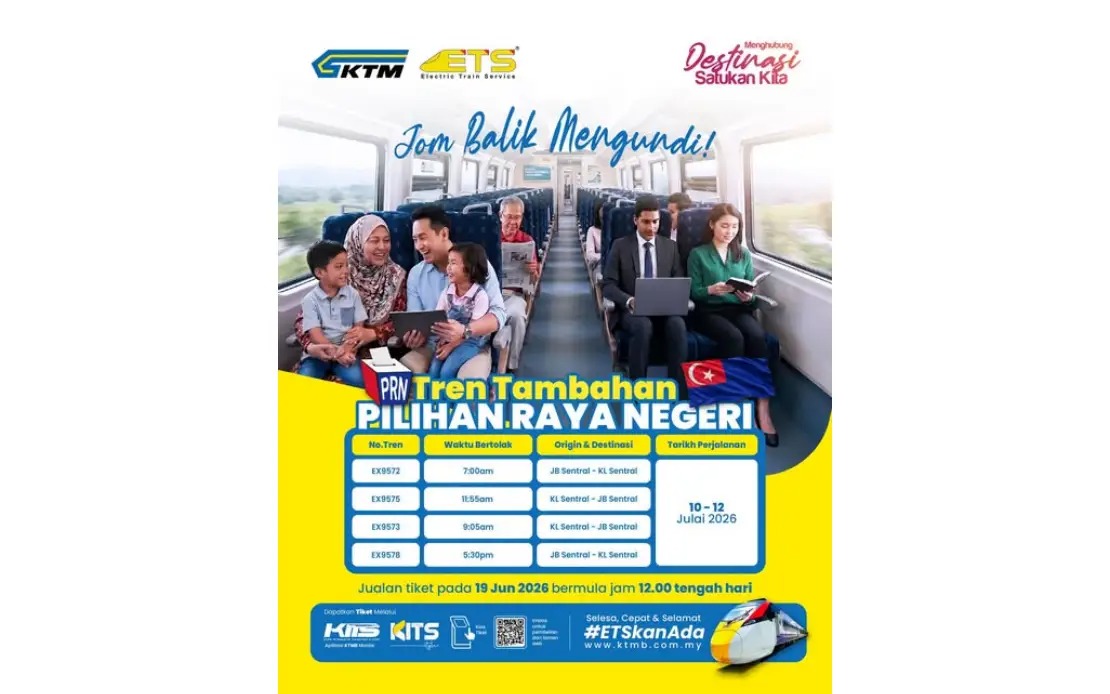
Keretapi Tanah Melayu Berhad (KTMB), the country's main railway operator, has responded to anticipated travel demand ahead of the Johor state election by introducing extra Express Train Service (ETS) departures on southbound routes. The move reflects transport planners' expectations that significant numbers of registered voters living outside the state will attempt to return home during the polling period, a pattern common in Malaysian elections where voters maintain strong ties to their constituencies of origin.
The operator announced that ticket sales would commence at noon on June 19, providing a two-week advance booking window before the travel rush. This timing allows passengers to secure seats across multiple journey dates and plan their return journeys with reasonable certainty. KTMB emphasised accessibility by offering purchases through four distinct channels: the KTMB Mobile application, the KITS Style platform, the online reservation system accessible via online.ktmb.com.my, and traditional ticket kiosks staffed at railway stations throughout the network. This multi-channel approach acknowledges varying levels of digital literacy among the voting population and ensures elderly voters or those uncomfortable with applications can still book seats conveniently.
The additional services will operate across a three-day window spanning July 10 to 12, sandwiching the July 11 polling day itself. This configuration allows voters to depart on July 10 if they wish to arrive the day before voting, participate on election day, and potentially return on July 12. The staggered arrangement also distributes passenger loads across multiple train departures rather than concentrating all demand into a single day, reducing platform congestion and station overcrowding that might otherwise occur in Johor Bahru or other major interchange points.
Context for this transport expansion lies in the Johor state election being called following the dissolution of the State Legislative Assembly on June 1. The Election Commission subsequently designated July 11 as polling day, providing a month-long campaign period during which political parties mobilise supporters across the state and beyond. In competitive state elections, voter turnout can significantly influence outcomes, particularly in marginal constituencies where decisions might hinge on a few hundred votes. Consequently, political organisations typically encourage supporters to return home, and transport providers anticipate increased demand on inter-city routes during election periods.
For Malaysian readers, this announcement carries practical implications beyond the immediate Johor election. The deployment of additional rail capacity during electoral periods illustrates how government agencies plan logistics to facilitate democratic participation. The willingness of KTMB to augment services at what is effectively peak-demand timing reflects institutional recognition that elections represent important civic events justifying resource allocation. Voters planning to travel should book early rather than waiting until the last moment, as the railway operator will likely experience heavy demand as the polling date approaches, particularly on the evening of July 10 when most people will attempt to travel.
The technological infrastructure supporting ticket sales—particularly the mobile applications—represents growing digitisation of Malaysian public services. Younger voters accustomed to smartphone-based transactions will find the app-based booking straightforward, while the persistence of physical ticket windows indicates KTMB's awareness that not all segments of the electorate have embraced digital purchasing. This hybrid approach, increasingly common across Malaysian government agencies, attempts to balance modernisation with inclusivity.
From a regional perspective, Malaysia's election infrastructure demonstrates how Southeast Asian democracies manage the logistical challenges of holding elections across geographically dispersed populations. Unlike smaller island nations or city-states, Malaysia's federal structure and dispersed voter population mean that elections routinely displace thousands of temporary migrants, students, and workers from their usual residences. The coordination between electoral authorities, transport operators, and other government bodies to facilitate this movement reflects institutional maturity in managing democratic processes.
The Johor election assumes heightened significance within Malaysian politics given that state's economic importance and historical influence on national politics. The state's status as home to major petrochemical industries, the port at Tanjung Pelepas, and significant manufacturing sectors means that the political complexion of Johor state government carries implications beyond the state itself. Consequently, the electoral engagement levels tend to be elevated, and transport operators can reasonably expect above-average utilisation of long-distance rail services during the voting period.
Voters should note that the additional ETS services represent a temporary augmentation rather than permanent expansion of the timetable. Following the election, KTMB will presumably return to standard scheduling, so passengers should not assume that the enhanced service frequency will persist beyond July 12. Early booking during the advance sales period beginning June 19 provides the best opportunity to secure preferred departure times and seating arrangements, particularly for travel on July 10 when the largest surge of homebound voters is likely to occur.