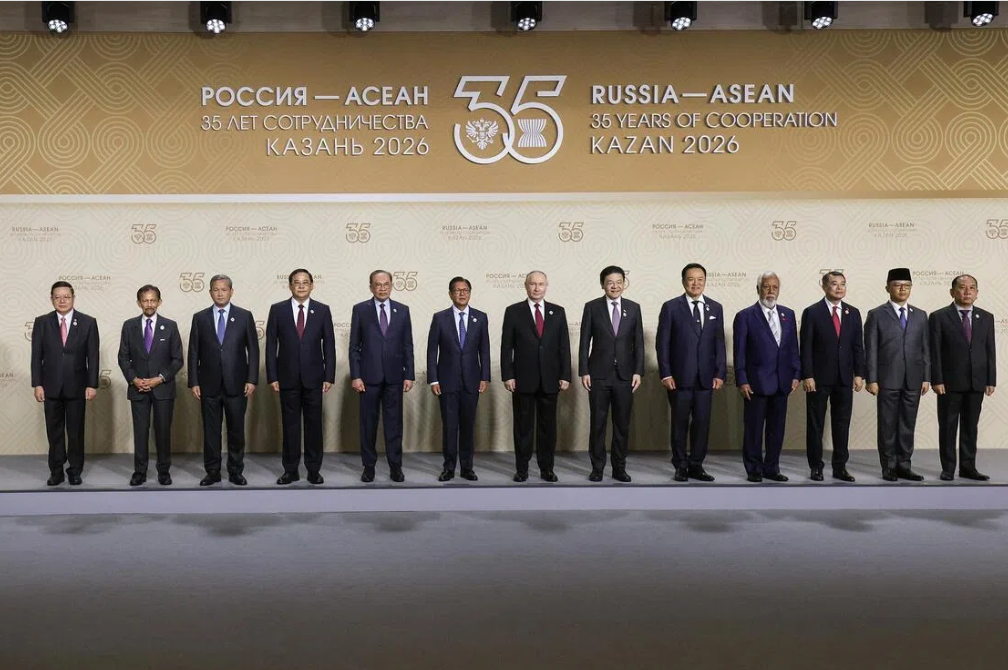
The Asean-Russia Commemorative Summit in Kazan this month has underscored the two sides' determination to strengthen engagement across multiple sectors, even as geopolitical tensions complicate the regional security landscape. The gathering, convened on June 17 and 18 at the request of Russian President Vladimir Putin, served as a milestone moment—celebrating three and a half decades of formal relations and three decades of structured dialogue partnerships. The summit's timing reflects Moscow's deliberate efforts to maintain diplomatic momentum with Southeast Asia at a moment when great-power competition is reshaping global alignments.
Three significant accords emerged from the proceedings, each designed to operationalise cooperation in concrete terms. The Kazan Declaration itself functions as a comprehensive review of bilateral progress since 1989, while simultaneously charting a roadmap for the next chapter of engagement. Complementing this overarching text, a Joint Statement on Cultural Cooperation was signed to elevate people-to-people connections and artistic exchanges. Most significantly, the Asean-Russia Comprehensive Plan of Action spanning 2026 to 2030 provides a detailed framework for collaborative initiatives across the coming half-decade. These agreements collectively signal intent to expand ties beyond traditional diplomatic courtesies into substantive cooperation in maritime affairs, commercial activity, energy security, physical and digital connectivity, counterterrorism, educational advancement, and cultural preservation.
Prime Minister Lawrence Wong's remarks at the summit offered a carefully calibrated articulation of Singapore's position—one that acknowledges Russia's relevance to regional stability while maintaining unwavering adherence to international legal principles. Wong stressed that Asean and Russia should identify zones of convergence where mutual interest permits productive collaboration, whilst simultaneously reinforcing mechanisms designed to build trust and prevent conflict escalation. This measured approach reflects the broader Southeast Asian dilemma: maintaining pragmatic ties with a major Eurasian power whilst avoiding entanglement in global power struggles that could threaten regional autonomy. Singapore's diplomatic language underscored that the relationship, whatever its limitations, remains valuable for Southeast Asia's strategic environment.
The Prime Minister explicitly welcomed Russia's sustained commitment to Asean Centrality—the principle that the bloc should remain the driving force in shaping the regional order. He noted that Russia has consistently participated in Asean-led forums, particularly the Asean Regional Forum and the East Asia Summit, and invited further Russian engagement with these platforms when the Philippines hosts them later this year. Looking ahead to Singapore's assumption of the Asean rotating chairmanship in 2027, Wong signalled openness to expanding Russia's role within Asean mechanisms, suggesting that Moscow will have opportunities to deepen institutional involvement across the coming years. This invitation carries strategic weight, as it positions Russia not as an outside observer but as a stakeholder in Asean-centred architecture.
Wong identified concrete cooperative areas where Asean and Russia can deliver tangible benefits without navigating contentious geopolitical minefields. Disaster risk management represents an obvious domain given the typhoon-prone geography of Southeast Asia and Russia's technical expertise in emergency response systems. Countering illicit drug trafficking—a persistent scourge affecting multiple Asean capitals—offers another avenue where Moscow's law enforcement apparatus and intelligence capabilities could complement regional efforts. Educational and cultural exchanges, Wong suggested, deserve expanded emphasis; he highlighted the regular participation of Russian officials in civil service training programmes across Asean member states, including Singapore, as evidence of existing people-to-people connectivity that warrants amplification. These initiatives serve the dual purpose of fostering genuine human connections while building the interpersonal trust networks that underpin durable diplomatic relationships.
Wong's broader strategic framing acknowledged the volatile global environment in which Asean must navigate. He argued that deepening regional integration whilst simultaneously diversifying external partnerships has become more crucial precisely because international conditions are increasingly unpredictable. This formulation reflects the bloc's core strategy of maintaining equidistance from competing powers whilst extracting maximum benefit from each. Against this backdrop, Wong positioned support for international law and rules-based order not as alignment with any particular power, but as a principled commitment to universal norms. This distinction matters enormously for Southeast Asia, which cannot afford to be perceived as taking sides in great-power contests but must simultaneously uphold the legal frameworks upon which its own security depends.
The Prime Minister's treatment of ongoing conflicts illustrated this balancing act with precision. On Ukraine, Wong reiterated Singapore's unambiguous position: the invasion violates international law and breaches principles of sovereignty and territorial integrity that are foundational to the entire Southeast Asian state system. Singapore has maintained sanctions on Russia since 2022, and these remain in effect, reflecting the government's conviction that legal principles cannot be selectively applied. Yet Wong also committed Singapore to supporting diplomatic pathways toward ceasefire and ultimate peace settlement, framed through adherence to international law and the UN Charter rather than geopolitical preference. Notably, Wong welcomed the nascent rapprochement between the United States and Iran, viewing it as a positive development for regional stability and freedom of navigation through the critical Strait of Hormuz—a waterway through which Malaysian, Indonesian, and Singaporean maritime commerce flows.
The emphasis on unimpeded transit through international waterways carries particular salience for Southeast Asian readers. The United Nations Convention on the Law of the Sea, which provides the legal foundation for freedom of passage through straits and chokepoints, directly underpins Southeast Asia's economic lifeline. Any restriction on traffic through the Strait of Hormuz or comparable passages would devastate the region's trade-dependent economies. This concern transcends Asean-Russia relations; it reflects a deeper anxiety about great-power behaviour that could fundamentally disrupt regional commerce. Wong's invocation of this principle in the context of the Asean-Russia summit subtly communicates that even as Asean engages Russia, it will not acquiesce to any arrangement that threatens these vital arteries of international commerce.
Wong's bilateral meeting with President Putin, arranged at the Russian leader's initiative, provided an opportunity for direct exchange on sensitive matters. The discussion underscored, Wong observed in a social media post, the value of continued dialogue even when countries harbour fundamental disagreements. This framing—that engagement itself possesses intrinsic value regardless of issue-specific divergences—encapsulates the Asean approach to major powers. Rather than treating relationships as binary (aligned or opposed), Southeast Asian states prefer to compartmentalise disagreements whilst pursuing cooperation in compatible domains. For Russia, maintaining channels to pragmatic Southeast Asian partners like Singapore becomes more important as Western responses to its Ukraine intervention intensify. For Singapore and Asean, keeping Moscow engaged within regional institutions preserves the possibility of positive-sum outcomes and reduces the risk that Russia might be driven toward more destabilising regional partners.
Wong also met with Rustam Minnikhanov, the Rais (president) of Russia's Republic of Tatarstan, a federal subject with longstanding connections to Singapore. The relationship dates to 2007 when Lee Kuan Yew, then Minister Mentor, visited Tatarstan—a gesture that established personal and institutional linkages at a subnational level. Such ties, whilst often overlooked in grand strategic analysis, can prove surprisingly durable and productive. Wong and Minnikhanov discussed cultural, educational, and people-to-people cooperation, suggesting that Asean-Russia engagement extends beyond the central government to encompass federal entities with their own international aspirations. This decentralised approach to diplomacy has long characterised Singapore's strategy, allowing it to cultivate multiple entry points for influence and information exchange.
The Kazan summit ultimately demonstrates that despite profound disagreements on Ukraine and international law interpretation, Asean remains committed to inclusive regionalism that accommodates major powers willing to respect regional autonomy and institutional primacy. For Malaysian and other Southeast Asian observers, the summit's outcomes carry important implications. They suggest that Russia, rebuffed by Western institutions, will likely intensify efforts to position itself as a valuable partner within Asian frameworks. They also confirm that Asean states, including Singapore, will continue their delicate balancing act—maintaining moral clarity on violations of international law whilst preserving practical engagement with powerful actors. This approach, tested repeatedly over recent decades, remains the bloc's most effective strategy for navigating a multipolar world where complete alignment with any single power remains impossible and potentially dangerous.
Looking forward, the 2026-2030 action plan will determine whether current declarations translate into substantive advances. Concrete projects in energy cooperation, digital connectivity, and educational exchanges will offer meaningful tests of Asean-Russia commitment. Meanwhile, Russia's participation in Asean-centred forums through 2027 and beyond will reveal whether Moscow can sustain engagement without demanding the kind of strategic alignment that Asean states remain unwilling to provide. For Southeast Asia, the challenge remains unchanged: extracting maximum benefit from relationships with all major powers whilst refusing to sacrifice the principles of sovereignty, non-interference, and rules-based order that constitute the foundation of the regional system itself.