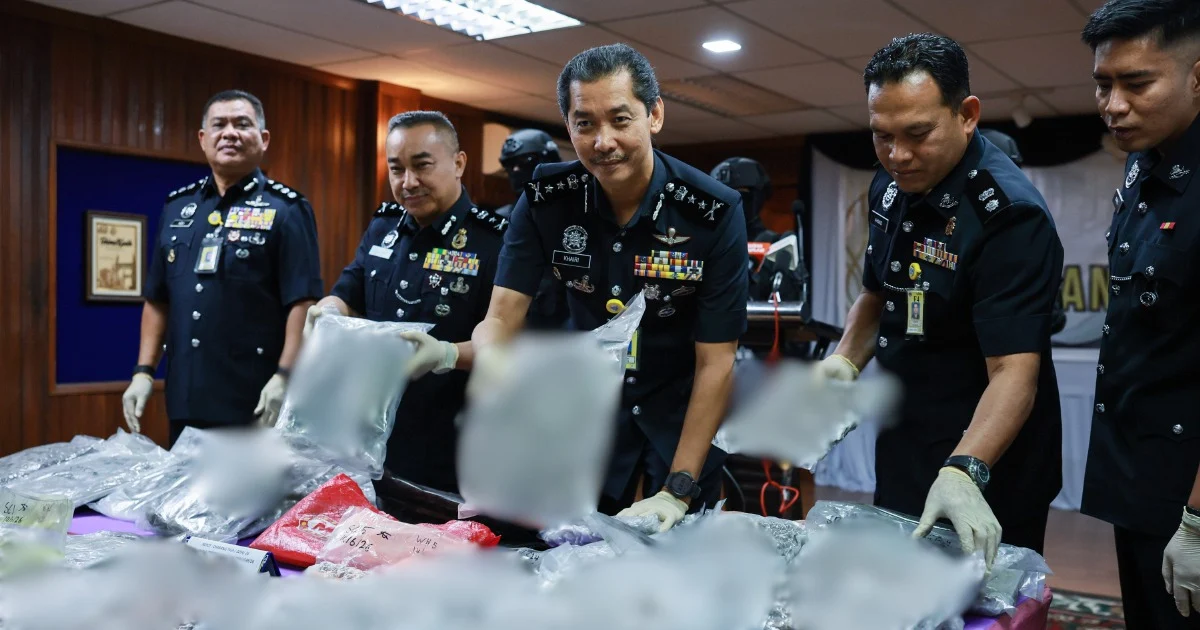
Officers working under the Terengganu police command have apprehended two siblings in connection with what authorities describe as a significant narcotics storage operation centred on a residential address in Kampung Duyong Besar, Kuala Terengganu. The breakthrough follows an investigation that culminated in the discovery of drugs estimated to carry a street value of RM1.76 million, marking a notable enforcement success in the region's ongoing battle against substance trafficking.
The detained men are believed to have converted their family home into a distribution and storage hub, utilising the residence as a strategic point in what investigators suspect forms part of a broader drug network. The location's selection—a residential neighbourhood rather than a commercial warehouse—suggests a deliberate effort to minimise official scrutiny by blending illicit operations into ordinary domestic settings, a tactic that has become increasingly common among trafficking syndicates operating across Peninsular Malaysia.
Residential drug operations present particular challenges for law enforcement agencies, as they require heightened sensitivity to community privacy while maintaining rigorous investigative standards. The successful identification and dismantling of this particular operation underscores the Terengganu police force's capacity to detect such concealed activities through methodical intelligence gathering and community cooperation. The scale of the seizure indicates this was not a small-scale operation but rather a facility designed to handle significant quantities of contraband.
The implications for Terengganu extend beyond the immediate arrests. The state, positioned along established trafficking corridors, has repeatedly become a focal point for drug distribution networks seeking to move substances from production sources toward major urban consumption markets in the Klang Valley and beyond. Busting operations like this one disrupts supply chains and raises operational costs for traffickers, though enforcement gaps elsewhere can quickly enable replacement operations to establish themselves.
The RM1.76 million valuation reflects street-level pricing and demonstrates the substantial profit margins that drive organised drug distribution. These figures, when aggregated across multiple busts nationwide, paint a picture of an extremely lucrative illicit economy that continues to attract criminal enterprise despite escalating enforcement efforts and increasingly severe penalties under Malaysian drug laws. The brothers' alleged involvement suggests they occupied positions within a supply hierarchy, receiving bulk shipments and managing distribution to secondary markets.
Malaysian drug enforcement faces persistent structural challenges. Cross-border trafficking from neighbouring countries, porous regional boundaries, and the emergence of synthetic narcotics alongside traditional substances like heroin create a complex environment. Terengganu's coastline and proximity to Thailand add further vulnerability to seaborne smuggling operations. Successful individual busts, while valuable, represent only partial solutions to systemic issues requiring coordinated regional action and sustained resource investment.
The detention of these two individuals will trigger further investigative lines as authorities seek to identify their suppliers, distributors, and customers within the network. Intelligence gathered from the residence and the arrested men may yield leads pointing toward connected operations elsewhere. Police have signalled their commitment to tracing the source of the drugs and mapping out the complete supply architecture of which this operation formed a component.
For Malaysian communities, particularly in states like Terengganu where drug-related social harms remain a serious concern, such enforcement actions provide tangible evidence of police responsiveness. Drug abuse and its associated crime contribute significantly to family breakdown, youth delinquency, and public health crises. Dismantling storage and distribution nodes represents a direct intervention in the mechanisms that deliver addiction-enabling substances to vulnerable populations.
The operation also highlights the importance of neighbourhood vigilance and public cooperation with law enforcement. Information from residents, business operators, or other community members frequently provides the initial triggers for investigations that eventually uncover major operations. Police departments have increasingly encouraged formal channels for anonymous reporting, recognising that community intelligence often precedes electronic surveillance or intelligence analysis.
Moving forward, this case will contribute to ongoing assessments of trafficking patterns and enforcement priorities across the East Coast. The Terengganu police and their counterparts in federal agencies will analyse the seized materials, interview the detained brothers, and develop broader understanding of the networks they served. Such intelligence, properly synthesised and shared across jurisdictions, strengthens the collective capacity of Malaysian law enforcement to anticipate and intercept trafficking activities.
The detention of the two brothers underscores that despite the scale and sophistication of drug trafficking in Malaysia, frontline police work combined with investigative competence and community engagement continues to yield significant results. The RM1.76 million haul represents drugs prevented from reaching end users and profit prevented from flowing to criminal organisations. As Terengganu authorities continue their investigation, this operation will serve as both an enforcement success and a reminder of the ongoing nature of the challenge facing the nation's drug control efforts.