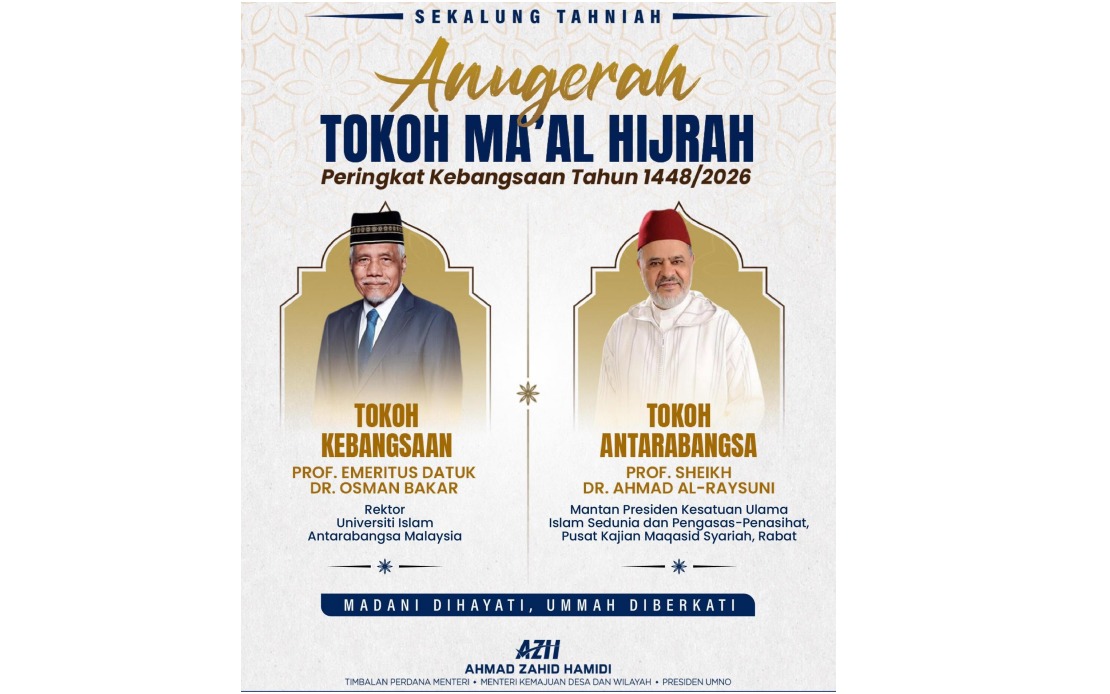
Malaysia's Deputy Prime Minister Datuk Seri Dr Ahmad Zahid Hamidi has urged the nation's Muslim community to view this year's Tokoh Maal Hijrah award recipients as beacons of excellence and dedication, citing their accomplishments as models for aspiration and emulation across the country.
The two honourees selected at the national-level Maal Hijrah celebration held at Masjid Putra in Putrajaya represent pinnacles of intellectual and spiritual contribution to Islamic scholarship and Muslim societies. Prof Emeritus Datuk Dr Osman Bakar claimed the National Tokoh Maal Hijrah Award, while Prof Sheikh Dr Ahmad Al-Raysuni, a renowned Islamic jurisprudence specialist from Morocco, secured the International Tokoh Maal Hijrah Award.
Ahmad Zahid underscored that recognition bestowed upon these distinguished scholars should galvanise Muslims to intensify their pursuit of knowledge whilst simultaneously strengthening their commitment to community welfare and broader societal development. His remarks reflect a broader governmental emphasis on positioning Islamic scholarship and values as catalysts for progressive nation-building within Malaysia's multiethnic context.
The Deputy Prime Minister highlighted that Osman Bakar and Ahmad Al-Raysuni's achievements embody the profound impact that dedicated Islamic thought and practice can exert on empowering Muslim communities, enhancing intellectual discourse, and disseminating Islamic principles characterised by compassion, prudence and tangible benefit to society. This framing positions scholarly endeavour and spiritual leadership as integral components of national advancement rather than merely personal achievement.
Second Deputy Prime Minister Datuk Seri Fadillah Yusof independently echoed similar sentiments, emphasising that the award recipients exemplify the calibre of contribution expected from those committed to advancing the broader Muslim world. His commentary extended the discourse beyond individual accomplishment to encompass collective responsibility towards community prosperity and institutional strength.
Fadillah contextualised the Maal Hijrah awards within the historical and spiritual significance of Prophet Muhammad's migration from Mecca to Medina, framing this pivotal moment not as an isolated historical occurrence but as a perpetual philosophical framework guiding Muslim action. The hijrah narrative, in his interpretation, encapsulates foundational Islamic values including sacrifice, communal cohesion, fortitude and purposeful commitment to beneficial transformation.
This theological interpretation carries particular resonance for Malaysia's diverse society, where the principles of unity, interfaith harmony and structured national development remain central governmental preoccupations. By anchoring contemporary awards within classical Islamic history, federal leadership articulates a vision wherein Islamic practice serves as a unifying rather than divisive social force.
Fadillah's articulation of the hijrah spirit as a perpetual guide for societal development suggests that Islamic values should inform contemporary policy approaches and individual conduct alike. He called for sustained collaborative endeavour to reinforce social cohesion, deepen spiritual commitment, and expand ethical action across the Muslim community and throughout Malaysia's national fabric.
The Sultan of Perak, Sultan Nazrin Shah, formally conferred the honours upon the recipients, distributing cash prizes, ceremonial trophies, and certificates acknowledging their contributions during the official Putrajaya ceremony. This ceremonial structure underscores the institutional significance Malaysia's government assigns to recognising intellectual and spiritual leadership within the Islamic sphere.
The selection of an international recipient alongside a Malaysian honouree reflects Malaysia's positioning as a participant in broader global Islamic intellectual networks. Ahmad Al-Raysuni's recognition signals openness to transnational Islamic scholarship whilst simultaneously asserting Malaysian capacity to assess and appreciate international standards of Islamic jurisprudential excellence.
For Malaysian readers, the awards ceremony and attendant commentary from senior government figures illustrate how contemporary Islamic scholarship continues shaping national narratives around development, community cohesion, and values-based governance. The emphasis on knowledge-seeking and community service aligns with longstanding Malaysian policy frameworks emphasising Islam's compatibility with modernity and progressive state-building.
The Tokoh Maal Hijrah initiative represents an annual governmental mechanism for affirming particular expressions of Islamic thought and practice deemed consonant with national development objectives. Through such recognition, federal authorities subtly shape discourse around which Islamic intellectual traditions and scholars warrant emulation and institutional support within Malaysian Muslim communities.