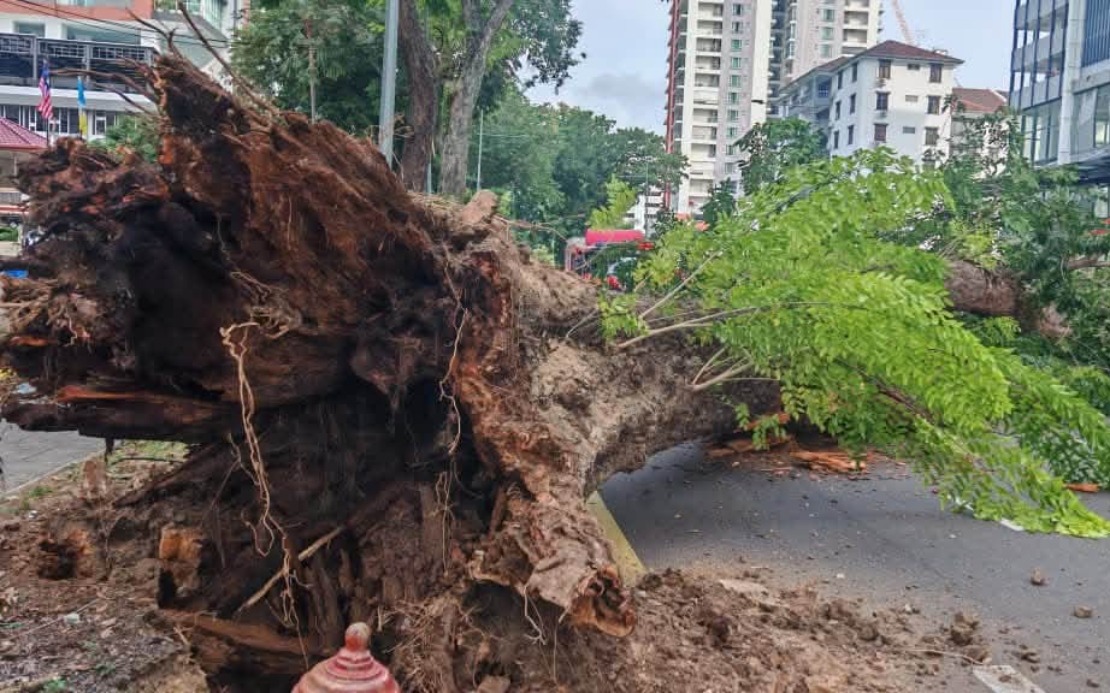
A towering 90-year-old Angsana tree that stood along Jalan Macalister in George Town gave way on August 9, crushing a vehicle and injuring three occupants in what city authorities attributed to a combination of internal decay and urban environmental stress. The Pterocarpus indicus specimen, measuring 28 metres in height, had suffered approximately 30 per cent root rot and cavity decay accounting for roughly 40 per cent of its base trunk structure, creating a structural weakness that ultimately proved catastrophic.
MBPP Mayor Datuk A. Rajendran outlined the interconnected factors that contributed to the tree's sudden failure. Beyond the biological deterioration of the tree itself, he identified chronic soil compaction, severely restricted rooting space, and ongoing infrastructure development in the vicinity as aggravating circumstances. The combination of these pressures had substantially elevated the likelihood of structural collapse, even before considering the tree's considerable height and weight.
The incident occurred at approximately 9 am with an elderly couple and their grandchild aboard a Perodua Ativa SUV when the tree fell without warning. Notably, there had been no reported heavy rainfall or strong winds in the hours leading up to the collapse, suggesting that the tree's failure was primarily driven by internal degradation rather than acute weather events. This detail underscores how urban trees can deteriorate silently over extended periods, only to fail suddenly when their structural integrity has been sufficiently compromised.
The city council's immediate response involved commencing removal operations at 9:41 am, with the road fully cleared and reopened by 2:20 pm following completion of clearing works. However, the incident prompted a broader examination of tree management practices along the corridor. A comprehensive assessment of mature and aged trees conducted by MBPP during 2024 had already flagged 13 specimens along Jalan Macalister as requiring removal, all of which have now been felled.
Questions inevitably arose regarding whether warning signs had been detected earlier. The Mayor noted that the most recent formal maintenance work on trees along Jalan Macalister occurred on January 29, 2024. Additionally, a remote sensing study conducted in the preceding year had evaluated the trees' condition and detected no warning indicators at that time. This apparent contradiction between clean health assessments and subsequent structural failure raises concerns about the efficacy of detection methods and the speed at which tree condition can deteriorate in constrained urban environments.
The collapse reflects a broader challenge facing Malaysian municipalities: the management of mature tree stock in densely built areas where urban infrastructure competes directly with natural systems for space and resources. MBPP's 2024 inventory identified 2,535 trees across various risk categories. Among these, 45 cases involved drainage obstruction, 138 were classified as dead wood, 2,242 fell under risk assessment categories, and 110 were affected by development or infrastructure projects. This comprehensive categorisation suggests a systematic approach, yet the George Town incident demonstrates that systematic assessment does not guarantee prevention of all failures.
The council approved 179 high-risk trees for removal during the current year, of which 148 had been felled by the time of the collapse, with 247 additional trees removed in the first three quarters. Trees targeted for removal cited multiple justifications: interference with drainage systems, evidence of death or dangerous lean angles, documented collapse risk, active development projects, road and river widening initiatives, and encroachment upon Penang Water Supply Corporation (PBAPP) pipeline routes. This multiplicity of reasons reflects the complex negotiations required between urban development, utility infrastructure, and environmental preservation.
Following the incident, MBPP instructed its appointed contractor to accelerate work aimed at reducing the height of vulnerable trees and felling specimens deemed at risk of collapse along Jalan Macalister, decisions to be informed by assessments conducted by certified arborists. This represents a shift toward more aggressive preventive intervention, though such measures carry their own implications for urban greenery and heritage preservation. The question for Malaysian cities, particularly those with established tree canopies like Georgetown and Kuala Lumpur, is how to balance the ecological and aesthetic benefits of mature trees against the legitimate public safety imperatives that arise when trees' structural integrity becomes questionable.
The George Town collapse serves as a cautionary case study for municipalities across Southeast Asia grappling with ageing tree populations in compact urban cores where infrastructure pressures are intense. As cities densify and underground utilities proliferate, rooting space for trees diminishes even as above-ground structures grow heavier and taller. Detection technologies may improve, but prevention ultimately requires either adequate space for healthy root development or realistic decisions about which heritage trees can be sustainably maintained within modern urban environments. For Malaysia's heritage cities, this incident suggests that a more integrated approach to urban forestry—one that factors infrastructure constraints into preservation decisions from the outset—may be necessary to prevent future tragedies while preserving the green character that distinguishes historic districts.

