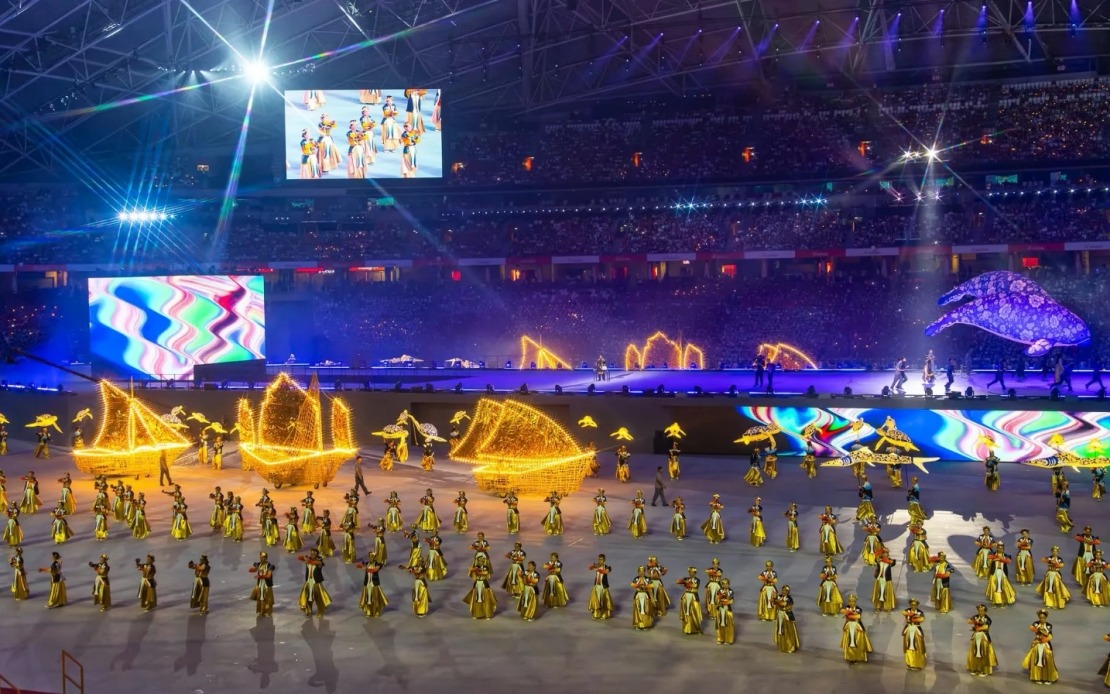
Singapore's 61st National Day celebrations on Sunday marked a significant milestone with the restoration of the National Day Parade to the National Stadium, ending a ten-year hiatus from the iconic venue. The event, held under the inspiring theme "Majulah Singapura, Go Beyond!", reunited the republic's political leadership and thousands of citizens in a vibrant display of patriotism and national pride. President Tharman Shanmugaratnam and Prime Minister Lawrence Wong, accompanied by Cabinet ministers and parliamentary members, presided over the ceremonies alongside approximately 42,000 members of the public who filled the stadium dressed in the national colours of red and white.
The revival of the National Day Parade at its traditional home represents more than merely a logistical shift; it signals Singapore's confidence in gathering large crowds for major national occasions and reflects the city-state's desire to reconnect with ceremonial traditions that strengthen collective identity. After a decade of alternative venues and modified formats, the decision to return to the National Stadium demonstrates the authorities' commitment to restoring grand public ceremonies as centrepieces of national celebration. This return occurs within the broader context of Southeast Asian nations reaffirming their institutional ceremonies and public gatherings as expressions of national cohesion and cultural continuity.
A striking innovation characterised this year's observance: the Presidential Gun Salute and State Flag Flypast were relocated to Kallang Basin, creating an expanded ceremonial experience that extended far beyond the confines of the stadium itself. This geographical expansion allowed the traditional military salute to be viewed by spectators positioned throughout the wider Kallang precinct, democratising access to these ceremonial moments and creating a more inclusive national celebration. Four 25-pounder Howitzer guns, mounted on Mobility 3rd Generation rafts, navigated the basin waters in a coordinated display that brought the pageantry to thousands of additional observers who gathered across the surrounding area.
The military dimension of the celebrations showcased the precision and coordination of Singapore's armed forces. The traditional 21-gun salute drew participation from 151 service members drawn from the 23rd Battalion of the Singapore Artillery and the 35th Battalion of Singapore Combat Engineers. This substantial military presence underscored the historical role of the Singapore Armed Forces in the nation's development and security, whilst demonstrating the integration of military personnel into civilian national occasions. The ceremonial structure reflected Singapore's constitutional framework, wherein the armed forces occupy a prominent symbolic position within national identity and governance.
The parade and ceremony segment commenced at approximately 6 p.m. and unfolded under the subsidiary theme "Go Beyond Self", which oriented the entire spectacle towards values of individual and collective transcendence. The segment assembled 32 contingents encompassing more than 2,000 participants, representing a comprehensive cross-section of Singapore's institutional and civil society landscape. These contingents comprised six Guard of Honour units escorting the Singapore Armed Forces Colours Party, ten uniformed youth organisations, and sixteen supporting contingents. The Guard of Honour contingents themselves embodied institutional diversity, drawing 72 participants from the Singapore Army, Republic of Singapore Navy, Republic of Singapore Air Force, Digital and Intelligence Service, Singapore Police Force, and Singapore Civil Defence Force.
The performance segment that followed centred entirely on the overarching "Go Beyond!" theme and featured 36 professional artistes alongside more than 2,600 performers drawn from the broader population. This massive ensemble production sought to narrate authentic Singaporean stories whilst incorporating cutting-edge technological innovation alongside a carefully composed musical score. The scale of participation—involving thousands of performers alongside professional entertainment—reflected the organisational sophistication required to stage contemporary national ceremonies in a city-state of Singapore's density and complexity.
A particularly noteworthy dimension of this year's show segment involved deliberate inclusion of performers with diverse abilities and backgrounds. The organisers featured seven dancers from varied demographic and ability categories, including an autistic dancer and a dancer with Down syndrome. This programming choice carried explicit symbolic weight, as the authorities framed these performances as demonstrations of how every Singaporean, irrespective of background, circumstance, or physical capacity, can meaningfully participate in shaping the nation's collective future. The inclusion strategy reflected contemporary international discourse on inclusive governance and social participation, positioning Singapore as attentive to disabilities rights and inclusive representation within national symbolism.
For Malaysian observers, Singapore's National Day celebration offers several points of comparative reflection. Both nations share postcolonial histories of nation-building and institutional consolidation, though through divergent constitutional frameworks and multicultural compositions. Singapore's ability to orchestrate such large-scale public ceremonies with apparent seamless coordination reflects the administrative capacities developed through decades of centralised governance. The emphasis on technological innovation, inclusive participation, and carefully curated messaging within ceremonial contexts demonstrates how city-states in the region employ national occasions as opportunities to reinforce particular narratives about progress, unity, and collective purpose.
The decision to return the National Day Parade to the National Stadium after a decade-long absence also carries subtle political messaging about public confidence and institutional stability. The gathering of 42,000 spectators in a confined venue during contemporary times carries implications about perceived public safety and the willingness of citizens to participate in concentrated civic gatherings. This willingness itself reflects broader assessments of social cohesion and trust in government institutions to manage large public assemblies. For a small island nation with limited geographic space and high population density, the successful execution of such events depends upon remarkable coordination between civilian administration, military apparatus, and voluntary public participation.
The structural composition of the ceremonies—with their emphasis on uniformed services, youth organisations, and carefully selected performers—reveals the continuing importance of state-directed institutional participation in Singapore's national celebrations. Unlike some democracies that emphasise spontaneous or bottom-up celebration, Singapore's National Day reflects a more choreographed approach wherein state institutions, civil society organisations, and civilian participants operate within defined frameworks and structured participation. This organisational model reflects Singapore's distinctive approach to governance and public life, wherein coordination and planning serve as prerequisites for successful large-scale civic occasions.
The 61st National Day observance occurred within a broader regional context of Southeast Asian nations negotiating questions of national identity, economic development, and international positioning. Singapore's celebration of six decades of independence carried particular resonance given the nation's transformation from a colonial trading post into one of the world's wealthiest and most advanced economies. The ceremony's themes of "going beyond" and transcending individual limitations aligned with Singapore's ongoing emphasis on innovation, adaptation, and positioning itself at the forefront of technological and economic development within the region. These aspirational elements in ceremonial messaging serve to reinforce governmental priorities and national development strategies to both domestic and international audiences.
The inclusion of technological innovation within the performance segment reflected Singapore's strategic self-positioning as a forward-looking society embracing digital transformation and advanced technological systems. This emphasis on innovation within a ceremonial context demonstrates how modern nation-states integrate economic and technological narratives into the symbolic fabric of national identity. For Singapore, where economic competitiveness and technological advancement form core pillars of national strategy, embedding these themes within National Day celebrations serves to reinforce their centrality to national purpose and identity. The elaborate ceremonial apparatus thus functions simultaneously as celebration, institutional demonstration, and strategic communication about national priorities and capabilities.

