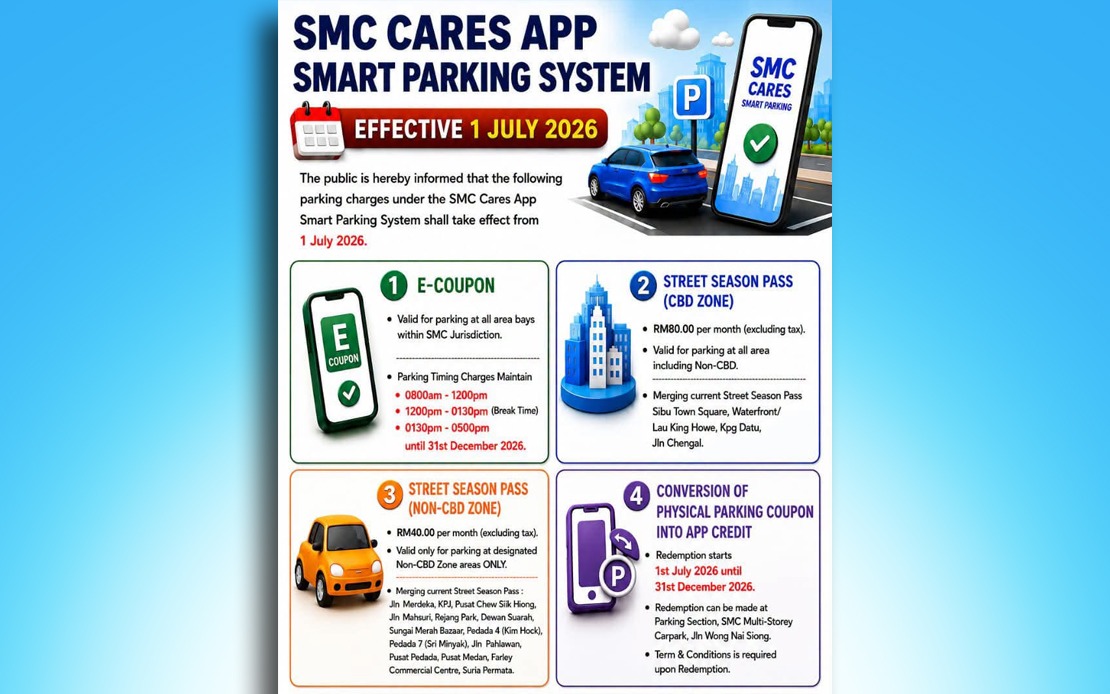
The Sibu Municipal Council has announced significant modifications to its troubled smart parking enforcement system, introducing a grace period of five to ten minutes before parking notices are issued and launching a dedicated senior citizen pass scheme. The moves represent a direct response to mounting public frustration with the SMC Cares Smart Parking system since its full rollout earlier this month, with thousands of users taking to social media to voice complaints about premature compounds, technical glitches, and accessibility barriers.
Chairman Clarence Ting Ing Horh acknowledged during a media briefing that the council had fundamentally underestimated user requirements when the system went live. The grace period will provide motorists adequate time to exit their vehicles and complete the mobile application activation process before enforcement begins, addressing one of the most contentious issues—notices being issued within seconds of parking. This adjustment signals a shift from rigid compliance to pragmatic implementation, a lesson increasingly relevant for Malaysian local authorities rolling out digital infrastructure across the country.
The council has tasked system provider Primal Solution Sdn Bhd with implementing the grace period framework, acknowledging that the original design prioritised technical compliance over user experience. Ting emphasised that the goal was fostering public cooperation rather than extracting revenue through penalties, a statement that implicitly critiques the perception that the system was weaponised against motorists. For other Malaysian municipalities considering similar smart parking deployments, Sibu's experience underscores the importance of beta testing with representative user groups before full implementation.
The Senior Citizen Parking Pass initiative, launching in August, addresses specific accessibility concerns raised by elderly residents struggling with app-based payment systems. While Ting deferred detailed specifications to a later announcement, the recognition that demographic-sensitive solutions are necessary reflects evolving administrative thinking about digital service delivery. In Malaysia's rapidly ageing population, such provisions may become standard requirements rather than optional amenities for local authorities implementing automated systems.
Ting also clarified the council's appeals mechanism, emphasising that motorists believing notices were issued erroneously—whether through registration number mistakes or other legitimate circumstances—can submit formal challenges for council review. This procedural transparency is crucial, given that photographic evidence underpins each notice in the system. The approach mirrors administrative best practices found in more mature municipal systems, though the clarity should arguably have been communicated during the initial rollout rather than in damage control mode.
Among the more contentious issues addressed was the distinction between parking enforcement and general traffic violations. Ting categorically stated that contracted parking wardens are authorised only for parking-specific breaches such as non-payment, overstaying, and overpayment violations, while illegal parking and obstruction cases remain under SMC's enforcement division and police jurisdiction. This clarification refutes social media allegations that private contractors were overstepping their remit, a critical point for public trust in the system.
The council introduced additional measures to improve wardens' interactions with the public, instructing contractors to enhance approachability and coaching staff to assist unfamiliar users. Notably, wardens have been directed to avoid face coverings unless medically necessary, enhancing identifiability and accountability—a small but symbolically important gesture acknowledging public concerns about anonymity in enforcement operations. A dedicated assistance counter at Sibu Public Library now provides hands-on guidance for system registration and usage, partially addressing the complicated onboarding process that deterred many users.
Ting defended Sibu's parking rates as competitive relative to other Sarawak municipalities, preempting criticism that fees were excessive. Importantly, he clarified that parking revenue flows directly to SMC, while the contractor receives separate service compensation, dispelling concerns that privatisation had inflated charges. This revenue model distinction is vital context often missing from public discourse, as it explains why councils pursue such systems—genuine fiscal necessity rather than opportunistic profiteering.
The SMC Cares system has already achieved 93,000 user registrations since introduction, with council projections suggesting the 100,000 target will be surpassed by year-end. This adoption trajectory, despite widespread complaints, indicates that motorists recognise the system's underlying utility despite its operational teething problems. The real challenge lies in converting early adopters into satisfied, habitual users—a transition requiring the refinements now being announced.
Widespread user grievances encompassed multiple layers: cumbersome registration procedures particularly punitive for older citizens, unintuitive interface design, sluggish system performance, unexpected logouts, payment processing delays, and the premature issuance of compounds before transactions completed. These are not minor inconveniences but fundamental failures of user-centred design. For Malaysian city planners considering smart parking systems, Sibu's experience provides a cautionary template—technology deployment must prioritise usability parity across demographic groups, particularly for essential services like parking.
The council's invitation for direct feedback represents a tacit acknowledgment that social media criticism, while sometimes unverified, often reflects genuine user pain points. Rather than dismissing online complaints, SMC is attempting to harness this feedback for system improvement—an increasingly necessary stance as civic participation channels shift toward digital platforms. This pragmatic engagement approach may prove more effective than traditional complaint mechanisms in addressing digital service grievances.
Sibu's recalibrations offer lessons extending beyond Sarawak's boundaries. As Malaysian municipalities accelerate smart city initiatives, the imperative for staged implementation with robust user testing, demographic-sensitive design, transparent appeals processes, and genuine feedback integration becomes increasingly obvious. Technology itself is value-neutral; how councils deploy it reflects underlying administrative philosophy. Sibu's course corrections suggest a gradual movement toward user-centric governance, though earlier implementation of these safeguards would have avoided months of public friction and erosion of municipal credibility.

