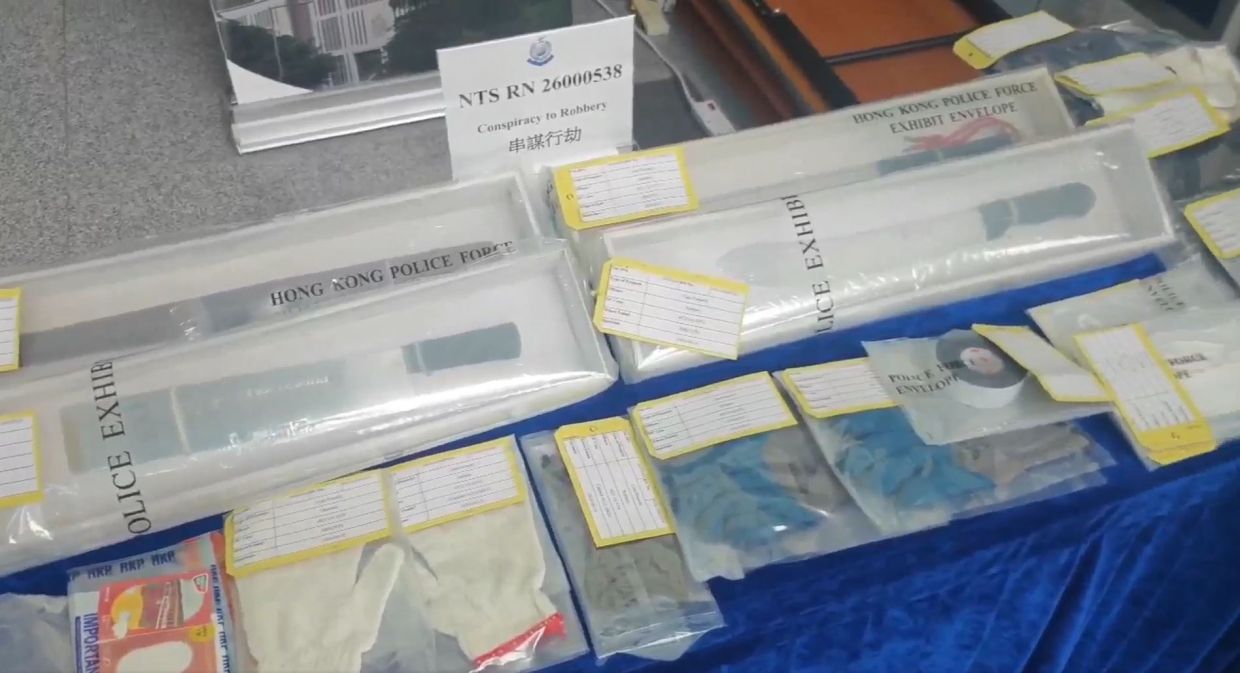
Police in Hong Kong have moved swiftly to round up suspects following a brazen daylight robbery at the airport's car park on Thursday that left a man injured and HK$7 million in gold bars missing. Within just 12 hours of the crime being reported, officers apprehended four men and three women aged between 20 and 39 on suspicion of conspiracy to commit robbery and criminal abetting. The rapid arrests underscore the police force's determination to clamp down on organized gang violence that continues to plague the city despite decades of efforts to dismantle triad operations.
The incident unfolded when the victim, who had travelled from Bali in Indonesia carrying six gold bars for a mainland businessman, became the target of a coordinated assault near car park 3 at Hong Kong International Airport. As he walked towards his vehicle early Thursday morning, three masked attackers wielding knives set upon him, inflicting stab wounds to his left hand and foot before making off with his backpack. The attackers fled in a seven-seater vehicle, demonstrating a level of planning and resource allocation that suggests professional involvement rather than opportunistic street crime. The victim subsequently received treatment at Princess Margaret Hospital and is reported to be in stable condition.
Investigators have already made significant progress in recovering evidence related to the crime. Police located and seized the seven-seater vehicle used in the escape in Tsuen Wan, as well as the knives employed during the attack. These recoveries form crucial components of the prosecution case and may yield forensic evidence linking suspects to the scene. The speed of vehicle recovery indicates that either informants within criminal networks provided tips or that police surveillance and intelligence gathering capabilities proved effective in tracking the perpetrators' movements.
Detailed investigations have revealed troubling links to organized crime, with some of the arrested individuals having documented connections to triad societies. However, investigators believe that several key conspirators remain at large and may have slipped across the border into mainland China, exploiting the relative ease of movement between Hong Kong and Guangdong province. Police have formally requested assistance from mainland law enforcement authorities to locate and apprehend the remaining suspects, reflecting the cross-border nature of modern organized crime in the Greater Bay Area. Such coordination between Hong Kong and mainland Chinese police agencies has become increasingly routine as crime syndicates become more sophisticated in their operations.
What distinguishes this case from random street robbery is evidence suggesting inside knowledge of the victim's movements and cargo. Investigators have concluded that the crime was not random but rather meticulously planned by individuals who possessed specific intelligence about the victim's arrival flight, the route he would take through the airport, and his intended parking location. This strongly indicates the involvement of an insider who had access to either flight information or airport operations data. The possibility of collusion among airport staff, ground handlers, or related service providers has prompted heightened security reviews throughout Hong Kong International Airport's operations and personnel vetting procedures.
The case highlights vulnerabilities in airport security despite Hong Kong's reputation as a safe, orderly city with strong law enforcement. The presence of armed gang members able to execute a violent robbery in broad daylight at one of Asia's busiest transportation hubs raises serious questions about perimeter security, CCTV coverage in car parks, and the adequacy of protective measures for high-value cargo movements. Airport authorities will likely face pressure to review security protocols and potentially increase uniformed police presence or armed security contractors in parking facilities. The incident also serves as a cautionary tale for business travelers and those transporting valuables through the airport.
From a regional perspective, the heist underscores the enduring challenge of organized crime networks operating across Southeast Asia and Greater China. The connection to a mainland businessman receiving goods through Hong Kong illustrates how the territory continues to function as a crucial transshipment point for valuable goods moving between international markets and the Chinese mainland. Criminal networks exploit Hong Kong's position as a global financial center and its connections to international trade routes. The sophistication displayed in planning this robbery—from reconnaissance to vehicle acquisition to cross-border escape—demonstrates that organized crime groups operating in the region possess substantial resources and operational capabilities.
The involvement of both male and female suspects is noteworthy, as it reflects the increasingly diverse composition of contemporary organized crime syndicates. Women playing active roles in violent crime represents a shift from traditional triad hierarchy and suggests that criminal organizations are adapting recruitment and operational strategies to overcome law enforcement pressure. This diversification may actually make organized groups harder to identify and penetrate using conventional intelligence methods based on male-dominated gang structures.
The investigation also raises important questions about airport cargo security and the movement of precious metals through Hong Kong's transportation infrastructure. Individuals regularly pass through the airport carrying high-value items without adequate protection, making them vulnerable to organized criminals who maintain networks capable of identifying and tracking such opportunities. Whether through legitimate business channels or informal trade networks, the movement of gold bullion through Hong Kong continues to represent a significant criminal opportunity. Authorities may need to implement enhanced advisory systems to warn travelers about security risks and encourage use of specialized secure transport services for valuable cargo.


%22%2F%3E%3C%2Fpattern%3E%3C%2Fdefs%3E%3Crect%20width%3D%22100%25%22%20height%3D%22100%25%22%20fill%3D%22url(%23ph25l6fg)%22%2F%3E%3Crect%20width%3D%22100%25%22%20height%3D%22100%25%22%20fill%3D%22url(%23ph25l6fp)%22%2F%3E%3Ctext%20x%3D%2250%25%22%20y%3D%2250%25%22%20text-anchor%3D%22middle%22%20dominant-baseline%3D%22central%22%20fill%3D%22rgba(255%2C255%2C255%2C0.95)%22%20font-family%3D%22Georgia%2C%20'Times%20New%20Roman'%2C%20serif%22%20font-weight%3D%22700%22%20font-size%3D%22272%22%20letter-spacing%3D%22-0.02em%22%3EAnwar%3C%2Ftext%3E%3C%2Fsvg%3E)