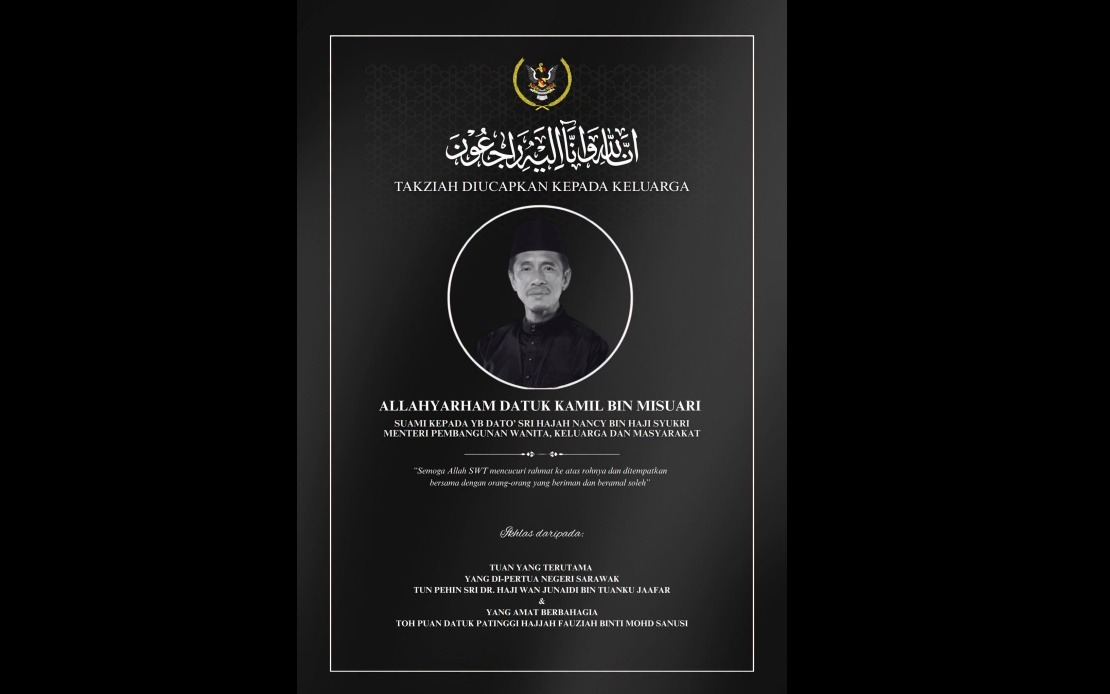
The Yang Dipertua Negeri Sarawak, Tun Dr Wan Junaidi Tuanku Jaafar, has conveyed his sympathies to Women, Family and Community Development Minister Datuk Seri Nancy Shukri following the passing of her husband, Datuk Kamil Misuari, on June 18. The 65-year-old passed away at a hospital in Kuala Lumpur this evening, with an official statement released by the Office of the Minister confirming the loss.
In response to the family's bereavement, Tun Dr Wan Junaidi issued a formal statement through Astana Sarawak expressing his and his wife Toh Puan Fauziah Mohd Sanusi's deepest sentiments during this difficult period. The statement reflected the customary expressions of sympathy extended by senior officials in Malaysia when significant losses occur within ministerial families or the wider political community.
The Sarawak Governor and his spouse offered prayers that Allah SWT would bestow blessings upon the deceased, accept his righteous deeds, and grant him a place among the righteous in the hereafter. Such spiritual affirmations form a central part of the Islamic tradition observed across Malaysia and represent the standard approach taken by high-ranking government officials when offering condolences to bereaved families within the civil service.
Beyond spiritual sentiments, Tun Dr Wan Junaidi and Toh Puan also prayed for divine strength and resilience for Datuk Seri Nancy and her extended family as they navigate the profound grief accompanying such a loss. The statement particularly emphasised prayers for patience and fortitude, recognising the emotional and practical challenges that lay ahead for the bereaved household during this transitional period.
The late Datuk Kamil Misuari had been married to Nancy since 1985, building a partnership spanning nearly four decades. Throughout their marriage, the couple were blessed with three children who will now adjust to life without their father. The longevity of their union underscores the depth of loss that the family will experience, particularly for a public figure managing ministerial responsibilities while processing personal tragedy.
Arrangements have been made to repatriate the deceased to Sarawak, his home state, where final rites will be conducted according to Islamic custom. The remains will be transported to Kuching on June 19, followed by a funeral service and burial at Samariang Muslim Cemetery. This arrangement reflects the family's commitment to honouring traditional practices and allowing local communities in Sarawak to pay their respects.
For Datuk Seri Nancy Shukri, this loss arrives during her tenure as Women, Family and Community Development Minister, a portfolio requiring significant personal attention and engagement with diverse stakeholder groups. The timing of such a personal tragedy presents considerable challenges for any public servant, particularly one holding a cabinet-level position with substantial administrative and public-facing responsibilities.
The passing of Datuk Kamil Misuari represents a moment of collective reflection within Malaysia's political and administrative circles, where support systems and expressions of solidarity become particularly important. Government officials at various levels have traditionally used such moments to reinforce bonds of fellowship and demonstrate the human dimensions underlying institutional structures.
Within the Malaysian context, where family and community support networks play essential roles in individual wellbeing, the broader significance of this loss extends beyond the immediate family circle. The public acknowledgment of bereavement by high-ranking officials serves both to honour the deceased and to recognise the resilience required of those continuing their public duties while managing personal loss.
The Governor's statement represents the formal recognition expected within Malaysia's constitutional framework, where the Yang Dipertua Negeri holds ceremonial and representative responsibilities encompassing expressions of national sympathy during moments of loss. Such gestures, though formal in nature, acknowledge the shared human experiences that transcend political and administrative hierarchies.