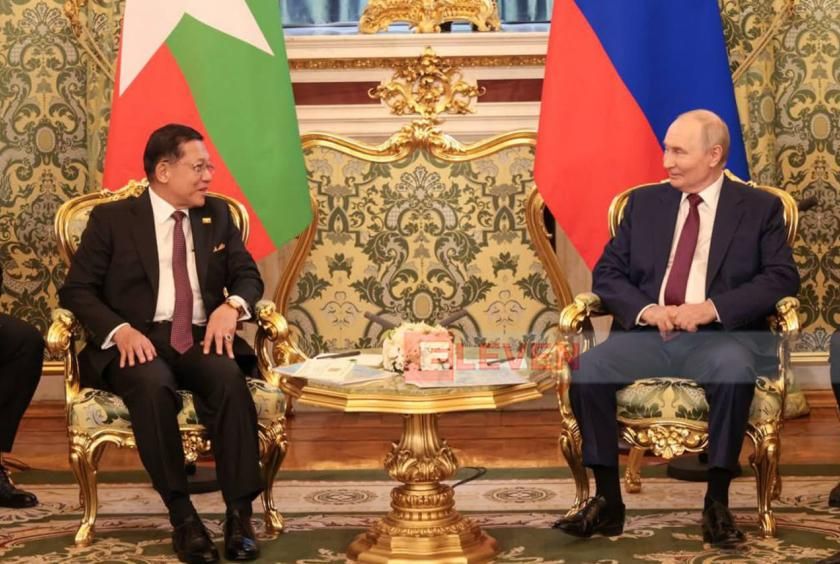
Moscow has signalled its commitment to deepening strategic ties with Myanmar across multiple sectors, with Russian President Vladimir Putin offering Russian expertise and investment in natural resource exploration, offshore oil and gas development, and liquefied natural gas exports during high-level talks with Myanmar President U Min Aung Hlaing in mid-August. The energy partnership represents a cornerstone of bilateral engagement, with Putin emphasising that resource cooperation and power generation projects will anchor the relationship between the two nations moving forward.
The meeting between the two leaders underscored the historical foundations of Russian-Myanmar relations, which trace back to the Soviet era when Moscow provided substantial development assistance across social, economic and defence sectors during the 1950s and 1960s. Putin highlighted the enduring legacy of that period, noting that hospitals and educational institutions built during the Soviet years continue to serve Myanmar's population. This historical narrative has become central to Moscow's pitch to Yangon, positioning Russia as a long-standing partner with demonstrated commitment to Myanmar's development rather than a newcomer seeking access to resources.
Energy cooperation stands at the forefront of the expanded partnership framework. Beyond traditional hydrocarbon exploration, Putin indicated Russian readiness to export liquefied natural gas to Myanmar, with potential applications extending beyond domestic consumption to regional markets. The Russian leader also referenced ongoing coal-fired power plant and oil refinery projects already in operation, suggesting momentum in the energy sector that predates this announcement. Notably, the two countries have previously signed an agreement on nuclear power plant construction, which Putin characterised as a flagship undertaking with significant long-term implications for Myanmar's energy independence and technological advancement.
The infrastructure dimension of the partnership extends well beyond energy. Putin enumerated multiple industrial projects at various stages of development, including steel and fertiliser manufacturing facilities that would deepen Myanmar's industrial capacity. Most significantly, Russia and Myanmar are discussing construction of a deep-sea port in southern Myanmar, a project with substantial geopolitical implications given Myanmar's strategic location on shipping lanes between the Indian Ocean and Southeast Asian maritime passages. Such port infrastructure would enhance Myanmar's connectivity to global trade networks while potentially serving Russian commercial and strategic interests in the region.
Digital and high-technology cooperation represents an emerging frontier in the bilateral relationship. Putin specifically mentioned Russian corporate proposals spanning cybersecurity, digital sector development and other advanced technology fields, areas where Myanmar seeks to modernise its infrastructure and regulatory frameworks. The 2025 space cooperation agreement further demonstrates ambitions to collaborate in cutting-edge domains that require sustained investment and technical transfer. These initiatives suggest Russia views Myanmar not merely as a resource partner but as a potential technology market and testing ground for Russian innovation exports.
Human capital exchange and cultural dimensions underscore the comprehensive nature of the engagement strategy. Putin noted that a visa-free arrangement facilitates movement of scientists, students, athletes and tourists between the two nations, while 400 Myanmar students currently study at Russian universities and approximately 17,000 have graduated from Russian institutions historically. The expansion of Russian language instruction at Myanmar universities and military academies, combined with planned Russian Orthodox Christian church construction in Yangon, indicates cultural and religious dimensions to the partnership. A new Myanmar consulate in Vladivostok and existing Myanmar cultural centres in Russian regions suggest mutual investment in permanent diplomatic and cultural infrastructure.
Military-technical cooperation constitutes another critical pillar of the relationship. Putin highlighted frequent military exercises conducted in Myanmar's waters and regular visits by Russian naval vessels, indicating a security dimension that complements economic engagement. This military component assumes particular significance given Myanmar's strategic position, its ongoing domestic political challenges, and regional security dynamics in Southeast Asia. The military relationship provides Russia with enhanced regional presence while offering Myanmar access to Russian defence technology and expertise.
The 12 memorandums of understanding signed during this visit formalise commitments across these multiple domains. Rather than singular agreements, the breadth of documents suggests systematic institutional coordination mechanisms being established to implement the expanded partnership. These formal instruments indicate both sides intend serious follow-through rather than purely rhetorical commitments. The timing and comprehensiveness of these agreements also reflect Russia's strategic interest in maintaining influence in Southeast Asia at a moment when international alignments face considerable flux.
For Malaysian observers and the broader Southeast Asian region, this deepening Russia-Myanmar partnership merits careful attention. Enhanced Russian presence and infrastructure development in Myanmar could reshape regional strategic dynamics, influence maritime security considerations, and affect supply chains and energy markets across Southeast Asia. Myanmar's role as a gateway between South Asia and Southeast Asia means that major infrastructure projects there carry implications extending well beyond bilateral relations. Furthermore, the energy cooperation arrangements, particularly regarding natural gas, could influence regional energy security and pricing dynamics that affect Malaysia's own energy interests and exports.
The partnership also reflects Russia's broader strategy of maintaining influence in Asia at a time when Western sanctions and geopolitical isolation have incentivised Moscow to deepen ties with non-Western partners. Myanmar's strategic location, natural resources, and complex international position make it an attractive partner for Russian investment and cooperation. However, the sustainability of this partnership depends on Myanmar's political trajectory and its capacity to implement infrastructure projects amid domestic challenges and governance constraints.
Moscow's willingness to engage in long-term infrastructure development and technology transfer suggests confidence in Myanmar's stability and governance. The nuclear power agreement, in particular, represents a high-stakes commitment that typically requires substantial international oversight and technical capacity. Such projects signal Russian confidence in Myanmar's ability to absorb and operate advanced technologies, even as the country navigates significant domestic political transitions and institutional development needs.
For regional economies including Malaysia, the implications extend to supply chain dynamics, energy markets, and the broader question of how Southeast Asian countries navigate relationships with major powers during periods of international strategic competition. Myanmar's deepening ties with Russia demonstrate how regional states seek to maintain multiple partnerships and maximise economic opportunities, even as geopolitical tensions elsewhere create pressures for alignment. Understanding these dynamics proves essential for Malaysian policymakers assessing regional trends and their potential impact on Malaysian interests in energy security, maritime safety, and regional economic integration.

