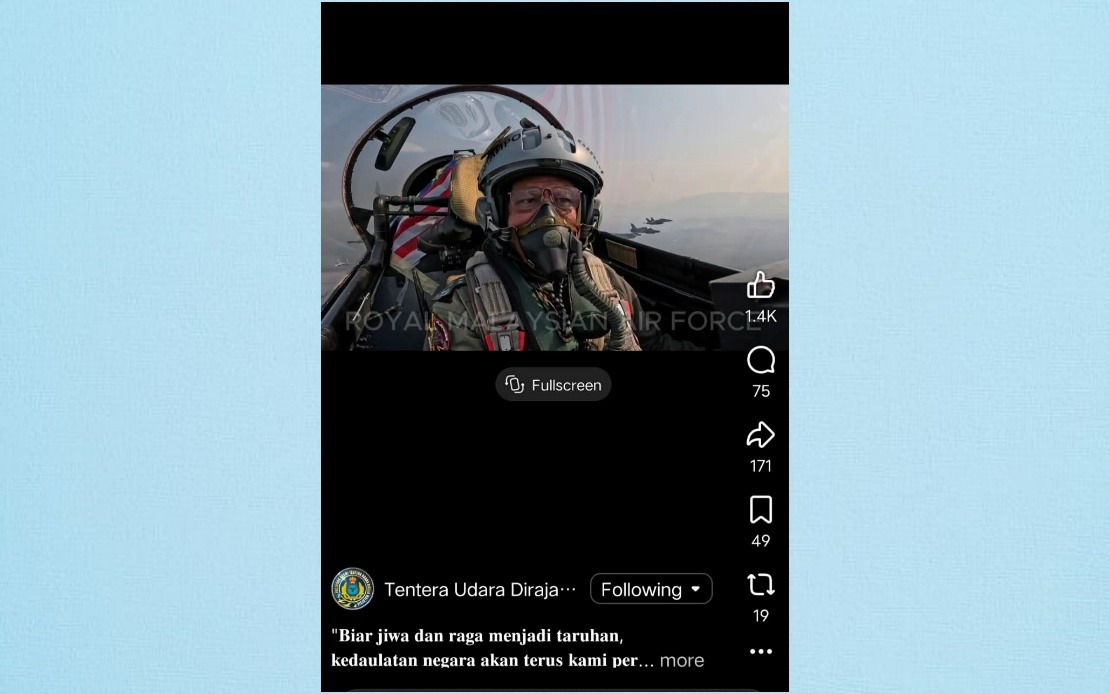
The skies above Putrajaya resonated with the distinctive roar of military aircraft on August 31 as the Royal Malaysian Air Force delivered a high-octane aerial spectacle marking the nation's 69th National Day. The meticulously choreographed ten-minute display, which commenced at 9.30 am, represented one of the centrepiece events of the day's celebrations at Dataran Putrajaya, drawing thousands of spectators eager to witness the extraordinary coordination and technical prowess of Malaysia's air arm.
General Tan Sri Muhamad Norazlan Aris, the RMAF chief, once again demonstrated his operational credentials by personally assuming the pilot seat of a Sukhoi Su-30MKM fighter jet to lead the entire formation. This marked the second consecutive year that the service chief has taken on this high-profile role, underscoring the symbolic importance placed on senior military leadership directly participating in such national showcases rather than merely observing from the ground. His decision to fly exemplifies a hands-on approach to military command and sends a powerful message regarding the professional standards and readiness of the service.
The fighter complement comprised a formidable array of contemporary combat aircraft. Four Sukhoi Su-30MKM multirole fighters, which represent the backbone of Malaysia's air superiority capabilities, formed the core of the aerial demonstration. These were complemented by four F/A-18D Hornet strike fighters, among the most advanced platforms in the RMAF inventory, and three BAE Hawk 208 lead-in fighter trainers. The selection of these particular aircraft types reflected deliberate choices to showcase different operational roles within the air force, from air-to-air combat capabilities to ground attack and training functions.
The display's choreography highlighted the technical sophistication achievable through coordinated flight operations. Specially trained pilots executed four distinct formation types—the Kite, Diamond, Delta and Victory Combine formations—each requiring precise spatial awareness, split-second timing, and extensive prior rehearsal. These formations serve dual purposes: they demonstrate the exceptional skill levels within the pilot corps while simultaneously providing tangible evidence of the operational readiness and cohesion that characterise a professional military air arm.
Much of the spectacle's impact derived from the professional commentary provided throughout the performance. Major Patrick Dinnesh, Major Neny Suhaida Ab Suki, and Captain Muhammad Iqbal Nasrudin offered running narration that educated spectators about the aircraft types, the complexities of the manoeuvres being executed, and the operational contexts in which such formations function. This explanatory layer transformed what might have been merely impressive acrobatic displays into an informative experience that helped civilian audiences understand military aviation capabilities and the technical demands placed on aircrew.
Following the fighter jet segment, the RMAF transitioned the display's focus to underscore its broader logistical and support capabilities. The C-130H Hercules, a venerable tactical transport aircraft that has served Malaysia faithfully for decades, flew in formation alongside the more modern A400M Atlas and the smaller CN235 transport. These aircraft physically demonstrated the RMAF's ability to project power and deliver supplies across the archipelago—capabilities that extend beyond combat operations to encompass disaster relief, humanitarian assistance, and national development missions that resonate directly with civilian populations.
Helicopter operations added further dimension to the demonstration. The EC725 and AW139 rotorcraft operated by the RMAF performed coordinated flying that highlighted the service's vertical lift capabilities, essential for search and rescue operations, personnel transport, and fire support missions. Notably, these helicopters flew in formation alongside assets from partner services—the Malaysian Army, Royal Malaysian Navy, Fire and Rescue Department, and Royal Malaysia Police—visually reinforcing the concept of inter-service cooperation and joint military-civilian operational capabilities that characterise modern disaster management and national security responses.
The aerial spectacle generated palpable excitement among the assembled crowds. Thousands of spectators maintained focused attention on the skies throughout the entire sequence, their attention captured by the combination of sheer auditory impact—the thunderous engine noise of high-performance military jets—and the visual drama of precisely coordinated manoeuvres. For many Malaysians, such displays provide rare opportunities to witness their military capabilities firsthand, fostering a connection between the general public and the armed services that extends beyond abstract concepts of national defence.
The integration of diverse aircraft types and service branches reflected deliberate messaging about national defence beyond the RMAF's immediate remit. By incorporating Malaysian Army, Navy, police, and fire rescue assets, the display communicated that national security encompasses far more than traditional military-versus-military confrontation. The choreography implicitly acknowledged that contemporary threats often involve natural disasters, humanitarian crises, and transnational challenges requiring seamless coordination across institutional boundaries.
For observers tracking Malaysian military capabilities, the air display offered substantive data points regarding platform availability and operational currency. The simultaneous deployment of multiple Su-30MKMs, Hornets, and transport aircraft suggested healthy serviceability rates—a non-trivial achievement for mid-range air forces managing complex equipment inventories. The presence of recently acquired A400M platforms, which Malaysia introduced to gradually replace aging C-130H fleets, signalled ongoing modernisation efforts despite budgetary constraints typical across Southeast Asian defence establishments.
The spectacle's political dimensions warrant consideration within Malaysia's broader security landscape. Public demonstrations of military capability, particularly those led visibly by senior commanders, serve multiple audiences simultaneously. Domestically, such displays reinforce public confidence in institutional capacity to protect national interests. Regionally, they signal to neighbouring states and potential strategic competitors that Malaysia maintains credible air capabilities and professional military structures. In an era of intensifying great power competition throughout Southeast Asia, maintaining visible credible deterrence carries strategic weight.
Beyond the immediate National Day context, the air display reflected current thinking within the RMAF regarding force presentation and public engagement. Rather than treating military operations as exclusively classified or obscure, the service recognised value in transparent public demonstration of capabilities. This approach supports recruitment efforts, fosters civil-military cohesion, and demonstrates taxpayer value by showing concrete outcomes from defence expenditure—considerations increasingly important as Malaysian decision-makers grapple with competing budgetary demands across health, education, and infrastructure sectors.

