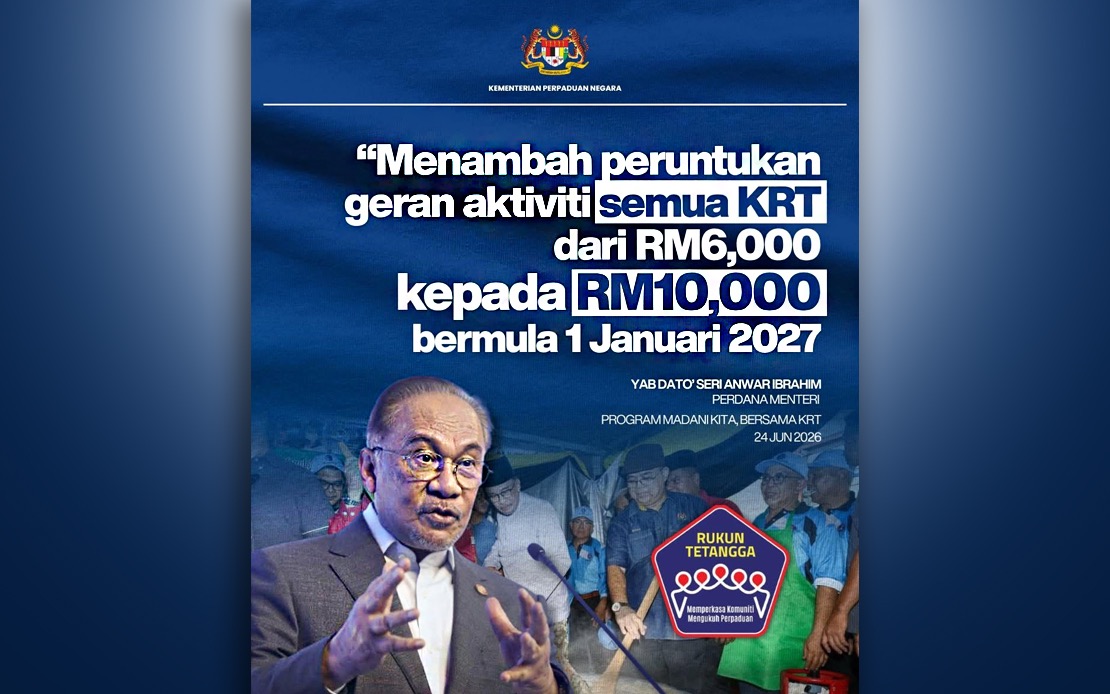
The government has significantly increased its financial support for neighbourhood watch groups across Malaysia, a move that will directly strengthen community organising capacity in every district. The annual grant for Kawasan Rukun Tetangga (KRT)—the formal neighbourhood watch network—has been raised from RM6,000 to RM10,000, benefiting all 8,615 registered KRT areas nationwide. The increase takes effect from January 1, 2027, and was announced by Prime Minister Datuk Seri Anwar Ibrahim during the MADANI KITA programme held in Dataran Segamat, Johor, on June 24.
National Unity Minister Datuk Aaron Ago Dagang framed the decision as recognition of the KRT's pivotal contribution to Malaysian society over the past fifty years. Speaking through a formal statement, Aaron emphasised that the higher grant allocation reflects the MADANI Government's broader commitment to empowering community-level organisations, which he characterised as the foundational engine for building social cohesion and advancing national development objectives. The KRT system, which involves approximately 250,000 members, currently reaches more than 12 million Malaysians through structured community activities, making it one of the most expansive grassroots networks in the nation.
The financial injection carries substantial implications for the scope and quality of neighbourhood initiatives. With an additional RM4,000 per KRT area annually, these groups will have greater flexibility to expand their programming across multiple domains including unity-focused events, community welfare schemes, educational support, local security arrangements, voluntary service projects, and micro-economic initiatives that empower residents. According to Aaron, the expanded budget will enable KRT clusters to design and execute higher-impact interventions that address specific neighbourhood priorities rather than relying on minimal baseline funding that constrains programme ambition.
Over the past year alone, KRT groups orchestrated more than 100,000 community activities, demonstrating remarkable operational reach despite constrained resources. The grant increase acknowledges this track record while positioning KRT to scale up proven models of neighbourhood engagement. Aaron stressed that the additional funding must be utilised strategically to maintain KRT's effectiveness as a vehicle for social trust-building and inter-community understanding, rather than becoming dispersed across routine administrative costs. The Ministry of National Unity is expected to establish oversight mechanisms ensuring optimal deployment of the new resources.
The neighbourhood watch system holds particular significance within Malaysia's multicultural context. KRT operates as a deliberate platform for fostering relationships across ethnic, religious, and socioeconomic boundaries at the most intimate level of society. Aaron's public comments underscored this dimension, arguing that strong neighbourly bonds regardless of identity markers represent Malaysia's fundamental competitive advantage as a diverse nation. By investing in KRT, the government is effectively investing in the social infrastructure that prevents fragmentation and builds the interpersonal trust necessary for national stability.
This funding announcement also reflects broader government strategy around the MADANI framework, which emphasises inclusive development, democratic participation, and strengthened social institutions. Rather than concentrating resources in centralised programmes, the approach delegates implementation to decentralised community structures with direct accountability to residents. The KRT increase fits within this philosophy of empowering local actors to solve local problems through community consensus and collective action.
For residents in both urban and rural contexts, the practical impact will be tangible. Neighbourhood watch groups will be able to organise more frequent community dinners and cultural celebrations that build social cohesion, establish more comprehensive security patrols and neighbourhood safety initiatives, provide better targeted assistance to vulnerable residents including elderly persons and low-income families, and support youth engagement programmes that channel energies toward constructive community service. These activities, multiplied across 8,615 KRT areas, create a nationwide infrastructure for preventive social cohesion work that complements formal government services.
The timing of the announcement—mid-2024 with implementation in early 2027—provides KRT groups adequate planning horizon to design expanded programmes and develop implementation capacity. Local KRT leaders will need to engage residents in priority-setting processes to ensure that new funding aligns with neighbourhood-specific needs rather than becoming generic across all areas. This requires transparent dialogue between KRT leadership, local residents, and municipal authorities to coordinate complementary initiatives and avoid duplication with other government programmes operating at the neighbourhood level.
Southeast Asian governments increasingly recognise that social stability depends on functional community institutions rather than state presence alone. Malaysia's KRT system, now bolstered with enhanced funding, exemplifies this understanding. The grant increase signals that the government views neighbourhood-level organising as critical infrastructure deserving dedicated investment, comparable to physical infrastructure or human capital development. For other Southeast Asian nations considering similar community strengthening strategies, Malaysia's KRT model offers a tested institutional framework worth studying.
The funding increase also carries economic implications for neighbourhood development. With expanded resources, KRT groups can establish small-scale economic initiatives including micro-financing schemes, skills training programmes, and cooperative arrangements that generate household income while strengthening community bonds. These activities diversify KRT's role beyond security and celebration into economic empowerment, making neighbourhood participation attractive across different socioeconomic motivations and addressing both social and material community needs.
For the KRT movement itself, the grant increase represents validation after decades of volunteer-driven operations. The shift from RM6,000 to RM10,000 annually—a 67 percent increase—acknowledges that contemporary neighbourhood challenges require more resources than earlier eras demanded. Whether addressing digital-age security threats, supporting displaced workers during economic transition, or managing the social impacts of urban development, today's neighbourhood watch groups operate in a more complex environment requiring expanded capacity.
Looking ahead, successful implementation depends on effective communication with KRT leaders about funding mechanisms, reporting requirements, and programme flexibility parameters. The Ministry of National Unity will need to balance accountability for public resources with operational autonomy for local groups, avoiding excessive bureaucratic oversight that stifles grassroots creativity. Training programmes may also be necessary to help KRT coordinators maximise the planning and management value of additional funding, particularly in areas where KRT leadership lacks formal programme design experience.
The announcement ultimately represents a strategic investment in Malaysia's social foundation at a moment when community fragmentation and social distance pose tangible risks. By strengthening the KRT system through doubled annual grants reaching 8,615 neighbourhood clusters nationwide, the government is reinforcing the daily human interactions and local institutional practices that convert national unity rhetoric into lived social reality. The success of this initiative will depend less on the funding amount itself than on how effectively local KRT members translate additional resources into activities that deepen neighbourhood bonds and respond to genuine community priorities.