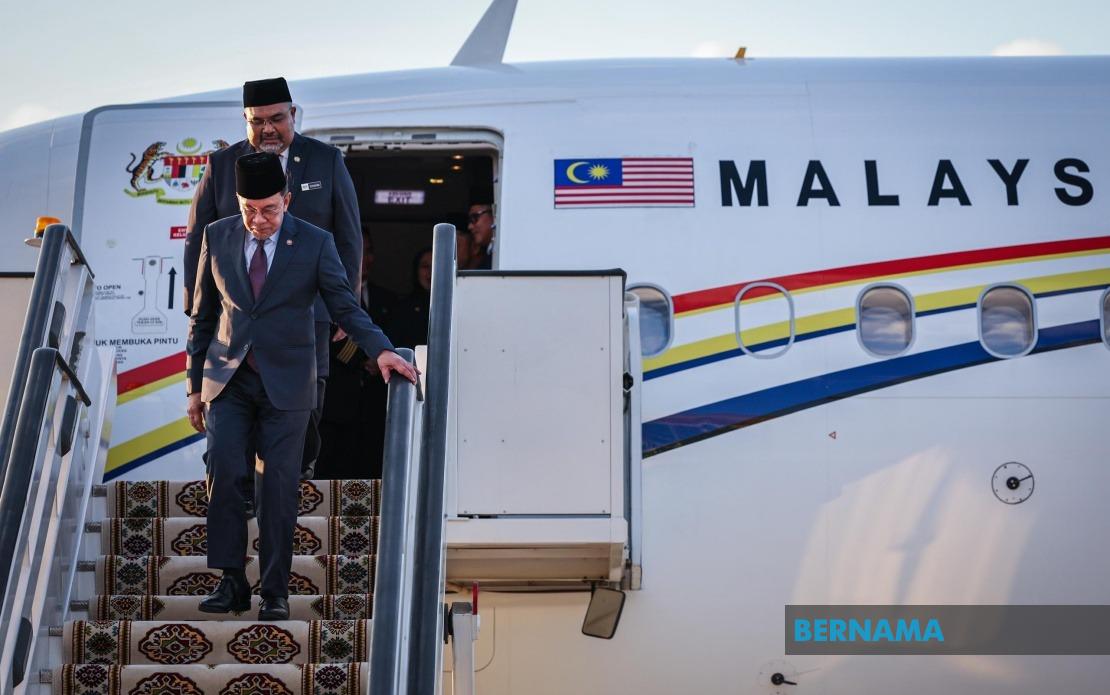
Prime Minister Datuk Seri Anwar Ibrahim touched down in Ashgabat on Tuesday evening to commence a two-day official visit to Turkmenistan, marking a significant diplomatic milestone as the first sitting Malaysian prime minister to make such a journey to the Central Asian nation. His aircraft landed at Ashgabat International Airport at 8 pm local time, concluding an earlier working visit to Kazan in the Republic of Tatarstan. The timing and sequence of Anwar's Central Asian tour underscores Malaysia's strategic interest in deepening engagement with resource-rich nations across the region, particularly as Kuala Lumpur seeks to diversify partnerships and economic opportunities beyond traditional markets.
The prime minister arrived accompanied by a delegation reflective of Malaysia's multifaceted approach to the visit. Minister of Investment, Trade and Industry Datuk Seri Johari Abdul Ghani and Minister of Economy Akmal Nasrullah Mohd Nasir travelled alongside Anwar, signalling that the discussions will centre heavily on commercial expansion and bilateral economic cooperation. The presence of officials from both the Prime Minister's Office and the Foreign Ministry further demonstrates the institutional weight placed on these engagements, suggesting that outcomes may extend beyond immediate trade negotiations to encompass longer-term diplomatic and strategic frameworks.
At the airport, Malaysia's Ambassador to Turkmenistan Mohd Suhaimi Ahmad Tajuddin received the prime minister, while the Turkmenistan side was represented by Deputy Chairman of the Cabinet of Ministers for Oil and Gas Guvanch Agajanov. This ceremonial reception, whilst standard diplomatic protocol, carries symbolic importance in Central Asian diplomatic culture, where oil and gas portfolios carry particular significance given the nation's resource-dependent economy. The choice of Agajanov as the official welcome representative hints at the energy sector's prominence in anticipated bilateral discussions.
The visit represents a reciprocal gesture following Turkmenistan President Serdar Berdimuhamedov's official visit to Malaysia in December 2024. Such exchanges form the foundation of contemporary diplomatic relations, with each nation demonstrating commitment to sustained engagement through high-level visits. For Malaysia, this represents the fifth prime ministerial visit to Turkmenistan in total, indicating a long-standing but not particularly frequent pattern of top-level diplomatic contact. The historical baseline suggests that whilst relations exist, there remains untapped potential for deeper integration and cooperation.
The formal schedule commencing on June 19 reveals a deliberately structured agenda designed to balance ceremonial elements with substantive negotiations. President Berdimuhamedov will host a welcoming ceremony at the Presidential Palace followed by bilateral talks and the signing of a joint statement, indicating that both governments have prepared concrete agreements for announcement. The exchange of memoranda of understanding signals ongoing negotiations in multiple policy domains, potentially spanning energy, trade, investment, and possibly defence or security cooperation. An official luncheon hosted by the Turkmenistan president will provide informal settings for candid discussions, a diplomatic staple that frequently yields insights into broader strategic thinking beyond formal statements.
Anwar's participation in Friday prayers at the Turkmenbashi Ruhy Mosque, also known as the Gypjak Mosque, carries layers of meaning beyond religious observance. For Malaysia, demonstrating respect for local religious customs whilst maintaining its identity as a Muslim-majority nation reinforces shared values and cultural affinity. This practice has become characteristic of Anwar's diplomatic visits to Muslim-majority nations, presenting Malaysia as a bridge between Islamic and secular governance models and appealing to regional audiences invested in such narratives.
The Malaysia-Turkmenistan Forum, to be jointly officiated by both leaders at the Chamber of Commerce and Industry of Turkmenistan, represents a crucial venue for private sector engagement. Such forums typically facilitate networking between Malaysian and Turkmen businesses, potentially unlocking investment opportunities in energy, telecommunications, manufacturing, and services sectors. The forum provides a platform for identifying complementary economic interests and removing bureaucratic barriers to trade and investment.
Trade data underscores the economic dimension of this diplomatic visit. In 2025, Turkmenistan ranked as Malaysia's fourth-largest trading partner among Central Asian nations, with bilateral trade valued at RM75.80 million. Malaysian exports to Turkmenistan reached RM75.50 million, reflecting a nine percent year-on-year increase. Whilst these figures appear modest compared to Malaysia's global trade volumes, the growth trajectory and regional significance warrant attention. The composition of Malaysian exports likely includes value-added products and services rather than raw materials, suggesting a complementary economic relationship.
Petroliam Nasional Bhd, Malaysia's national oil company, constitutes the most substantial link between the two nations. Petronas' cumulative investments in Turkmenistan have reached RM52.73 billion since 1996, making the corporation a critical economic actor in the bilateral relationship. This investment dwarfs official trade figures, indicating that the relationship extends far beyond conventional bilateral commerce. Petronas' presence in Turkmenistan's energy sector provides Malaysia with both strategic influence and economic returns, particularly valuable given global energy transitions and the geopolitical importance of energy security. Anwar's visit, coupled with the presence of the Investment Minister, signals potential discussions about expanding Petronas' footprint, facilitating new project development, or addressing operational challenges.
For Malaysian observers, this visit carries broader implications for the nation's positioning within Central Asia. As China expands its Belt and Road Initiative across the region and Russia maintains historical influence, Malaysia's engagement through diplomatic visits and selective investment demonstrates an effort to maintain a balanced, independent foreign policy. The visit also reflects Anwar's personal diplomatic agenda, which has emphasised greater South-South cooperation and diversification away from traditional Western economic and political partnerships.
Turkmenistan itself presents both opportunities and challenges for Malaysian engagement. The nation possesses substantial natural gas reserves and sits at the crossroads of Asian trade corridors, yet faces international scrutiny regarding governance and human rights practices. Malaysia's diplomatic approach appears to prioritize pragmatic economic cooperation whilst maintaining formal diplomatic protocols, a stance consistent with broader ASEAN practice of engagement without overt political conditionality.
The timing of Anwar's Central Asian tour reflects Malaysia's deliberate cultivation of relationships in regions offering economic complementarity and strategic balance. As regional geopolitics intensify and traditional power blocs seek influence in Central Asia, Malaysia's visits signal an intent to participate in shaping regional outcomes rather than remaining passive. The visit concludes with a press conference directed at Malaysian media, ensuring domestic audiences receive curated messaging about outcomes and achievements.
Looking forward, the tangible outcomes from this visit—measured through new agreements, investment commitments, and trade facilitation measures—will determine whether this visit marks a turning point in bilateral relations or represents continuity in a modest but stable partnership. For Malaysia's economic interests, particularly through Petronas, and for broader regional diplomacy, the substantive results will matter more than ceremonial elements.

%22%2F%3E%3C%2Fpattern%3E%3C%2Fdefs%3E%3Crect%20width%3D%22100%25%22%20height%3D%22100%25%22%20fill%3D%22url(%23ph3j096g)%22%2F%3E%3Crect%20width%3D%22100%25%22%20height%3D%22100%25%22%20fill%3D%22url(%23ph3j096p)%22%2F%3E%3Ctext%20x%3D%2250%25%22%20y%3D%2250%25%22%20text-anchor%3D%22middle%22%20dominant-baseline%3D%22central%22%20fill%3D%22rgba(255%2C255%2C255%2C0.95)%22%20font-family%3D%22Georgia%2C%20'Times%20New%20Roman'%2C%20serif%22%20font-weight%3D%22700%22%20font-size%3D%22320%22%20letter-spacing%3D%22-0.02em%22%3EGRS%3C%2Ftext%3E%3C%2Fsvg%3E)