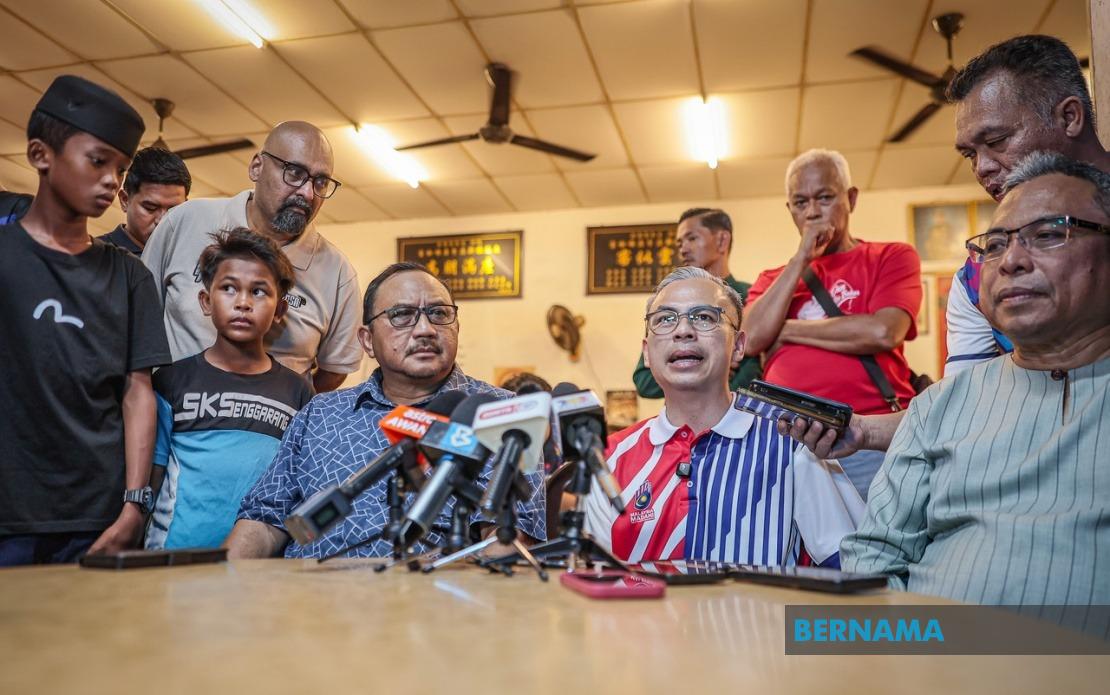
Pakatan Harapan has unveiled a dual-pronged campaign strategy for the 16th Johor State Election that fuses traditional community organising with contemporary digital tools, positioning itself to maximise voter outreach across diverse demographics. The approach reflects a recognition that effective political messaging in Malaysia must now operate simultaneously across physical and online spaces, particularly in a state where support remains competitive and contested. Communications director Datuk Fahmi Fadzil outlined the coalition's intentions in Batu Pahat, indicating that the strategy would activate immediately once the official nomination period concludes.
PKR, the largest component party in Peninsular Malaysia within the coalition, will field 20 candidates across the state. Party leaders have already coordinated their movements for nomination day activities, with Fahmi personally visiting Semerah while deputy president Nurul Izzah Anwar will accompany Senggarang candidate Onn Abu Bakar at that constituency's nomination centre. This visible presence by senior figures serves both practical and symbolic purposes, demonstrating organisational capacity while generating media coverage that reinforces campaign momentum at the crucial launching moment.
Central to Pakatan Harapan's messaging discipline is an explicit commitment to fact-based communication during the election period. In a political environment where misinformation and viral falsehoods can shift perceptions rapidly, the coalition has positioned truthfulness as a differentiating principle. Fahmi stressed that accuracy in policy explanation and voter education would distinguish PH's campaign from competitors, a calculated bet that Malaysian voters increasingly scrutinise claims and reward substantive policy platforms. This emphasis also responds to widespread public concern about election-period disinformation, a phenomenon that has affected recent campaigns across Southeast Asia.
The coalition has established dedicated digital infrastructure to support rapid information dissemination about candidates and party positions. An official media group will function as a centralised hub for curated content, allowing PH to maintain consistent narratives while enabling supporters to share verified materials through their own networks. This structure acknowledges that traditional media gatekeeping has weakened while social media algorithms reward authentic, distributed sharing over broadcast-style announcements. For a coalition managing multiple parties and candidates with different local bases, such coordination tools become essential for coherence.
Packaging alongside this campaign machinery is Pakatan Harapan's development narrative, particularly emphasising federal-state cooperation in Johor. Fahmi highlighted two flagship infrastructure projects as evidence of the coalition's capacity to translate political will into tangible economic benefits. The Rapid Transit System Link represents urban modernisation essential for Johor Bahru's competitiveness, while the Johor-Singapore Special Economic Zone signals integration into regional growth corridors. These projects embody arguments that PH governance transcends rhetorical promises, generating employment and narrowing regional inequality that has historically disadvantaged Johor's interior districts relative to coastal economic hubs.
The coalition's governance record in states under its control provides empirical foundation for campaign claims about delivery capacity. Selangor, Negeri Sembilan and Penang have demonstrated that Pakatan Harapan administrations can execute infrastructure projects, maintain fiscal discipline, and address service provision concerns. This track record becomes particularly valuable in Johor, where voters have experienced transitions between different administrations and can compare performance metrics. Specific candidates like Dr Maszlee Malik and Onn Abu Bakar carry personal reputations built through prior governance or professional roles, personalising the coalition's broader claims about capability and integrity.
Fahmi announced that Pakatan Harapan will release a comprehensive state-specific manifesto addressing Johor's particular concerns and priorities. Rather than simply transplanting the national platform, this acknowledgement of local distinctiveness suggests the coalition recognises that state elections turn on issues specific to their context. Housing affordability in urban areas, agricultural sustainability in Muar and Kluang, port operations in Tanjung Pelepas and Pasir Gudang, and rural development in interior constituencies each demand tailored policy responses. A dedicated manifesto signals seriousness about governance at state level rather than treating such elections as mere referendums on federal government performance.
Cybersecurity and information integrity during the campaign period have received institutional attention beyond Pakatan Harapan's internal efforts. The Malaysian Communications and Multimedia Commission has convened a special task force incorporating the Election Commission, Royal Malaysia Police and Malaysian Media Council to monitor and suppress misinformation. This multi-agency approach reflects official recognition that election-period disinformation poses risks to democratic legitimacy and public trust. By situating this work within formal institutions rather than leaving it to individual parties, authorities attempt to establish non-partisan credibility around fact-checking and misinformation response.
The campaign's grassroots component extended to Fahmi's participation in the Hasrat MADANI programme, where he engaged residents directly in Senggarang and attended a community film screening of Blood Brothers. These activities ground political engagement in social connection rather than transactional vote-seeking, building relationships that endure beyond single election cycles. Such presence in neighbourhoods also allows politicians to hear concerns directly and adjust messaging accordingly, creating feedback loops that pure digital strategies cannot replicate.
For Malaysian political observers, Pakatan Harapan's Johor strategy reflects broader evolution in campaign methodology. The coalition operates in an environment where voter volatility has increased, traditional party identification has weakened, and information consumption patterns fragment across platforms and demographics. Neither purely grassroots nor purely digital approaches suffice alone. Grassroots engagement builds trust and community bonds but reaches limited numbers within compressed timeframes. Digital strategies achieve scale and speed but can feel impersonal or inauthentic without grounding in visible community presence. Pakatan Harapan's integrated model attempts to capture advantages of both approaches while mitigating their individual limitations, recognising that contemporary electoral competition demands sophistication across all communication channels and community engagement modalities.

