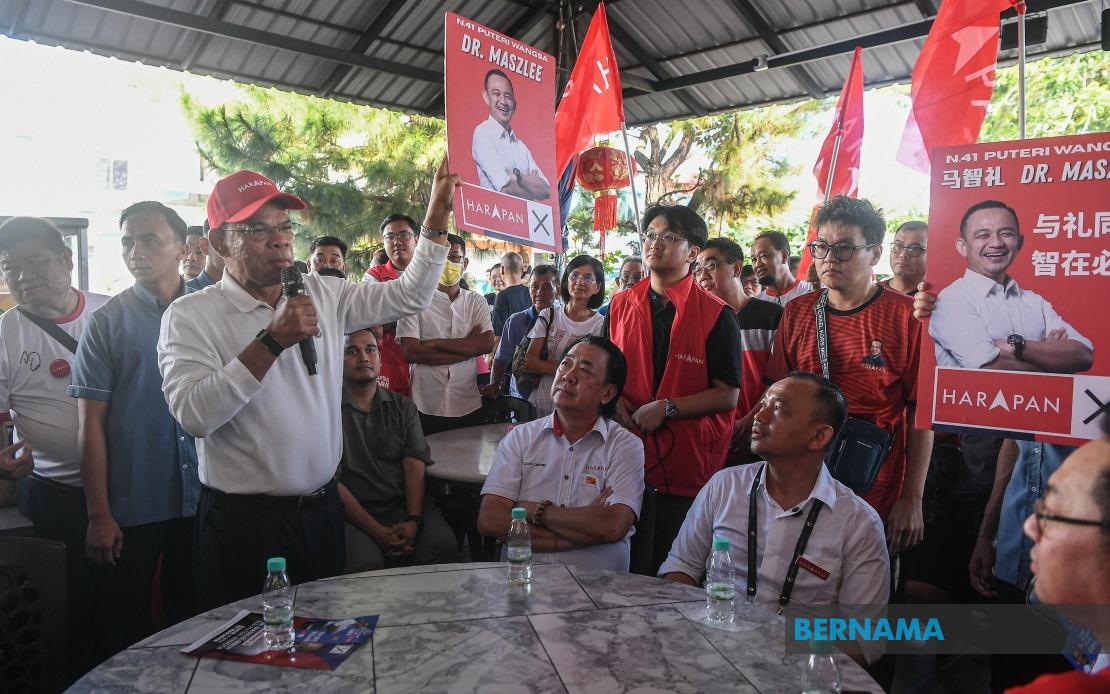
Pakatan Harapan is riding what its leadership describes as a surge in voter support in the Johor state election campaign, a momentum the coalition attributes largely to its methodical and transparent approach to contesting the 56 available seats. Speaking after meeting with the Chinese community and a candidate in Johor Bahru on July 5, PKR's joint election director Datuk Seri Saifuddin Nasution Ismail outlined how PH has differentiated its efforts across constituencies, moving away from the one-size-fits-all approach that has traditionally characterised Malaysian state election campaigns.
The cornerstone of PH's strategy lies in what party officials term "grading" the contested seats—essentially categorising the 56 state assembly constituencies according to priority levels determined by real-time ground support assessments. This classification system allows the coalition to direct campaign resources, volunteer efforts, and candidate attention toward areas where the party believes it has the strongest prospects while still maintaining a presence across all seats. Saifuddin Nasution explained that this tactical granularity recognises the vastly different political terrain across Johor's constituencies, each shaped by distinct demographic profiles, local issues, and historical voting patterns.
The contrast between constituencies exemplifies why such differentiation matters. Puteri Wangsa, a relatively new seat with urban middle-class voters, presents fundamentally different challenges and opportunities compared to Johor Lama, which carries deeper historical significance and an older voter demographic. Similarly, Larkin's diverse urban composition stands apart from the rural and semi-rural character of Endau. By acknowledging these variations explicitly, PH argues it can craft more relevant messaging and deploy candidates whose backgrounds and expertise align with local concerns. This approach represents a departure from generic national campaign templates that often fail to resonate across Malaysia's diverse constituencies.
Beyond internal strategy, PH has found unexpected advantages in its opponents' positioning. The decision by PAS to contest only 11 of the 56 seats whilst simultaneously encouraging its supporters to back Barisan Nasional candidates elsewhere has created an opening for PH. Where PAS has chosen not to stand, its supporters face a binary choice between PH and BN—a scenario that potentially benefits the coalition in areas where PAS's Islamic messaging had previously fragmented the opposition vote. Saifuddin Nasution framed this as a contrast to what he termed PH's more transparent and principled approach, where the coalition announced its full seat allocation clearly and presented an implementable manifesto rather than strategic abstentions that might confuse voters.
The appearance of Datuk Dr Mohd Puad Zarkashi, a former UMNO Supreme Council member, at a series of talks conducted by Prime Minister Datuk Seri Anwar Ibrahim in Felda Ulu Tiram represented another symbolic boost to PH's campaign narrative. The defection or public alignment of high-profile figures from the ruling coalition carries particular weight in Malaysian politics, signalling cracks in BN's traditional support base. Such moments, whilst perhaps modest in immediate numerical impact, carry outsized psychological significance—they suggest that BN is losing the confidence of its own establishment figures, a perception that can ripple through voter consciousness and erode the sense of inevitability that ruling coalitions depend upon.
PH's candidate selection also features in the coalition's confidence narrative. The designation of Dr Maszlee Malik as the party's representative in Puteri Wangsa reflects a deliberate attempt to field accomplished, recognisable figures in competitive constituencies. Saifuddin Nasution characterised Maszlee as both qualified and a strategic asset, implying that PH's candidate roster has been carefully curated for electability and the ability to govern should the coalition secure the state mandate. This contrasts with occasional accusations that Malaysian political parties sometimes deploy candidates primarily for factional or reward purposes rather than electoral viability.
The electoral mechanics underscore the stakes involved. All 172 candidates competing for the 56 seats means average five-way contests, a fragmentation that benefits whichever party can consolidate its support most effectively. Early voting scheduled for July 7 precedes the main polling day on July 11, a timeline that concentrates campaign intensity over a brief period. For PH, the challenge becomes sustaining the momentum that leadership claims is building on the ground whilst ensuring that the coalition's voter mobilisation machinery translates sentiment into actual ballot-box outcomes.
From a broader Malaysian political perspective, the Johor election assumes significance beyond the state's borders. Johor, Malaysia's second-largest state by population and a traditional BN stronghold, has become a testing ground for whether the opposition can achieve meaningful breakthroughs in peninsular heartlands. The 2023 general election saw PH make substantial gains, but translating that into state-level control remains difficult given structural advantages that ruling coalitions enjoy at state level. A strong PH performance in Johor would suggest that the coalition's support has deepened beyond the urban, educated, middle-class demographics that traditionally favour it, extending into more diverse communities including rural and working-class voters.
The transparency and tactical clarity that Saifuddin Nasution emphasised also speaks to a shift in opposition campaign practice. Where opposition coalitions previously struggled with internal divisions and opaque seat-sharing arrangements that frustrated supporters, PH has attempted to present clearer arrangements and more coherent messaging. The allocation of seats—20 for PKR, 19 for Amanah, and 17 for DAP—reflects a reasonably proportionate distribution that avoids the appearance of one partner dominating. Whether this structural clarity translates into voter preference remains the central question as July 11 approaches.
For Malaysian voters, particularly those in Johor who will ultimately determine the election outcome, the choice encompasses broader questions about political direction. BN's longstanding dominance in the state confronts an opposition coalition projecting renewed vigour and tactical sophistication. The grading system and targeted strategy that PH promotes represents an attempt to move beyond symbolic opposition rhetoric toward more practical, implementation-focused campaigning. Whether such methods prove sufficient to unseat an entrenched ruling coalition depends ultimately on whether the support trends that PH claims to observe among Johor's diverse communities translate into actual electoral victories on polling day.

