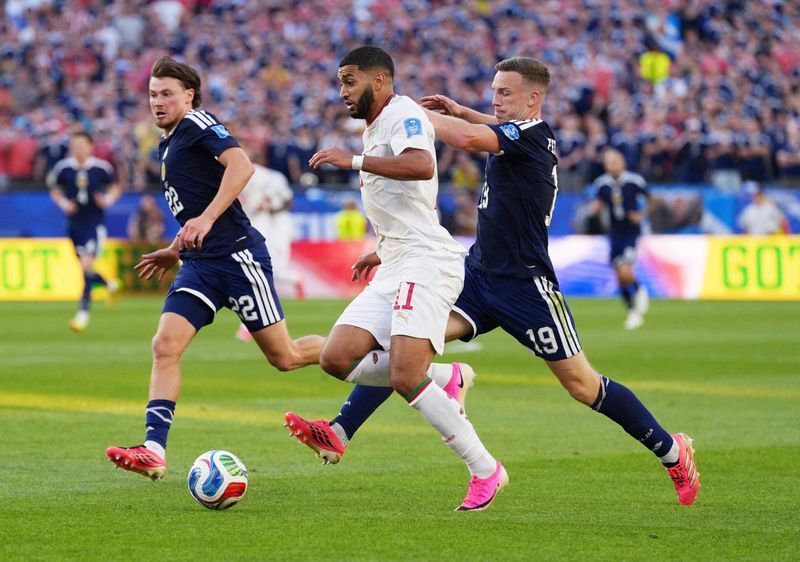
Morocco demonstrated overwhelming superiority to dispatch Scotland 1-0 in their World Cup Group C encounter at Foxborough, Massachusetts on Friday, courtesy of what proved to be the fastest goal of the entire tournament. The decisive moment arrived with startling suddenness when Ismael Saibari latched onto a Brahim Diaz cross after just 71 seconds, capitalising on central defender Grant Hanley's premature departure from his marking assignment. The goal encapsulated Morocco's dominance throughout the ninety minutes, a performance that shifted the balance of power in a group that appeared far more competitive heading into Friday's fixture.
With four points accumulated from their opening two matches, Morocco now occupy the summit of Group C and hold considerable momentum as they prepare to face Haiti on Wednesday. Scotland, conversely, find themselves in a precarious position despite accumulating three points from their first two games. The Scots must now navigate a daunting final group match against five-time champions Brazil, a confrontation that could well determine whether Steve Clarke's side advances beyond the initial phase. Later on Friday, Brazil faced Haiti in what represented a critical encounter for multiple teams' qualification prospects.
Saibari's early breakthrough represented a watershed moment in the midfielder's World Cup campaign. Having already found the net in Morocco's previous 1-1 draw against Brazil seven days earlier, the player has now become only the second African player ever to score in his opening two World Cup appearances, joining Egypt's Mohamed Salah in that exclusive company. The milestone carries added significance given Saibari's reported imminent transfer to Bayern Munich, suggesting the German champions are acquiring a player capable of performing under the most intense pressure on football's grandest stage.
The speed with which Morocco established their advantage reflected the visitors' superior tactical organisation and collective intensity. Scotland had entered the match brimming with confidence following their historic 1-0 triumph over Haiti, a result that ended a 36-year drought without a World Cup victory. Yet any hopes that momentum might carry into this encounter were swiftly extinguished as the North Africans, surprise semi-finalists in Qatar four years ago, methodically suffocated their opponents' attacking ambitions. The Scots managed not a single shot on target throughout the opening forty-five minutes, a statistic that starkly illustrated their complete subjugation by Morocco's pressing and possession-based football.
Morocco carved out numerous opportunities to extend their lead beyond the opening goal, with the difference between their dominance and final scoreline proving genuinely remarkable. Azzedine Ounahi orchestrated a dangerous move down the left flank during the first half, cutting the ball back invitingly but watching as two teammates failed to make meaningful contact at the critical moment. Bilal El Khannouss tested Scottish goalkeeper Angus Gunn on multiple occasions, while Saibari himself struck the post with a deflected effort that flickered agonisingly wide. The breadth and quality of Morocco's chances suggested that Scotland had endured extraordinarily good fortune in limiting the damage to a single goal.
Ounahi had prompted debate the previous day by publicly declaring Morocco's ambitions to reach the World Cup final, comments that initially struck some observers as overconfident. Yet the evidence presented on the pitch suggested the midfielder's assertion was not mere rhetoric but reflected a genuine belief in his team's capabilities. The Moroccans exhibited the tactical discipline, collective work rate, and ruthless efficiency characteristic of genuine tournament contenders. Their ability to control proceedings without appearing to require maximum exertion hinted at considerable reserves of quality and experience.
A complicating factor surrounding the encounter involved the reception afforded to Morocco captain Achraf Hakimi by the Scottish crowd. The defender faced sustained booing throughout the match, a response stemming from ongoing legal difficulties that see Hakimi embroiled in a rape trial. While Hakimi's individual circumstances remained peripheral to the broader sporting contest, the incident highlighted the broader complexities and challenges that occasionally intrude upon international football's surface narrative.
Scotland's second-half performance demonstrated greater urgency and willingness to take risks, as Clarke's men pushed forward in search of an elusive equaliser. Yet despite creating some genuine opportunities as the match progressed, the Scots lacked the clinical finishing required to trouble Brahim Diaz's side or restore parity to proceedings. Morocco's defensive organisation remained sufficiently solid to repel Scottish attacks, while simultaneously maintaining the threat that any clearance might transition rapidly into a counterattacking opportunity.
The result reshapes the Group C landscape considerably. Morocco's position at the summit carries psychological advantages entering the final round of matches, though their confrontation with Haiti represents no guaranteed formality. Haiti's participation in the World Cup represents an achievement in itself, yet the Caribbean nation's defensive vulnerabilities have proven consistently exploitable by more technically accomplished opponents. Scotland's destiny now rests substantially upon their capacity to achieve an unexpected positive result against Brazil, a proposition that ranks among the tournament's more daunting assignments. Brazil and Haiti's Friday evening encounter would carry significance for multiple teams' qualification scenarios, with the outcome potentially reshaping the mathematical permutations underpinning Group C advancement.