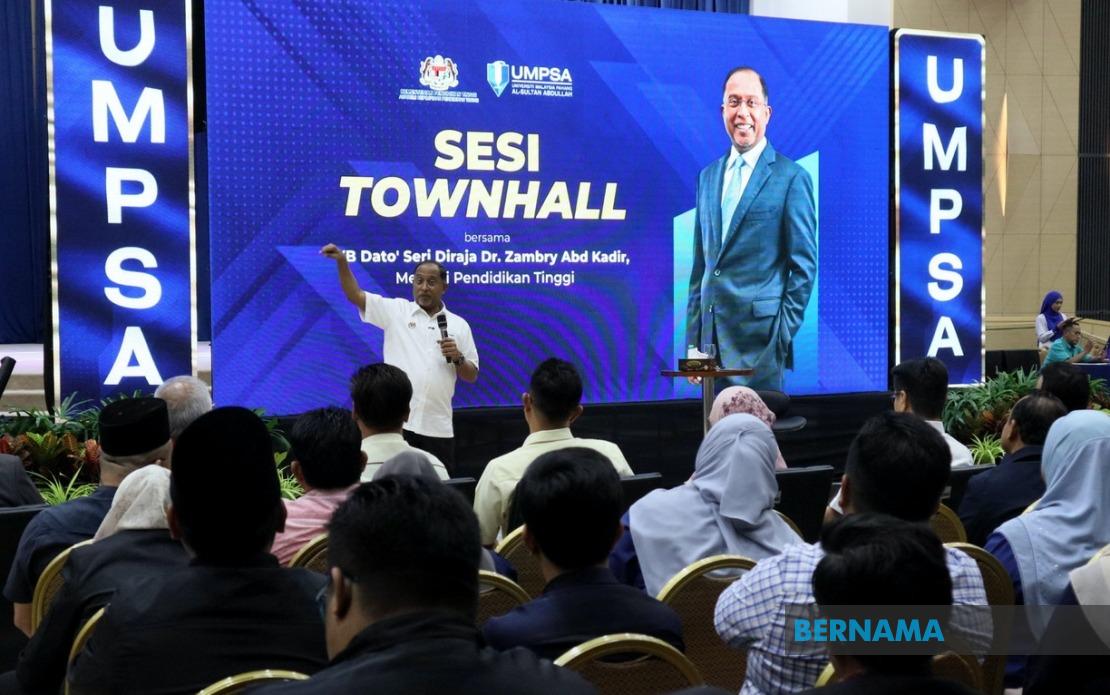
The Ministry of Higher Education (KPT) is moving swiftly to operationalise Prime Minister Datuk Seri Anwar Ibrahim's recent instruction concerning how universities handle student disciplinary matters, signalling a significant recalibration of campus governance in the country. Minister Datuk Seri Dr. Zambry Abd Kadir disclosed that the ministry has commenced the necessary procedural steps following the Prime Minister's guidance, which specifically addresses the treatment of students who face sanctions for voicing criticism against the government.
The directive carries substantial implications for Malaysia's university system, particularly given the historical rigidity of campus discipline frameworks. Dr. Zambry emphasised that the ministry's response incorporates considerations that extend beyond mere administrative convenience—the approach acknowledges legislative protections and university regulations that govern student rights, especially the sensitive issue of student freedom of expression. This acknowledgement reflects broader constitutional principles around fundamental liberties that had previously been constrained within university walls.
To translate these directives into concrete action, the minister revealed that all vice-chancellors convened with the director-general of Higher Education to discuss implementation mechanisms. This high-level coordination suggests the government recognises that successful policy reform requires institutional buy-in from university leadership rather than top-down enforcement alone. A formal statement documenting the agreed procedures is expected to follow, providing clarity to campus administrators handling ongoing or future disciplinary cases.
Dr. Zambry's comments were made during his attendance at a youth leadership programme at Universiti Malaysia Pahang Al-Sultan Abdullah, where approximately 500 young academic staff and administrators from institutions across Pahang, Terengganu, and Kelantan gathered. The timing underscores the ministry's commitment to engaging the next generation of university leaders in this policy transition, potentially building institutional momentum for change from within the academic community.
A critical question remains regarding how these changes will affect Malaysia's substantial private higher education sector. Dr. Zambry acknowledged that private institutions operate under a distinct regulatory framework—the Private Higher Educational Institutions Act 1996—which complicates uniform implementation across all campuses. Nevertheless, the minister expressed hope that privately-owned institutions, particularly those with state ownership or close state affiliations, will voluntarily align their disciplinary procedures with the new government direction, even if formal legal requirements do not mandate compliance.
The policy shift gained momentum following Anwar Ibrahim's remarks at the Malaysia Madani Intellectual Forum Series 13, where he articulated the government's intention to exonerate students previously sanctioned for criticising him and state institutions. This represents a dramatic reversal from decades of campus governance characterised by restrictive regulations and swift punishment for dissent. The Prime Minister's announcement explicitly links this clemency initiative to the broader repeal of the Universities and University Colleges Act (AUKU) 1971, a colonial-era statute long criticised for suppressing academic freedom and student activism.
The timing framework the Prime Minister outlined is particularly significant: while formal legislative amendment to AUKU is expected to require considerable parliamentary time, the government intends to immediately absolve students of disciplinary offences through administrative action. This two-track approach demonstrates awareness that legislative processes move slowly while the injustice of existing sanctions requires urgent remedy. Students currently bearing the weight of disciplinary records—which can affect career prospects and social standing—will find relief through executive action rather than waiting for legislative completion.
However, the Prime Minister was careful to define boundaries around this clemency. Exoneration applies specifically to university disciplinary matters relating to campus-based criticism and expression. Criminal charges brought by the Royal Malaysia Police under broader criminal law remain untouched by this directive. This distinction preserves the government's ability to pursue criminal cases while still reforming the university-specific disciplinary framework, though it also highlights the complex intersection between campus autonomy and national security frameworks that continues to define Malaysian governance.
The policy carries profound implications for Southeast Asia's university ecosystem. Malaysia's higher education system has long served as a regional model—sometimes positive, sometimes cautionary—for other nations' campus governance. A genuine shift toward protecting student expression could encourage similar reforms in neighbouring countries while establishing Malaysia as a space where intellectual discourse and student activism operate with greater protection. Conversely, incomplete implementation or backsliding would signal that the repeal of AUKU represents symbolic gesture rather than systemic transformation.
For Malaysian students and young academics, the unfolding changes represent either genuine liberation or a test of whether institutional cultures can adapt when formal rules evolve. University administrators will face the challenge of implementing new disciplinary standards when decades of restrictive practice have become embedded in institutional procedures and mindsets. The success of this transition depends substantially on whether university leadership genuinely embraces the principle that student expression—even critical expression—strengthens rather than threatens institutional integrity.
The coordination between the Prime Minister's office, the higher education ministry, and university vice-chancellors suggests high-level political commitment to implementation. Yet the voluntary nature of private sector alignment and the dependency on institutional goodwill create uncertainty about whether this reform will reshape Malaysia's entire university landscape or remain confined to public institutions. Southeast Asian observers will closely watch whether Malaysia's policy shift toward academic freedom endures or faces reversal as political dynamics evolve.

