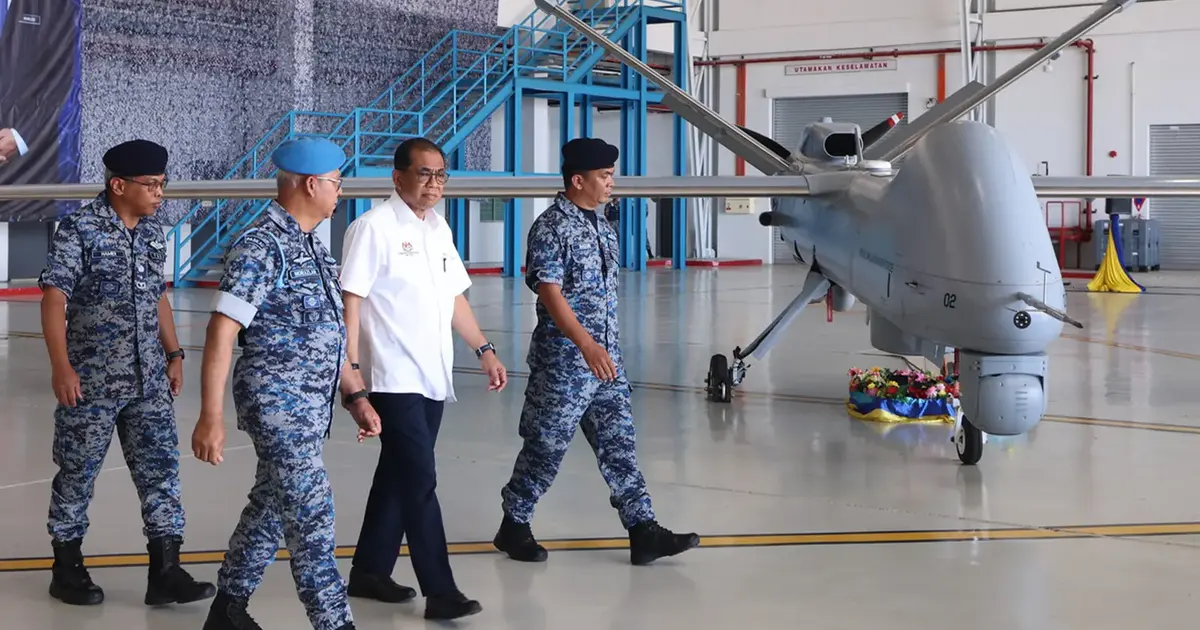
Malaysia has acquired a significant technological advantage in monitoring contested waters through deployment of the Anka-S unmanned aircraft system, according to Defence Minister Khaled. The aircraft's endurance capability—capable of remaining airborne for a full day without refuelling—positions the country to strengthen its intelligence operations across the vast South China Sea, where competing territorial claims from multiple nations create ongoing tensions.
The acquisition represents a strategic investment in unmanned aerial technology, a domain where several regional powers have made substantial progress in recent years. The Anka-S platform, developed to address modern security challenges, provides Malaysia with enhanced reconnaissance abilities at a time when maritime domain awareness has become increasingly central to regional security strategies. For a nation managing multiple maritime boundaries and economic interests spanning some of Southeast Asia's busiest shipping lanes, such capabilities carry considerable weight.
Defence Minister Khaled's emphasis on the aircraft's role in protecting national sovereignty underscores the delicate balance Malaysia must maintain in the South China Sea. The region remains one of the world's most strategically important waterways, with trillions of dollars in annual trade passing through its waters. Simultaneously, overlapping territorial and maritime claims—involving China, Vietnam, the Philippines, Brunei, and Malaysia—have created a complex security environment requiring constant vigilance and sophisticated monitoring capabilities.
The 24-hour non-stop flight capability fundamentally changes Malaysia's operational tempo in maritime surveillance. Traditional aircraft require regular returns to base for refuelling and crew changes, creating gaps in coverage that can last hours. The Anka-S's extended endurance means Malaysian forces can maintain persistent surveillance over designated areas of the South China Sea, gathering real-time intelligence on vessel movements, environmental conditions, and activities that might threaten national interests. This persistence translates directly into improved situational awareness—a critical factor in preventing incidents and responding rapidly to emerging threats.
Information gathered through such systems carries particular importance given the intensity of maritime activity in contested waters. Commercial shipping, fishing vessels, military patrols, and research operations all converge in these regions, and distinguishing between legitimate activities and those that might violate Malaysian sovereignty requires sophisticated analysis and continuous observation. The Anka-S provides the raw intelligence needed to support such analysis, enabling authorities to make informed decisions about resource deployment and diplomatic responses.
Malaysia's acquisition also reflects broader regional trends toward sophisticated defence technology adoption. Neighbouring countries have similarly invested in unmanned systems, surveillance capabilities, and advanced monitoring infrastructure. For Malaysia to maintain effective deterrence and preserve its ability to defend its claimed territories and maritime zones, staying technologically competitive has become essential. The Anka-S deployment signals the government's commitment to modernising defence capabilities across both air and maritime domains.
The aircraft's contribution to sovereignty protection extends beyond direct military applications. The intelligence gathered supports Malaysia's diplomatic position regarding maritime claims and territorial disputes. Documented surveillance data demonstrating Malaysia's active presence and management of its claimed areas strengthens legal and political arguments in international forums. Such evidence becomes particularly valuable in contexts where competing nations dispute the extent and validity of others' claims.
Integrating the Anka-S into Malaysia's broader security framework requires substantial organisational adjustments. Personnel must receive training in unmanned aircraft operations, sensor interpretation, and integration with existing command structures. Intelligence gathered must flow seamlessly through established analytical channels, informing decision-makers across defence, maritime, and diplomatic agencies. When executed effectively, such integration transforms new technology from isolated capability into a force multiplier affecting entire security strategies.
The system's deployment also carries implications for Malaysia's partnerships and strategic relationships within Southeast Asia. The Association of Southeast Asian Nations has repeatedly emphasised the importance of maintaining peace and stability in the South China Sea while respecting international law, particularly the United Nations Convention on the Law of the Sea. Technology enabling stronger maritime domain awareness contributes to this objective by reducing ambiguity, improving communication, and enabling more proportionate responses to potential violations or incidents.
Looking forward, the Anka-S represents the type of capability-building essential for Malaysia to protect its interests in an increasingly complex maritime environment. As global shipping volumes continue expanding and resource competition intensifies, maintaining surveillance over vast ocean areas becomes more challenging and more critical simultaneously. The aircraft's extended endurance and intelligence-gathering capacity directly address these dual pressures, providing Malaysia with tools to assert its sovereign rights effectively while contributing to broader regional stability objectives.