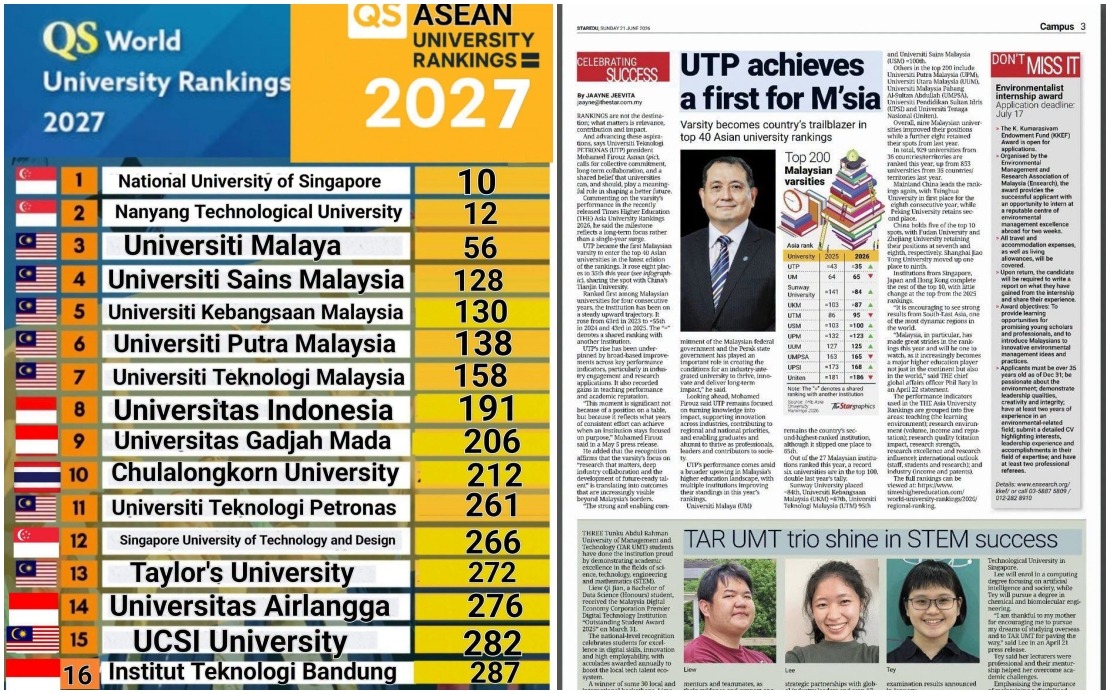
Malaysia's higher education sector has demonstrated renewed competitive strength on the international stage, with the nation's universities securing prominent positions in the latest Times Higher Education Asia University Rankings 2026. The performance underscores the country's trajectory as a credible destination for tertiary education and research in Southeast Asia and beyond, according to remarks from Higher Education Minister Datuk Seri Dr Zambry Abd Kadir, who highlighted the achievement as evidence of Malaysia's capability to establish itself as a globally recognised centre for academic excellence and innovation.
The minister's acknowledgement of these ranking successes carries particular significance for Malaysia's broader positioning within the competitive regional education landscape. While international university rankings remain inherently imperfect measures, Dr Zambry noted they serve as valuable indicators of institutional quality, reputation and competitive standing among peers worldwide. This nuanced perspective reflects growing ministerial understanding that rankings, though important, constitute merely one metric among many for assessing educational impact and societal contribution. The focus on rankings should not eclipse the deeper mission of universities to serve communities and advance knowledge, yet their visibility in these systems does influence student recruitment, research partnerships, and institutional prestige.
Universiti Teknologi Petronas achieved a historic breakthrough by becoming the first Malaysian university to enter Asia's top 40, climbing to 35th position in the 2026 rankings from 43rd the previous year. This advancement represents a significant milestone for the private institution and signals confidence among international evaluators in the quality of its research output, teaching standards, and institutional management. The trajectory suggests that strategic investment in research infrastructure and faculty development can yield measurable improvements within relatively short timeframes, a lesson that may encourage other Malaysian institutions to intensify their efforts in these domains.
The broader ranking results demonstrate consistent strength across Malaysia's university ecosystem. Twenty-seven Malaysian institutions secured places in the latest rankings, a substantial representation reflecting the depth of quality across both public and private sectors. More tellingly, six universities attained positions within Asia's top 100, while eleven advanced into the top 200. These figures indicate that Malaysia's higher education system possesses multiple centres of excellence rather than relying on a single flagship institution, a structural advantage that enhances the nation's regional competitiveness and provides prospective students with diverse quality options.
Public universities featured prominently among the recognised institutions, with Universiti Malaya, Universiti Kebangsaan Malaysia, Universiti Teknologi Malaysia, Universiti Sains Malaysia, and Universiti Putra Malaysia all maintaining strong positions. The inclusion of Universiti Utara Malaysia, Universiti Malaysia Pahang Al-Sultan Abdullah, Universiti Pendidikan Sultan Idris, and Universiti Tenaga Nasional alongside these prestigious names indicates that excellence extends beyond the traditionally dominant elite institutions. This distributive pattern of recognition supports Malaysia's capacity to absorb growing student demand while maintaining academic standards across multiple specialised sectors.
Dr Zambry attributed these achievements to the collective endeavours of diverse stakeholders within the higher education ecosystem. Lecturers and researchers drive innovation and knowledge creation; students contribute through their engagement and eventual career success; alumni networks amplify institutional reputation through their professional achievements; administrative staff provide essential operational support; and industry partners facilitate practical relevance and employment pathways. This systemic perspective acknowledges that university rankings reflect not individual heroics but rather the cumulative effect of coordinated effort across institutional structures. The recognition that success depends on collaborative networks rather than isolated merit encourages institutional leaders to invest in relational capital and cross-sector partnerships.
The implications of Malaysia's improved ranking performance extend beyond national pride or institutional prestige. Enhanced international visibility attracts both domestic and foreign students seeking quality education, generating revenue streams that support research initiatives and faculty recruitment. International ranking prominence facilitates partnerships with leading global universities, enabling research collaborations and faculty exchange programmes that enrich local educational environments. For Malaysia's position within ASEAN and the broader Indo-Pacific region, strong performance in international rankings signals that regional students need not necessarily venture to distant English-speaking countries to access world-class education, potentially retaining talent and capital within Southeast Asia.
Yet these achievements should prompt reflection on what universities are fundamentally for and whether international rankings adequately capture their true value. Malaysian institutions serve crucial roles in training professional workforces, conducting research addressing local challenges, supporting cultural development, and contributing to social mobility. A university's ranking may not reflect its effectiveness in these domains, particularly for institutions prioritising regional impact over global prestige. The danger emerges when ranking-chasing becomes an end in itself, diverting resources from teaching quality, student welfare, or research addressing pressing Southeast Asian concerns such as sustainability, climate adaptation, or health security.
The minister's call for this momentum to continue gaining strength towards producing Malaysia's finest talents and reinforcing the nation's position as a preferred education destination sets an aspirational tone for the sector. Sustaining ranking improvements will require continued investment in research facilities, faculty development, student support services, and international partnerships. It will also demand that Malaysian institutions maintain intellectual autonomy and ethical standards amid competitive pressures that sometimes incentivise gaming the ranking systems rather than genuine improvement.
For Malaysian students and families, these ranking achievements offer tangible reassurance that quality higher education exists domestically, potentially at substantially lower cost than international alternatives. For policymakers, the results vindicate continued public investment in universities despite budgetary constraints and competing social priorities. Moving forward, Malaysia's challenge involves consolidating these ranking gains while ensuring that the pursuit of international standing does not compromise universities' responsibilities to address national development priorities and serve as engines of inclusive, equitable growth within Malaysian society.
%22%2F%3E%3C%2Fpattern%3E%3C%2Fdefs%3E%3Crect%20width%3D%22100%25%22%20height%3D%22100%25%22%20fill%3D%22url(%23ph1q1qkg)%22%2F%3E%3Crect%20width%3D%22100%25%22%20height%3D%22100%25%22%20fill%3D%22url(%23ph1q1qkp)%22%2F%3E%3Ctext%20x%3D%2250%25%22%20y%3D%2250%25%22%20text-anchor%3D%22middle%22%20dominant-baseline%3D%22central%22%20fill%3D%22rgba(255%2C255%2C255%2C0.95)%22%20font-family%3D%22Georgia%2C%20'Times%20New%20Roman'%2C%20serif%22%20font-weight%3D%22700%22%20font-size%3D%22226%22%20letter-spacing%3D%22-0.02em%22%3EEnergy%3C%2Ftext%3E%3C%2Fsvg%3E)