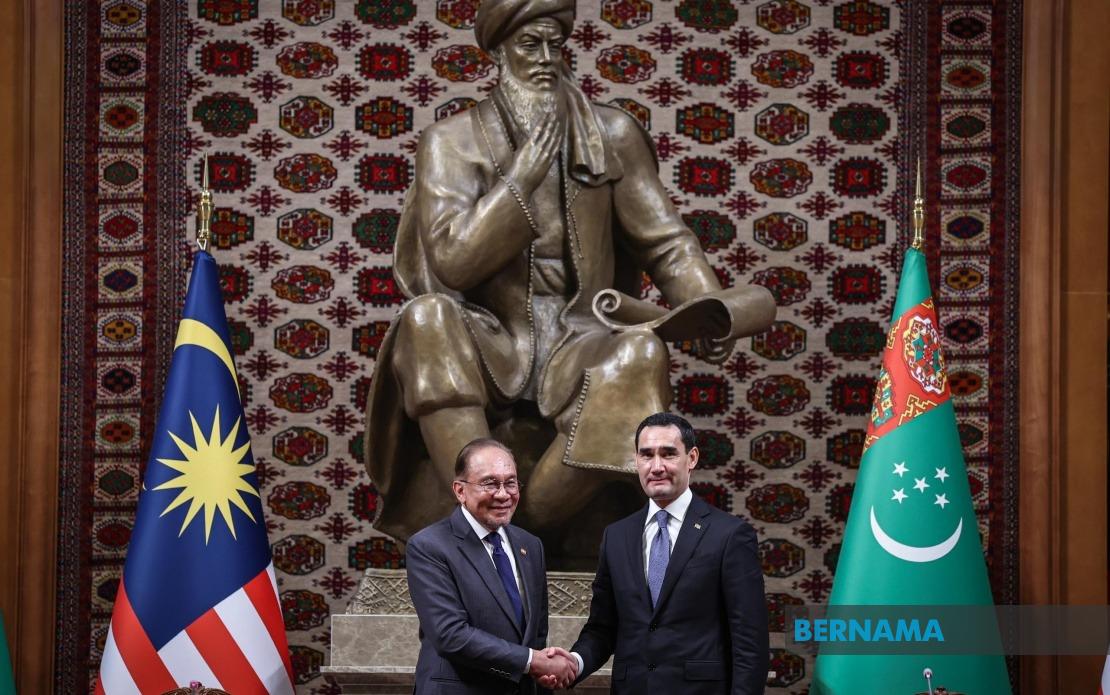
Prime Minister Datuk Seri Anwar Ibrahim has signalled Malaysia's intention to build a more comprehensive relationship with Turkmenistan, moving beyond traditional diplomatic exchanges towards a partnership anchored in mutual strategic interests and tangible benefits for both nations. The commitment emerged from high-level talks in Ashgabat on Friday, where Anwar met with Turkmenistan President Serdar Berdimuhamedov at the Presidential Palace, culminating in the signing of multiple bilateral agreements that map out concrete areas for expanded cooperation.
The formal documentation of this relationship underscores a deliberate shift towards structured engagement. Malaysia and Turkmenistan exchanged four key instruments: an Air Services Agreement that will facilitate direct connectivity between the countries, a memorandum of understanding between Malaysia's Institute of Diplomacy and Foreign Relations and Turkmenistan's Institute of International Relations, a cooperation framework involving Malaysia's Ministry of Transport and Turkmenistan's State Service, and a scientific partnership between the Academy of Sciences Malaysia and the Academy of Sciences of Turkmenistan. These agreements collectively establish the institutional scaffolding needed to translate political goodwill into actionable initiatives.
The scope of bilateral cooperation outlined during the talks reflects both nations' recognition of complementary strengths. Energy emerged as a central pillar of discussion, likely given Turkmenistan's substantial natural gas reserves and Malaysia's expertise in petroleum and renewable energy sectors. Trade and investment represent another critical dimension, offering opportunities for Malaysian companies to access Central Asian markets whilst attracting Turkmen investment into Malaysia's growing economy. The inclusion of the halal industry and Islamic banking indicates Anwar's strategic positioning of Malaysia as a regional hub for Shariah-compliant commerce, an area where the country holds considerable influence and experience.
Education, research, and science and technology cooperation signal both countries' commitment to developing human capital and fostering innovation. Malaysia's advanced universities and research institutions can facilitate knowledge transfer and collaborative projects with Turkmen counterparts, whilst broader scientific partnerships may yield mutual benefits in addressing regional challenges. Tourism was equally highlighted, suggesting both governments see potential in attracting visitors and facilitating cultural exchange, though detailed mechanisms remain to be developed through implementing agencies.
Anwar's emphasis on transparency and disciplined implementation deserves particular attention. The commitment to ensure agreements are executed in a systematic, open manner reflects lessons learned from previous bilateral arrangements across Southeast Asia and beyond, where ambitious frameworks sometimes faltered due to weak enforcement mechanisms or unclear accountability structures. By prioritising these principles, Malaysia signals its expectation that both parties will maintain serious momentum and deliver concrete outcomes rather than allowing documents to languish in government files.
This visit marks Anwar's first official trip to Turkmenistan since assuming office as Malaysia's 10th Prime Minister in November 2022, nearly eighteen months into his tenure. The timing suggests the government has been methodically building diplomatic relationships whilst managing domestic priorities. The invitation from President Berdimuhamedov provided the formal occasion, yet the comprehensive nature of the discussions indicates substantial preparatory work by Malaysia's foreign service and sectoral ministries.
The delegation accompanying Anwar reflected the cross-governmental importance assigned to this engagement. Minister of Investment, Trade and Industry Datuk Seri Johari Abdul Ghani's presence underscored focus on commercial dimensions, whilst Minister of Economy Akmal Nasrullah Mohd Nasir highlighted Malaysia's interest in macroeconomic cooperation. The inclusion of senior government officials suggested that multiple agencies had stakes in the outcomes, indicating the partnership touches numerous domestic sectors and interests.
For Malaysia, deepening ties with Turkmenistan offers strategic advantages within a broader Central Asian engagement strategy. As China's Belt and Road Initiative reshapes regional power dynamics and Russia navigates international sanctions, Southeast Asian nations including Malaysia are carefully calibrating relationships with Central Asian countries to diversify partnerships and secure economic opportunities. Turkmenistan's energy resources and geographic position along historic trade routes make it a natural focus for Malaysian diplomatic and commercial attention, particularly as Malaysia seeks to reduce energy import dependence and expand export markets.
The Air Services Agreement carries particular significance for both nations. Enhanced flight connectivity reduces transaction costs for business travel, tourism, and people-to-people exchange. For Malaysia's aviation industry, routes to Central Asia represent growth opportunities, whilst Turkmen citizens gain easier access to Southeast Asian markets and services. Similarly, expanding scientific collaboration positions both nations to benefit from global research networks and address shared challenges in energy transitions, water management, and sustainable development.
The joint statement signed by Anwar and Berdimuhamedov, though not detailed in the announcement, likely contains aspirational language about long-term cooperation whilst setting parameters for the agreements' implementation. Such documents typically outline shared values, mutual respect for sovereignty, and commitment to peaceful resolution of disputes. In Anwar's case, the reference to friendship strengthened by trust and mutual respect reflects his government's broader diplomatic philosophy emphasising multilateralism and measured engagement with diverse international partners.
Turkey's position in global affairs also influences Malaysia's Central Asian strategy indirectly. Turkmenistan's neutrality status, recognised by the United Nations, means it maintains cautious distance from major power competitions. Malaysia's approach similarly emphasises non-alignment and pragmatic engagement across ideological divides. This philosophical alignment may facilitate deeper cooperation than otherwise possible, as both nations can pursue mutual interests without becoming entangled in larger geopolitical contests.
Looking ahead, the partnership's success depends on implementing agencies translating memoranda into functioning projects. Trade figures between Malaysia and Turkmenistan remain modest compared to Southeast Asian averages, suggesting significant room for growth once frameworks are operationalised. The halal industry cooperation merits particular monitoring, as Malaysia has positioned itself as a global authority in this sphere and can share certification standards, market access knowledge, and best practices with emerging players like Turkmenistan seeking to capture growing global demand.
This engagement with Turkmenistan reflects Malaysia's broader strategy of maintaining diverse international partnerships whilst deepening Southeast Asian integration. By investing diplomatic energy in Central Asia, the government demonstrates commitment to regional stability, economic diversification, and positioning Malaysia as a credible interlocutor for non-aligned, moderate Muslim-majority nations navigating complex geopolitical environments.