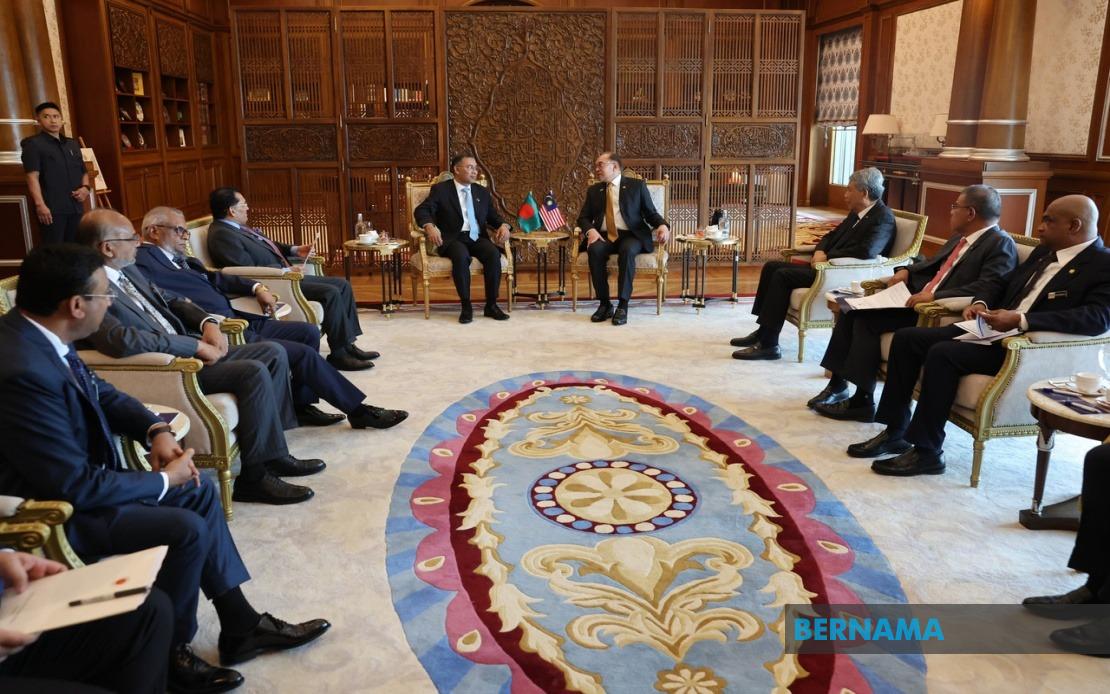
Malaysia and Bangladesh have committed to pursuing a coordinated regional approach to resolving the Rohingya refugee crisis, with both nations signalling their intention to work through established ASEAN frameworks and diplomatic channels. Prime Minister Datuk Seri Anwar Ibrahim made the announcement during a joint press conference in Putrajaya with Bangladesh Prime Minister Tarique Rahman, who was concluding a two-day official visit to Malaysia. The commitment represents a significant show of solidarity between the two countries, which together host substantial populations of displaced Rohingya people and bear the primary humanitarian and logistical burden of the ongoing crisis.
Anwar emphasised that Malaysia and Bangladesh share deep conviction in finding a permanent resolution to the plight of hundreds of thousands of Rohingya refugees currently scattered across camps and communities in both nations. The Prime Minister outlined a structured diplomatic strategy that would leverage the collective weight of ASEAN member states to engage Myanmar's authorities on the conditions necessary for safe and dignified repatriation. This multilateral approach reflects recognition that the Rohingya issue transcends bilateral relations and requires sustained regional pressure and mediation to achieve meaningful progress towards voluntary and sustainable return of refugees to their homeland.
The two leaders plan to utilise their respective foreign ministers as primary conduits for dialogue, working in concert with formal ASEAN mechanisms to maintain consistent diplomatic engagement with Myanmar. This institutional approach signals intent to elevate the issue beyond episodic high-level meetings, embedding ongoing discussions within the regular structures of regional diplomacy. Bangladesh Prime Minister Tarique Rahman expressed profound concern regarding the humanitarian circumstances endured by Rohingya populations sheltered within his country's camps and communities, while simultaneously acknowledging Malaysia's continued commitment to supporting efforts aimed at facilitating their eventual, safe return to Myanmar with dignity and security assurances intact.
Beyond the Rohingya question, the bilateral engagement between Anwar and Tarique encompassed substantive discussions on expanding Malaysia-Bangladesh cooperation across multiple economic and strategic sectors. The two leaders reviewed progress in their existing relationship and identified fresh opportunities to deepen partnership in areas including trade and investment, human resource development, semiconductor manufacturing, energy security, agricultural development, and educational exchange. These broader conversations reflect mutual recognition that strong bilateral foundations strengthen both nations' capacity to address regional challenges effectively, including complex humanitarian issues like the Rohingya displacement.
The official visit culminated in the formal execution of several binding instruments designed to institutionalise renewed cooperation. The two governments exchanged a Memorandum of Understanding focused on cultural collaboration, which aims to foster greater people-to-people understanding and strengthen cultural ties between Malaysia and Bangladesh. Additionally, two Exchanges of Notes were signed addressing counter-terrorism research collaboration and investment promotion and facilitation mechanisms, underscoring shared security concerns and economic ambitions within the region.
Tarique's visit marks his first bilateral official journey abroad since assuming office in February 2026, indicating that Malaysia holds particular strategic importance in Bangladesh's early international diplomatic priorities. The choice of Malaysia as a premiere destination for his initial bilateral engagement suggests Bangladesh's recognition of Malaysia's regional influence, economic significance, and shared interest in addressing the Rohingya crisis. This sequencing carries symbolic weight, demonstrating that Bangladesh views the Malaysia relationship as foundational to its broader regional strategy under the new administration.
Commercial relations between the two nations have expanded substantially, reflecting deeper economic integration within South Asia and beyond. During 2025, bilateral trade between Malaysia and Bangladesh totalled RM12.18 billion, equivalent to USD2.84 billion, representing a significant commercial relationship. Malaysia's exports to Bangladesh reached RM10.08 billion, driven predominantly by petroleum products and refined energy commodities essential for Bangladesh's growing industrial and power generation needs. Meanwhile, Bangladesh's exports to Malaysia amounted to RM2.10 billion, comprising primarily textiles, apparel, and footwear products, sectors in which Bangladesh possesses considerable comparative advantage and manufacturing expertise.
Within Malaysia's broader trade architecture, Bangladesh has emerged as a consequential partner, ranking as the nation's 28th largest trading partner globally. More significantly, Bangladesh occupies second position among Malaysia's trading partners within the South Asian region, surpassed only by India, while simultaneously serving as Malaysia's second-largest export destination and import source within South Asia. This dual positioning underscores the economic importance Bangladesh holds within Malaysia's regional engagement strategy, particularly given the subcontinent's growing economic dynamism and population-driven consumption growth.
The convergence of humanitarian concerns and economic opportunity evident in the bilateral engagement reflects the multidimensional nature of contemporary Malaysia-Bangladesh relations. While the Rohingya refugee issue represents the most visible and morally urgent dimension of cooperation, the broader economic and security partnerships provide structural foundations that enable more effective collaborative action on transnational challenges. Investment in these complementary domains—trade expansion, technology cooperation, counter-terrorism coordination, and educational exchange—strengthens institutional relationships that prove invaluable when addressing complex, protracted issues like refugee displacement and repatriation.
For Malaysia, strengthening ties with Bangladesh carries additional strategic significance within the context of broader Indo-Pacific engagement and ASEAN cohesion. Bangladesh, though not an ASEAN member, possesses considerable influence across the Indian Ocean region and maintains significant demographic and economic weight that increasingly shapes regional dynamics. Enhanced Malaysia-Bangladesh cooperation, particularly on issues affecting shared humanitarian concerns, demonstrates Malaysia's commitment to extending ASEAN's strategic influence and moral authority into adjacent regions confronting similar development and security challenges.
The Rohingya crisis remains among the most intractable humanitarian challenges facing Southeast Asia, with over 900,000 refugees currently residing in Bangladesh and approximately 180,000 in Malaysia, according to international organisations. Both nations bear disproportionate humanitarian burdens despite limited responsibility for the underlying conflict in Myanmar's Rakhine State. Malaysian and Bangladeshi efforts to coordinate diplomatic pressure through ASEAN channels represent attempts to break years of stalled negotiations and limited progress toward repatriation, though sustained international engagement and Myanmar's demonstrated willingness to facilitate return remain prerequisite conditions for meaningful advancement.
Moving forward, the effectiveness of the Malaysia-Bangladesh partnership on the Rohingya issue will largely depend on ASEAN's collective diplomatic leverage over Myanmar, a challenge that has proven difficult given Myanmar's internal instability and complex regional relationships. However, the renewed commitment from both nations, coupled with institutional frameworks now in place, provides a structured platform for pursuing incremental progress. The success of this approach will also require sustained engagement from international partners, including the United Nations and relevant donor nations, to complement regional diplomatic efforts with technical support, funding for humanitarian assistance, and incentives encouraging Myanmar's cooperation with repatriation planning.

%22%2F%3E%3C%2Fpattern%3E%3C%2Fdefs%3E%3Crect%20width%3D%22100%25%22%20height%3D%22100%25%22%20fill%3D%22url(%23ph9pgng)%22%2F%3E%3Crect%20width%3D%22100%25%22%20height%3D%22100%25%22%20fill%3D%22url(%23ph9pgnp)%22%2F%3E%3Ctext%20x%3D%2250%25%22%20y%3D%2250%25%22%20text-anchor%3D%22middle%22%20dominant-baseline%3D%22central%22%20fill%3D%22rgba(255%2C255%2C255%2C0.95)%22%20font-family%3D%22Georgia%2C%20'Times%20New%20Roman'%2C%20serif%22%20font-weight%3D%22700%22%20font-size%3D%22170%22%20letter-spacing%3D%22-0.02em%22%3EMalaysia%3C%2Ftext%3E%3C%2Fsvg%3E)
%22%2F%3E%3C%2Fpattern%3E%3C%2Fdefs%3E%3Crect%20width%3D%22100%25%22%20height%3D%22100%25%22%20fill%3D%22url(%23ph389gmg)%22%2F%3E%3Crect%20width%3D%22100%25%22%20height%3D%22100%25%22%20fill%3D%22url(%23ph389gmp)%22%2F%3E%3Ctext%20x%3D%2250%25%22%20y%3D%2250%25%22%20text-anchor%3D%22middle%22%20dominant-baseline%3D%22central%22%20fill%3D%22rgba(255%2C255%2C255%2C0.95)%22%20font-family%3D%22Georgia%2C%20'Times%20New%20Roman'%2C%20serif%22%20font-weight%3D%22700%22%20font-size%3D%22320%22%20letter-spacing%3D%22-0.02em%22%3EMACC%3C%2Ftext%3E%3C%2Fsvg%3E)