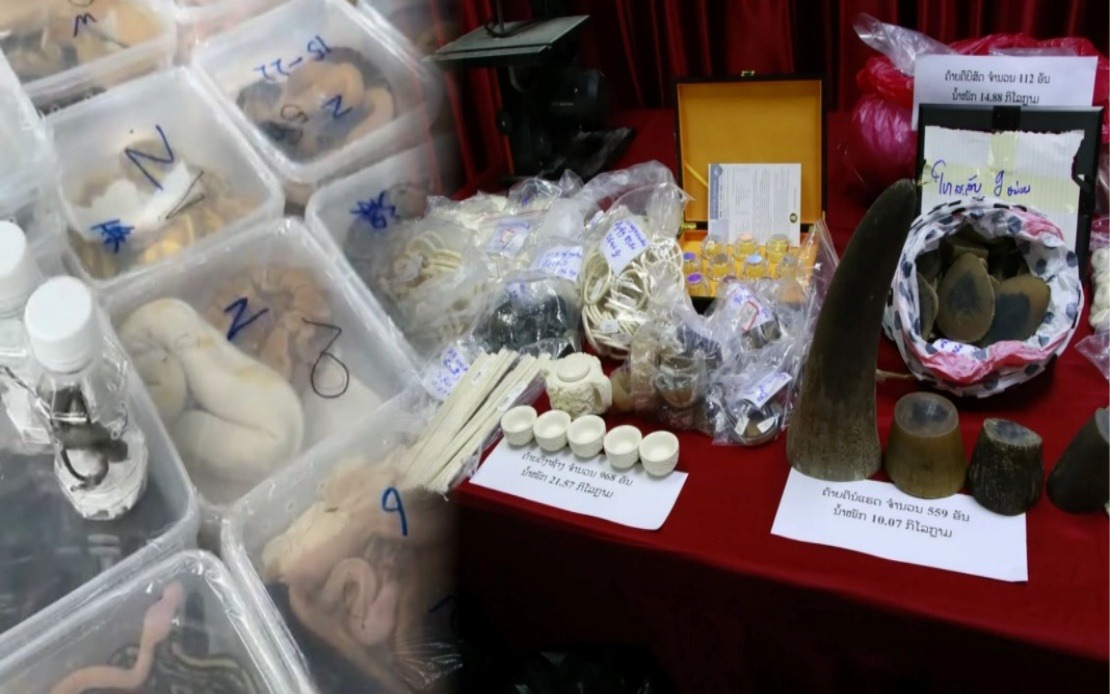
Laotian law enforcement has exposed a sophisticated wildlife smuggling network operating across the country's porous borders, rescuing nearly 300 endangered animals and intercepting substantial quantities of illegal animal products in coordinated operations spanning multiple provinces. The enforcement actions, conducted in Luang Prabang and Champasak provinces, highlight how criminal syndicates exploit Laos's geographic position as a transit hub for trafficking animals destined for markets across Southeast Asia and beyond.
The Lao Wildlife Enforcement Network's operation in Luang Prabang, one of the region's most popular tourist destinations, yielded alarming quantities of contraband wildlife materials. Officers discovered approximately 60 kilogrammes of suspected illegal products, including ornamental items resembling ivory, animal gallbladders harvested for traditional medicine, pangolin scales, and rhinoceros horn fragments. Additional seizures encompassed elephant skin powder, bear gallbladder extract, preserved hornbill heads, and tubes marketed as herbal remedies but containing unidentified wildlife-derived ingredients. The variety and sophistication of the confiscated goods suggest organised trafficking networks with established supply chains and customer bases throughout the region.
Just four days after the Luang Prabang discoveries, Laotian rangers achieved an even more significant breakthrough at the Vang Tao International Checkpoint in Champasak Province, the principal border crossing connecting to Ubon Ratchathani Province in northeastern Thailand. Authorities intercepted 294 live reptiles and other animals being transported on an international passenger bus heading towards Bangkok. The captured creatures included freshwater turtles, pythons, green snakes, gold-ringed cat snakes, and various lizard species—all species not naturally occurring in Laos, indicating they had been collected in other countries and were being transited through Laotian territory towards more lucrative Thai and international markets.
These enforcement successes are not isolated incidents but represent a pattern of criminal activity that authorities are increasingly able to disrupt. In late May, a Thai woman operating a traditional medicine and souvenir shop in Nakhon Phanom, a town directly across the Mekong River from Laos, was arrested following Thai police discovery of more than 100 protected wildlife remains in her inventory, the vast majority suspected to have originated from Laos. Similarly, on May 16, investigators dismantled a smuggling attempt at the Thai-Lao border involving 130 kilogrammes of processed elephant ivory and animal carcasses valued at substantial sums, according to Traffic Southeast Asia, a respected wildlife crime monitoring organisation.
Laos's central position in mainland Southeast Asia makes it uniquely vulnerable to exploitation by trafficking networks. The country shares international borders with Cambodia, China, Myanmar, Thailand, and Vietnam—five nations with populations numbering in the hundreds of millions and economies increasingly affluent enough to sustain demand for traditional medicines, exotic pets, and wildlife-based luxury goods. For traffickers, Laos represents both a source region for animals captured in its forests and a convenient transit corridor for contraband moving between source countries and consumer markets, particularly Thailand, China, and Vietnam. The country's limited enforcement resources, vast forest areas, and permeable borders create an environment where wildlife criminals operate with relative impunity.
The scale of global wildlife trafficking far exceeds what most people realise, according to recent research from the United Nations Office on Drugs and Crime. Their comprehensive World Wildlife Crime Report 2024 estimates that illegal wildlife trade generates approximately US$10 billion (RM41 billion) annually worldwide, placing it alongside human trafficking, narcotics distribution, and arms smuggling as one of the planet's most lucrative criminal enterprises. The report emphasises that despite two decades of intensified international cooperation, enforcement efforts, and treaty obligations, illegal wildlife trafficking continues to expand in both scope and sophistication.
The report identifies corruption as the fundamental enabler of wildlife smuggling networks. Without corrupt border officials willing to overlook shipments, corrupt wildlife inspectors who certify fake permits, and corrupt law enforcement officers who tip off traffickers about impending raids, the scale of current smuggling would be substantially reduced. This systemic corruption reflects broader governance challenges across the region, where official salaries lag far behind the profits available from facilitating illegal trade. Addressing wildlife trafficking therefore requires not merely catching individual smugglers but fundamentally reforming enforcement institutions and the economic incentives that make corruption attractive.
The animals rescued in recent operations face uncertain futures despite their rescue. Laotian authorities lack adequate facilities to house and care for hundreds of confiscated reptiles and other species. Many rescued animals suffer stress, injury, and disease from improper transport and handling before capture. Those that survive rehabilitation face difficult choices regarding repatriation to original habitats—which may be in different countries and difficult to identify—or placement in wildlife sanctuaries and zoos. The rescue of 294 animals represents a conservation victory but also exposes the limited capacity of Laotian institutions to manage wildlife crime effectively.
For Malaysian readers and policymakers, these developments carry significant implications. Malaysia itself serves as both a source region and transit hub for wildlife trafficking, and shares similar governance challenges to Laos regarding border control and enforcement capacity. The sophistication of the networks exposed in Laos, their ability to operate across multiple countries, and their exploitation of traditional medicine markets demonstrates that Southeast Asian trafficking operates as an integrated criminal system rather than isolated incidents. Malaysian cooperation with Laotian, Thai, and Vietnamese authorities through intelligence sharing, joint operations, and capacity building represents a strategic necessity rather than optional development assistance.
The particular targeting of traditional medicine products in these seizures reflects the deep cultural demand for wildlife-derived remedies across East and Southeast Asia. Bear gallbladder, rhino horn, elephant products, and pangolin scales command premium prices precisely because they occupy central places in traditional medicine systems with centuries of cultural authority. Addressing trafficking therefore requires not merely enforcement but also parallel efforts to develop synthetic alternatives, promote consumer education, and work with traditional medicine practitioners to encourage substitution of sustainable materials. Without addressing demand, enforcement alone will prove insufficient to protect endangered species.
Laotian authorities have demonstrated increased commitment to wildlife enforcement through these coordinated operations, which required sophisticated inter-agency coordination, intelligence gathering, and sustained investigative effort. However, the operations also suggest that trafficking remains embedded in criminal networks with sufficient resources to continue despite enforcement risks. The fact that nearly 300 animals were being transported on a regular passenger bus, in plain sight, suggests either remarkable operational security by the traffickers or inadequate routine inspection procedures at border crossings. Both possibilities underscore why comprehensive border management reform, combined with intelligence-led policing targeting the criminal networks themselves rather than merely interdicting shipments, remains essential for meaningful progress.
%22%2F%3E%3C%2Fpattern%3E%3C%2Fdefs%3E%3Crect%20width%3D%22100%25%22%20height%3D%22100%25%22%20fill%3D%22url(%23phb3yeg)%22%2F%3E%3Crect%20width%3D%22100%25%22%20height%3D%22100%25%22%20fill%3D%22url(%23phb3yep)%22%2F%3E%3Ctext%20x%3D%2250%25%22%20y%3D%2250%25%22%20text-anchor%3D%22middle%22%20dominant-baseline%3D%22central%22%20fill%3D%22rgba(255%2C255%2C255%2C0.95)%22%20font-family%3D%22Georgia%2C%20'Times%20New%20Roman'%2C%20serif%22%20font-weight%3D%22700%22%20font-size%3D%22194%22%20letter-spacing%3D%22-0.02em%22%3EMALBATT%3C%2Ftext%3E%3C%2Fsvg%3E)
%22%2F%3E%3C%2Fpattern%3E%3C%2Fdefs%3E%3Crect%20width%3D%22100%25%22%20height%3D%22100%25%22%20fill%3D%22url(%23ph5giing)%22%2F%3E%3Crect%20width%3D%22100%25%22%20height%3D%22100%25%22%20fill%3D%22url(%23ph5giinp)%22%2F%3E%3Ctext%20x%3D%2250%25%22%20y%3D%2250%25%22%20text-anchor%3D%22middle%22%20dominant-baseline%3D%22central%22%20fill%3D%22rgba(255%2C255%2C255%2C0.95)%22%20font-family%3D%22Georgia%2C%20'Times%20New%20Roman'%2C%20serif%22%20font-weight%3D%22700%22%20font-size%3D%22320%22%20letter-spacing%3D%22-0.02em%22%3EUS%3C%2Ftext%3E%3C%2Fsvg%3E)
%22%2F%3E%3C%2Fpattern%3E%3C%2Fdefs%3E%3Crect%20width%3D%22100%25%22%20height%3D%22100%25%22%20fill%3D%22url(%23ph31wd2g)%22%2F%3E%3Crect%20width%3D%22100%25%22%20height%3D%22100%25%22%20fill%3D%22url(%23ph31wd2p)%22%2F%3E%3Ctext%20x%3D%2250%25%22%20y%3D%2250%25%22%20text-anchor%3D%22middle%22%20dominant-baseline%3D%22central%22%20fill%3D%22rgba(255%2C255%2C255%2C0.95)%22%20font-family%3D%22Georgia%2C%20'Times%20New%20Roman'%2C%20serif%22%20font-weight%3D%22700%22%20font-size%3D%22194%22%20letter-spacing%3D%22-0.02em%22%3ESpeaker%3C%2Ftext%3E%3C%2Fsvg%3E)