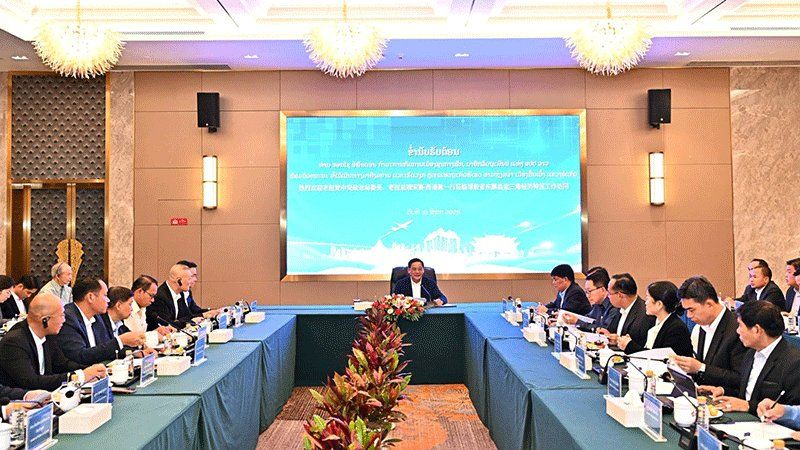
Prime Minister Sonexay Siphandone has signalled growing concerns about the management and developmental trajectory of the Golden Triangle Special Economic Zone (GTSEZ), demanding tighter regulatory oversight during a visit to the sprawling cross-border enclave in Bokeo province's Tonpheung district. With cumulative investments reaching approximately US$10 billion since the Zone's inception in 2007, the Lao leadership appears intent on extracting greater economic returns and ensuring that development aligns with national sustainability objectives.
The 10,000-hectare Zone—comprising 3,000 hectares designated for commercial activities and 7,000 hectares of forested areas—represents one of Laos's most ambitious attempts to leverage its geographic position as a confluence point for regional trade and investment flows. Straddling the Mekong River at the junction where Laos, Myanmar, and Thailand converge, with proximity to China's southwestern frontier, the GTSEZ offers investors unparalleled access to multiple large consumer markets and abundant labour pools. Yet the Prime Minister's recent intervention suggests that sheer location advantage has not translated into the development outcomes originally anticipated.
A striking statistic underscores the Zone's implementation challenges: despite nearly two decades of operations, companies have delivered only 60 per cent of the activities stipulated in their contractual agreements. This substantial performance gap—affecting ventures spanning manufacturing, real estate, hospitality, trade, finance, tourism, and services—indicates systemic weaknesses in accountability mechanisms and administrative capacity. The shortfall suggests either that investor commitments were overly optimistic or that enforcement mechanisms have proven insufficient to compel compliance with agreed benchmarks.
Dr Sonexay's intervention centred on institutional and procedural reforms aimed at improving the investment climate while simultaneously strengthening state oversight. He directed authorities to enhance the one-stop-service framework for investors, recognising that bureaucratic friction often deters or delays project implementation. Simultaneously, he called for stricter enforcement of Lao enterprise law and mandated that all financial transactions—encompassing wages, trade settlements, investment flows, and service payments—flow through the national banking system rather than informal channels. This dual approach reflects an intention to simultaneously attract investment and monitor capital flows more effectively.
Sector prioritisation formed a key component of the Prime Minister's guidance. Tourism, manufacturing, processing, transportation, education, and public health were identified as domains requiring accelerated development and investor focus. This sectoral preference indicates a shift towards economic activities with perceived multiplier effects and employment generation capacity, moving beyond the simpler real estate and hospitality investments that have dominated the Zone's early development phase. The emphasis on education and public health also suggests recognition that sustainable regional growth requires human capital investment and infrastructure supporting cross-border labour mobility.
Border management emerged as another significant concern. Dr Sonexay instructed officials to implement stricter controls over entry and exit within the Zone, while simultaneously fostering enhanced cooperation with neighbouring administrations to facilitate legitimate movement of workers, investors, and traders. This apparent paradox—strengthening security while deepening cross-border integration—reflects the Zone's inherent tension as a semi-autonomous enclave mediating flows between jurisdictions with varying regulatory standards. Improved airline connectivity and worker management protocols were identified as mechanisms through which this balance might be achieved.
The Zone currently sustains operations employing more than 10,000 registered workers, whilst accommodating an additional transient population exceeding 10,000 comprising investors, business operators, residents, and tourists. Managing this diverse population across competing national jurisdictions presents complex regulatory and infrastructure challenges. The deployment of more than 400 government officials across various sectoral agencies underscores the administrative footprint required to govern the Zone, yet the persistent performance gap suggests that bureaucratic presence alone has not guaranteed developmental effectiveness.
The concession agreement framework itself became subject to scrutiny, with Dr Sonexay calling for revisions ensuring alignment with contemporary Lao legislation. This initiative suggests that existing contractual arrangements may contain provisions granting excessive operational autonomy to Zone developers or privileging investor interests over public welfare. Modernising these agreements whilst maintaining investor confidence represents a delicate calibration that Vientiane must navigate carefully, particularly given the Zone's significance for both economic growth and geopolitical positioning.
For Malaysia and Southeast Asian observers, the Golden Triangle SEZ's trajectory carries instructive lessons regarding the governance challenges attending large cross-border economic zones. The shortfall in contracted activity delivery raises questions about feasibility assessment methodologies and the enforceability of performance commitments in jurisdictions with limited administrative capacity. Furthermore, the Prime Minister's emphasis on banking system oversight and labour migration management resonates with concerns voiced across the region regarding informal economic activity, remittance flows, and migrant worker exploitation. The Lao intervention suggests growing recognition that special economic zones cannot be left to operate under minimal supervision, contrary to the laissez-faire assumptions sometimes implicit in zone development policy.
The Prime Minister's demand for enhanced developer accountability and stronger management committee effectiveness also reflects broader regional patterns of governments reasserting control over nominally autonomous economic enclaves. This recalibration acknowledges that whilst market-driven development generates certain efficiencies, sustained broad-based prosperity requires active state stewardship, particularly in border regions where geopolitical considerations intersect with economic imperatives. How successfully Vientiane implements these regulatory enhancements will substantially influence both the Zone's future performance and its appeal to prospective investors across Southeast Asia and beyond.

