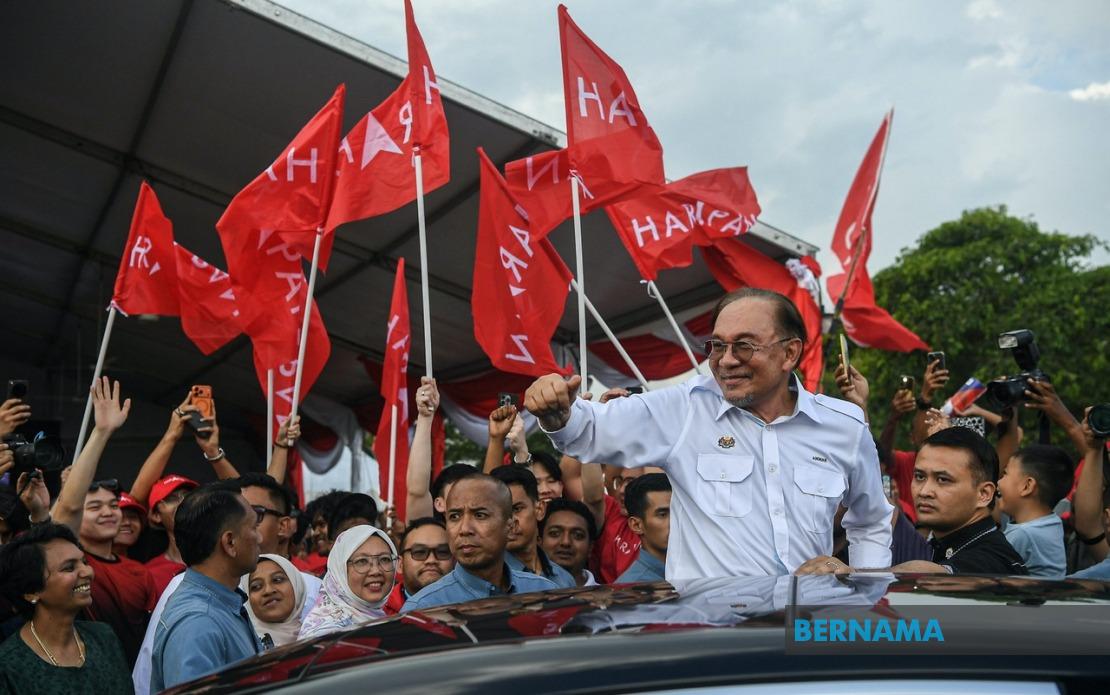
The 16th Johor State Election has showcased the full spectrum of modern campaign techniques, from viral TikTok content to sophisticated Facebook targeting. Yet beneath the digital noise, a quieter truth persists: Malaysia's older voters remain deeply persuaded by the simple act of meeting their candidates in person. A Bernama survey conducted during the campaign period offers revealing insights into how seniors in Johor distinguish between the authentic and the manufactured, between connection and content, in an election season increasingly dominated by algorithmic reach and online engagement metrics.
The research demonstrates that physical presence carries psychological weight that pixels cannot replicate. Senior voters interpret a candidate's willingness to attend rallies and engage with constituents face-to-face as a tangible expression of commitment and sincerity. When A. Chandra, a 70-year-old retired teacher from Perling, contrasts the energy of an in-person campaign event with watching a livestream from home, he articulates something fundamental about human perception: the atmosphere of a crowded gathering, the chance to observe body language and mannerisms, the immediate responsiveness to questions asked aloud—these elements create a form of political evidence that screens cannot provide. The texture of genuine engagement differs fundamentally from its digital simulation.
For voters like Maimunah Ismail, 73, from Sedeli, the preference for physical campaigning rests partly on communication clarity. Standing before a candidate, hearing their words directly rather than filtered through a digital feed, creates fewer opportunities for misinterpretation. Yet she also acknowledges the pragmatic appeal of social media: the ability to follow campaign updates while completing household tasks offers elderly voters a form of political participation that accommodates their daily routines and physical constraints. This dual engagement—consuming political content on screens while still valuing direct interaction—reveals that many older Malaysians are not rejecting digital tools but rather integrating them into a broader information-gathering strategy.
Saadon Mohamad, a 72-year-old settler, articulates a perspective common among his peers: that online availability of political information, while undeniably convenient, lacks the tangible atmosphere and emotional resonance of gathering in a crowd alongside fellow citizens. The excitement and communal energy of a campaign rally cannot be digitally transmitted. This observation points to deeper psychological dimensions of electoral participation—the role that shared experience plays in building voter confidence and commitment. The collective atmosphere itself becomes evidence of popular support.
Interestingly, assumptions about generational digital literacy do not hold true across Johor's population. Fairuz Saif, 59, challenges the stereotype that older Malaysians lack technological competence, instead arguing that campaign effectiveness online depends on presentation quality. When political parties fail to simplify their messaging or condense information effectively, even digitally comfortable voters struggle to extract value from these platforms. The medium itself matters less than the message's clarity and accessibility—a principle that applies regardless of age group.
Physical constraints reveal another dimension of this phenomenon. M. Sivathramani, 73, a retired civil servant with limited mobility from injuries, represents millions of older Malaysians for whom online campaigning provides essential access to political information without the burden of navigating crowded venues. Platforms like TikTok and WhatsApp offer him genuine democratic participation that his health situation would otherwise restrict. Yet significantly, he still expresses a preference for meeting candidates in person when mobility permits. This suggests that digital access serves primarily as an accommodation rather than an ideal solution.
Lee Lian Chen, 58, approaches electoral decision-making with systematic pragmatism. As a small business owner, time scarcity forces her to begin candidate research through social media before attending events in person. Her voting calculation centres on implementation capacity—whether politicians can translate promises into tangible delivery. For her segment, the hybrid approach makes tactical sense: digital media provides efficient initial screening, while face-to-face interaction offers final verification of a candidate's authenticity and competence.
Dr Nazreena Mohammed Yasin, a senior lecturer in social sciences at Universiti Tun Hussein Onn Malaysia, places these observations within broader theoretical frameworks about voter behaviour and generational information consumption patterns. Her analysis reframes the apparent competition between physical and digital campaigning as a false dichotomy. Rather, contemporary electoral politics increasingly demands that campaigns operate across both domains simultaneously, recognising that different voters access political information through different channels depending on their generation, professional circumstances, technological comfort, and physical capacity. The landscape has become fundamentally hybrid.
Dr Nazreena notes that traditional media consumption—newspapers, television—still structures the political awareness of some older voters, while others have transitioned to Facebook, WhatsApp, and TikTok for real-time updates and campaign footage. The diversity within Johor's older population means that no single approach optimally reaches all seniors. What appears demographically as a unified voting bloc actually comprises multiple sub-groups with distinct information-gathering habits and medium preferences. Political strategists must account for this heterogeneity.
The scholar further observes that working adults, regardless of age, tend toward digital solutions for campaign information due to occupational constraints and time pressures. Someone managing a business, juggling family responsibilities, or working inflexible hours may lack the capacity to attend evening rallies, making social media a practical necessity rather than a preference. Digital platforms solve a logistical problem—enabling political participation despite demanding schedules. The choice between online and offline becomes less about preference and more about feasibility.
The concept of hybrid voter behaviour—combining direct rally experiences with social media research before finalising ballot decisions—emerges as the dominant pattern across multiple age groups and circumstances. Voters synthesise information and experiences from multiple sources, treating each as contributing distinct value to their final assessment. A candidate's digital presence reveals their contemporary communication capabilities and message discipline. Their physical campaign performance demonstrates authenticity, responsiveness, and genuine community engagement. Neither source alone provides sufficient grounds for informed voting.
With 2.7 million voters eligible to cast ballots in Saturday's election for 56 representatives across Johor's constituencies, political parties cannot afford to privilege one campaign channel over another. The electorate clearly operates across multiple platforms and modes of information consumption simultaneously. Campaign strategies that recognise this reality—maintaining vigorous ground presence while sustaining sophisticated digital outreach—acknowledge the complex, multi-layered way modern Malaysian voters evaluate their choices.
The 16th Johor State Election ultimately demonstrates that Malaysia's political landscape has not simply transitioned from traditional to digital campaigning but rather expanded to encompass both. Voters have become increasingly sophisticated in integrating diverse information sources, treating each medium as offering particular insights into candidates' capabilities and character. As elections in Malaysia and across Southeast Asia grow more digitally sophisticated, the continued appetite for genuine face-to-face engagement among voters—particularly those with lived experience and sceptical eyes—offers a crucial counterbalance to algorithmic influence and micro-targeted messaging.

