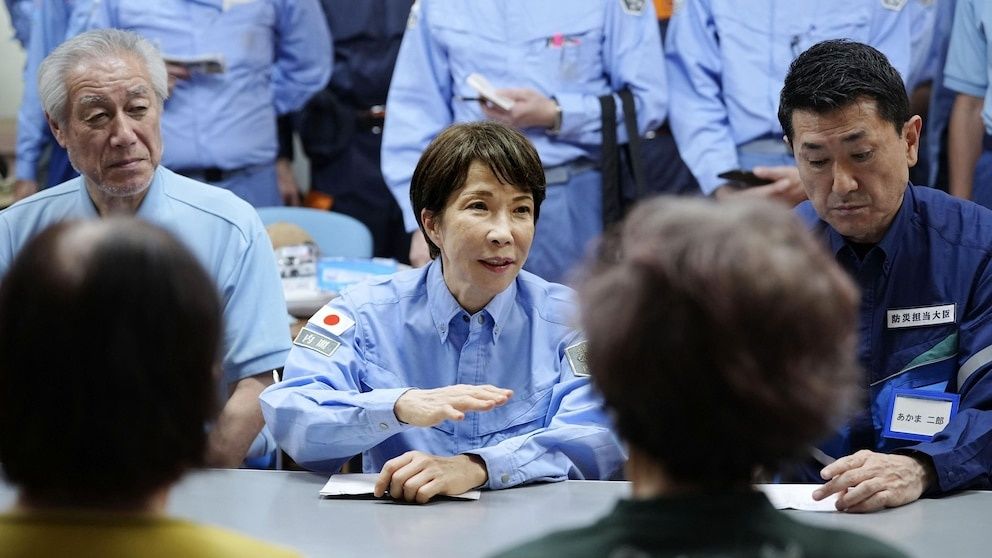
Prime Minister Sanae Takaichi has made her first visit to Japan's severely earthquake-damaged Kumamoto Prefecture, where residents are grappling with the twin crises of structural devastation and intensifying weather conditions. The magnitude 7.1 earthquake that struck the southern Kyushu island on Tuesday, August 4, has left 38 people dead and over 114 injured, while forcing tens of thousands from their homes into inadequate emergency shelters. As cleanup operations begin in earnest, the region now faces an even more pressing threat: scorching heat that the Japan Meteorological Agency has forecast to climb close to 40 degrees Celsius (104 Fahrenheit), creating dangerous conditions for vulnerable displaced populations.
The immediate aftermath has revealed the vast scale of the destruction across Kumamoto. Official figures show that approximately 700 homes have been completely destroyed, with a further 11,300 buildings sustaining varying degrees of damage. In the towns of Uki and Hikawa, construction crews have begun erecting temporary housing, while some local hotels and inns have opened their doors to shelter evacuees. Throughout affected communities, residents are methodically sorting through the wreckage, placing heaps of debris, shattered furniture and damaged appliances at collection points—a painstaking process now complicated by the oppressive heat that blankets the region.
The combination of structural damage and extreme weather has created a perfect storm for disaster response authorities. More than 46,000 households remain without access to clean water, while many residents simultaneously face acute fuel shortages. These dual crises are particularly alarming given that sweltering conditions typically drive significant increases in heat-related illnesses and deaths. In a tragic illustration of this danger, one of the 38 earthquake fatalities was attributed to apparent heat stroke suffered by a person sheltering in a parked car, whilst another death remains under investigation. Officials fear that without rapid improvements to shelter conditions and resource availability, the death toll could climb further in the coming days.
The shelter situation underscores broader vulnerabilities in Japan's disaster preparedness infrastructure. More than 8,500 people remain crowded into emergency shelters hastily converted from community centers, school gymnasiums and classrooms—facilities that many lack basic amenities such as air-conditioning. Beyond these institutional shelters, thousands of displaced residents are sleeping rough in their cars in town hall parking lots and parks, or attempting to survive outside damaged properties. Experts have long cautioned that such overcrowded conditions breed secondary problems: inadequate sanitation facilities, minimal privacy, increased risk of disease transmission, and psychological strain that can persist long after the initial disaster.
Kumamoto Governor Takashi Kimura used his meeting with Prime Minister Takaichi to emphasise the "abnormal heat" now compounding residents' suffering. In his appeal for enhanced government support, Kimura highlighted the critical shortages of clean water and medical care at evacuation centers—deficiencies that become life-threatening during heat waves. The governor's stark assessment appears to have resonated with the Prime Minister, who committed to examining what additional resources the national government could mobilize for the disaster-hit region and its affected population. Takaichi stated that the government would "move proactively" to address the governor's concerns, though she offered no specific commitments or timeline for implementation.
The Prime Minister's visit itself generated controversy on social media platforms. Takaichi toured the affected areas by military helicopter before visiting one of the region's best-equipped shelters, which featured cardboard beds, partition walls, and air-conditioning—amenities markedly absent from most other evacuation centers. This curated tour of a relatively comfortable facility prompted online criticism that her visit presented a distorted picture of the true hardship facing most displaced residents, many of whom lack basic comforts and cooling facilities in the sweltering heat.
Beyond the immediate humanitarian crisis, accountability questions have emerged regarding corporate decisions made during the disaster. Two employees at a general store operated by local company Habita were killed in an explosion at the Aeon Mall in Kashima after the initial quake struck. The company has acknowledged instructing these two workers, including 22-year-old Kurumi Otake, to return to the damaged building to secure sales proceeds in a safe—a decision that proved fatal. Two company executives attended the wake of one victim and apologized to her parents, with Otake's mother expressing anguish that "someone had stopped her" from returning to the building.
The mall explosion itself resulted from an apparent gas leak that ignited after roughly 3,000 shoppers had been evacuated to the parking area. However, some employees, including those sent back by Habita, remained inside the structure when the explosion occurred. The disaster at the mall claimed seven lives and necessitated rescue operations that recovered five additional survivors from the rubble. The incident has raised uncomfortable questions about the chain of decisions—both structural and managerial—that can transform an initial natural disaster into a secondary catastrophe.
For Malaysia and other Southeast Asian nations monitoring Japan's response, the Kumamoto earthquake offers sobering lessons about disaster preparedness and the cascading failures that occur when initial emergency response systems prove inadequate. The region's vulnerability to heat-related mortality during the critical post-earthquake period demonstrates that natural disaster planning cannot focus solely on the immediate impact of earthquakes themselves, but must account for secondary environmental hazards. The crowded shelter conditions and resource shortages echo similar challenges faced in previous major disasters across Asia, where rapid urbanization and population density have created enormous challenges for emergency management authorities.
The recovery process in Kumamoto will likely extend for months, if not years, particularly given the scale of structural damage and the ongoing resource constraints. Beyond the immediate humanitarian response, questions persist about the adequacy of Japan's building codes, shelter provision systems, and corporate accountability mechanisms during disasters. For a developed nation with sophisticated disaster management infrastructure, the unfolding crisis in Kumamoto suggests that even advanced preparedness systems can be overwhelmed when multiple stressors—heat, water shortages, shelter capacity limitations, and corporate negligence—converge simultaneously.

