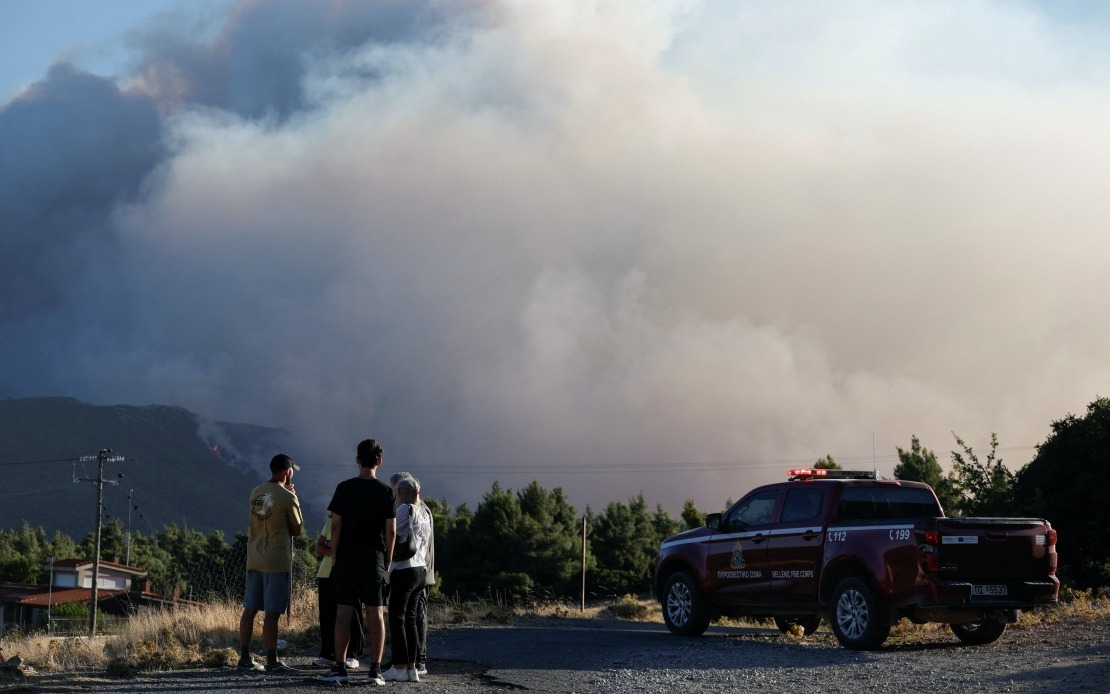
Greece's firefighting services faced an intense struggle on Sunday as a sprawling wildfire continued its destructive march across the Kithairon Mountains west of Athens, with the advancing flames now positioned dangerously close to the coastal city of Megara. The scale of the emergency response underscored the severity of the crisis, as hundreds of emergency personnel worked through the night and into daylight hours to contain the rapidly expanding inferno, supported by military assets, civilian volunteers, and specialized heavy equipment deployed across multiple fronts.
The firefighting operation drew resources from across Europe, reflecting both the scale of the disaster and international solidarity in crisis response. At least 500 firefighters were actively engaged in suppressing the blaze, augmented by specialist crews from Romania and France who travelled to Greece to assist with the overwhelming emergency. State broadcaster ERT reported that as daylight broke on Sunday, aerial support resumed operations with firefighting planes and helicopters resuming their water-dropping missions over the affected terrain, providing critical relief to ground crews exhausted from overnight efforts.
The unpredictable behaviour of the flames, driven by strong winds that periodically accelerated their spread, complicated containment efforts throughout the night. The communities of Veniza and Psatha bore the brunt of the fire's initial assault, experiencing particularly intense destruction as the flames swept through populated areas. The eastward trajectory of the fire presented an escalating threat, with the flames advancing to within several kilometres of Megara, a city located approximately 50 kilometres to the west of Athens. This proximity represented a critical development in the emergency, raising the stakes considerably as authorities worked to prevent the disaster from reaching the city's residential areas and infrastructure.
The environmental toll was staggering, with meteorological estimates suggesting that approximately 10,000 hectares of land across the north-western and western sectors surrounding Athens had already been consumed by the current fires. Such extensive destruction of forests and vegetation extends far beyond the immediate human crisis, carrying profound implications for the region's ecosystem, air quality, and long-term environmental recovery. The scale of burned territory reflects the intensity and duration of the firefighting campaign required to address this particular disaster.
Greek authorities initiated criminal investigations into the outbreak, arresting 13 individuals nationwide on suspicion of negligent arson. These arrests suggested that human carelessness, whether through abandoned campfires, discarded cigarettes, or other forms of negligent behaviour, may have contributed to igniting the catastrophic blaze. The criminal prosecutions underscored the legal and moral responsibility individuals bear in regions prone to wildfires, particularly during high-risk seasonal periods when dry conditions make vegetation extraordinarily vulnerable to ignition.
While the Megara situation commanded the most urgent attention on Sunday, Greece's wildfire crisis extended across multiple locations simultaneously. The island of Cephalonia was also experiencing a significant fire, though local authorities indicated that immediate population centres did not face imminent danger from that particular blaze. This geographic spread of multiple simultaneous fires placed additional strain on national emergency resources and personnel, as the country attempted to manage concurrent crises across diverse terrain and population centres.
On the island of Crete, firefighting operations had achieved more success, with local media reporting that wildfires there had been substantially extinguished by Sunday. However, the Cretan fires had necessitated the evacuation of several towns before they were brought under control. Media reports suggested that approximately 200 homes were destroyed across the island, though Greek authorities had not officially confirmed this casualty figure. The destruction on Crete demonstrated the residential toll these disasters exact, displacing families and destroying private property and livelihoods.
For Malaysian and Southeast Asian observers, the unfolding Greek disaster carries relevant lessons regarding climate vulnerability and disaster preparedness. Mediterranean nations increasingly experience intensified wildfire seasons as changing climatic patterns extend heat waves and reduce precipitation during critical periods. The mobilisation of international firefighting resources reflects the transnational nature of modern environmental emergencies, with expertise and personnel crossing borders to address catastrophes that individual nations struggle to manage alone. Southeast Asian nations, particularly those with significant forested regions like Indonesia and Malaysia, face comparable wildfire risks during dry seasons, making the Greek response mechanisms worth studying.
The crisis also highlights the importance of rapid aerial response capability, community evacuation protocols, and international coordination frameworks. Greece's deployment of military assets alongside civilian firefighting services demonstrates how governments integrate diverse response sectors during emergencies. The involvement of foreign crews suggests the value of bilateral and multilateral agreements that enable rapid resource-sharing during disasters, a model that could inform regional cooperation frameworks in Southeast Asia.
The broader context reveals how environmental challenges increasingly dominate policy discussions globally. Extreme weather events driven by shifting climate patterns have become routine rather than exceptional occurrences, requiring governments to invest continuously in emergency preparedness, equipment, and personnel training. The Megara wildfire, while geographically distant, represents a challenge increasingly familiar to regions across the globe, from North America to Australia to Southeast Asia, making it a universally relevant demonstration of how modern societies respond to environmental emergencies.

