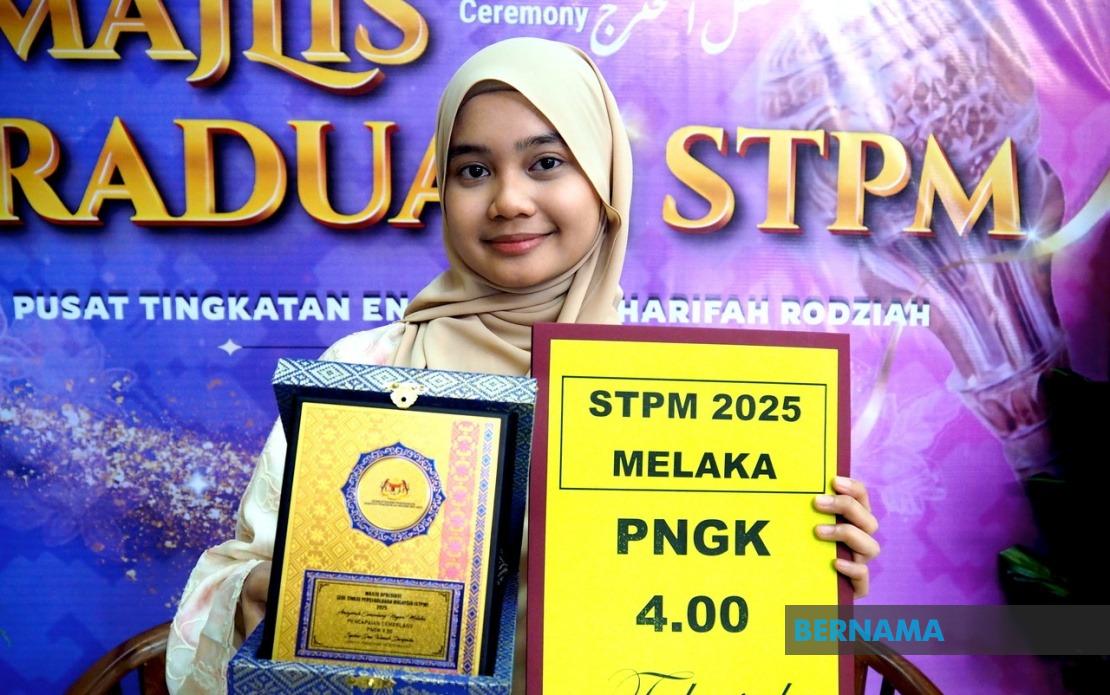
Nurfariesya Nasywa Hamedee's journey to academic excellence reads like a testament to resilience and familial devotion. The 21-year-old from Sekolah Menengah Kebangsaan Agama Sharifah Rodziah in Melaka clinched a perfect Cumulative Grade Point Average of 4.00 in the 2025 Sijil Tinggi Persekolahan Malaysia examination, a result announced on June 19 following the state-level awards ceremony attended by Datuk Rosli Abdullah, the State Deputy Exco for Education, Higher Education, and Religious Affairs.
What distinguishes Nurfariesya's achievement is not merely the stellar marks, but the extraordinary personal circumstances that framed her academic journey. Her father, Hamedee Asri, passed away from a sudden heart attack just one week before she was scheduled to sit for her Sijil Pelajaran Malaysia trial examination several years prior. The timing of his death could easily have derailed her educational trajectory at a critical juncture. Instead, his parting counsel—delivered indirectly through her mother, Yusnita Ruslan—became the cornerstone of her motivation. In those dark months following his death, when grief threatened to consume her future, Nurfariesya considered abandoning her studies altogether to enter the workforce and help support her family.
The decision to persevere with her education represented a profound choice, one that balanced filial obligation with paternal wishes. Hamedee's insistence that his daughter not squander her potential proved far more powerful than the immediate economic pressures facing the household. This message, conveyed by her mother during the period of acute mourning, crystallised into an unwavering commitment. Nurfariesya resolved that the best way to honour her father's memory was to pursue excellence in her studies, transforming grief into determination and loss into purpose.
As the third of four siblings, Nurfariesya brought home not only personal vindication but also validation for her family's sacrifices. Her earlier performance in the SPM examination—seven distinctions—had already suggested considerable academic promise. However, even she harboured realistic doubts about achieving a perfect CGPA. Based on her STPM trial results and preliminary self-assessments, she had calculated an expected outcome of approximately 3.92. Exceeding this projection to reach a flawless 4.00 demonstrates both the hidden reserves of her capability and the psychological power of purpose-driven study.
Beyond grief-fuelled motivation, Nurfariesya's success also reflects a genuine intellectual passion for her chosen field. Her deep interest in Shariah law, cultivated during her secondary school years, provided intrinsic motivation alongside the external driver of honouring her father. She enrolled in subjects encompassing General Studies, Arabic, Usuluddin (Islamic Theology), History, and Shariah—a demanding combination that demands both linguistic facility and theological reasoning. This curricular choice was not random but purposeful, directly aligned with her aspiration to become a Shariah lawyer, a profession that requires not only exceptional academic credentials but also a demonstrable commitment to Islamic jurisprudence.
Nurfariesya's plans extend beyond STPM success. She has already completed an interview for a Bachelor's Degree programme at Universiti Malaya, positioning herself to transition seamlessly from secondary to tertiary education. Her selection of STPM over other post-secondary pathways reflects pragmatic educational planning; she recognised the qualification as providing a shorter route to degree-level study whilst simultaneously opening doors to multiple higher learning institutions. This strategic approach, combined with her strong foundation in relevant subjects, enhances her prospects of admission to competitive programmes.
In reflecting upon her achievement, Nurfariesya offers counsel that resonates far beyond her own circumstances. She emphasises that no secret formula exists for academic success—only disciplined study habits, resilience in the face of setbacks, and unwavering faith. This humble articulation, rooted in lived experience, carries particular weight for Malaysian students navigating their own challenges. Her testimony suggests that extraordinary results emerge not from extraordinary talent alone, but from the intersection of ability, determination, and meaning derived from beyond oneself.
Nurfariesya was not the only outstanding performer celebrated at Melaka's 2025 STPM results announcement. Ng Zhen Hong, a 20-year-old student from Kolej Tingkatan Enam Tun Fatimah, earned recognition as the National-Level Best Student Award recipient for the Science Stream. Ng's achievement underscores the diversity of excellence across different academic disciplines and institutional contexts. The eldest of two siblings, he secured ten distinctions in his SPM examination and attributed his success to parental support, dedicated teachers, and a genuine passion for science subjects, particularly those involving quantitative analysis and problem-solving methodology. He invested one to two hours daily in lesson revision and approached scientific challenges as opportunities for mastery rather than obstacles.
Ng's planned trajectory toward Chemical Engineering or Electrical Engineering at Universiti Malaya reflects the pipeline of talent feeding Malaysia's technical workforce. His unexpected emergence as the national science stream leader suggests that consistent application and intellectual authenticity often yield results that exceed even personal expectations. Like Nurfariesya, he demonstrates that top-tier academic performance in contemporary Malaysia emerges from students who combine discipline with genuine intellectual engagement.
These two students embody contrasting yet complementary dimensions of Malaysian educational achievement. Nurfariesya's journey highlights the capacity of disadvantage—loss, grief, economic pressure—to be transmuted into exceptional performance through meaning-making and familial bonds. Her path toward Shariah law addresses professional areas where Malaysia requires skilled practitioners equipped with both technical competence and ethical grounding. Ng's trajectory into engineering disciplines aligns with the nation's ongoing need for technical expertise in an increasingly complex economic landscape. Together, their stories illustrate that educational excellence in contemporary Malaysia flows from varied sources: personal tragedy transformed into purpose, parental support networks, institutional quality, and the cultivation of genuine intellectual passion across different knowledge domains.
The broader context for these achievements lies in Malaysia's examination system and its role in channelling talent toward higher education and professional careers. The STPM remains a rigorous pathway attracting high-performing students who choose this route for various strategic and intellectual reasons. Results such as those announced in June 2025 across Melaka reflect the continuing vitality of this system and the motivations driving Malaysian young people to pursue academic excellence despite competing pressures and personal adversities. For students considering their post-SPM options, the examples set by achievers like Nurfariesya and Ng offer both inspiration and practical testament to the returns available through disciplined engagement with demanding curricula.