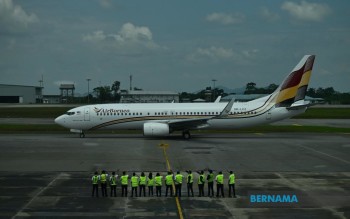
Deputy Prime Minister Datuk Seri Fadillah Yusof received AirBorneo Airways' inaugural commercial flight at Kuala Lumpur International Airport Terminal 1 on July 20, marking a significant moment in Sarawak's ongoing efforts to assert greater autonomy over its aviation infrastructure. Flight MY5005 from Kuching carried Sarawak Premier Tan Sri Abang Johari Tun Openg alongside state ministers and invited guests, underscoring the political importance attached to this launch. The arrival represented more than a routine inaugural service—it symbolized the fruition of Sarawak's long-standing ambition to operate its own commercial airline and reduce dependence on established carriers for regional connectivity.
AirBorneo, the Sarawak state-owned airline, has entered the commercial jet phase with two wet-leased Boeing 737-800 aircraft, a move that positions the carrier to compete directly on Malaysia's busiest domestic route. Chairman Datuk Amar Mohamad Abu Bakar Marzuki, who also serves as Sarawak's state secretary, characterized the inaugural flight as evidence of Sarawak's commitment to strengthening internal aviation networks and broadening economic possibilities across the state. His dual role underscores how closely integrated the airline remains with Sarawak's governance structure and development priorities. The timing of this launch comes amid broader discussions within Malaysia about regional development and the role of state-level enterprises in driving economic growth.
The significance of enhanced air connectivity for Sarawak cannot be overstated in the context of the state's geography and economic structure. Geographically dispersed communities and limited overland transport infrastructure make reliable and affordable air services essential for business development, tourism, and social cohesion. AirBorneo's entry into the Kuching–Kuala Lumpur market directly addresses a critical gap, offering passengers competitive alternatives to existing operators. By leveraging state ownership and resources, Sarawak aims to keep aviation revenue within the state economy rather than allowing profits to flow to privately-held competitors. This approach reflects a deliberate strategy to retain control over a key economic sector that influences both consumer mobility and business investment decisions.
From July 21, 2026, the airline will execute twice-daily flights on the Kuching–Kuala Lumpur corridor, establishing a frequency comparable to or exceeding established carriers on this route. Ticket pricing demonstrates AirBorneo's competitive positioning: Economy Class fares start at RM375 for one-way travel, whilst Business Class begins at RM736. These price points suggest the airline intends to capture market share across multiple passenger segments rather than positioning itself exclusively as a budget or premium operator. The affordability factor is particularly relevant for Malaysian readers, as lower airfares typically stimulate travel demand, which benefits not only the airline but also related tourism and hospitality sectors in both cities.
Chief Executive Officer Megat Ardian Mohd Aminuddin framed the launch as a pivotal inflection point in AirBorneo's development trajectory. His emphasis on safety, reliability, and service quality reflects industry-standard operational messaging but also signals awareness that AirBorneo must establish credibility among passengers accustomed to established carriers. The airline's success on the Kuching–Kuala Lumpur route will likely determine investor and government confidence in funding further expansion. Poor performance could jeopardize ambitious growth plans, whilst strong passenger uptake would validate Sarawak's investment thesis and open doors for network expansion across multiple routes.
The presence of several federal ministers—Tourism, Arts and Culture Minister Datuk Seri Tiong King Sing, Women, Family and Community Development Minister Datuk Seri Nancy Shukri, and Deputy Transport Minister Datuk Hasbi Habibollah—reflected the national-level significance attributed to this development. Federal government endorsement, implicit in ministerial attendance, signals alignment between Sarawak's aviation ambitions and Malaysia's broader economic integration objectives. This inter-governmental support could prove instrumental in facilitating regulatory approvals, airport slot allocations, and potential subsidies or tax incentives that may support AirBorneo's initial operations.
The Kuching–Kuala Lumpur service represents merely the opening chapter of AirBorneo's expansion narrative. Management has already announced plans to progressively extend the network into multiple domestic markets, with Singapore earmarked as the airline's first international destination. This trajectory reflects ambitions that extend beyond simple point-to-point connectivity; instead, AirBorneo aspires to function as a regional gateway for Sarawak, attracting international passengers and positioning the state as a travel hub within Southeast Asia. However, operating internationally introduces substantially greater complexity in terms of regulatory compliance, aircraft standards, and competitive pressures from established regional carriers.
AirBorneo's competitive environment warrants careful analysis for Malaysian observers. Established carriers such as Malaysia Airlines, AirAsia, and regional competitors have extensive experience, brand recognition, and network advantages that newcomers must overcome. AirBorneo's state ownership provides financial resilience that private competitors may lack, yet it does not guarantee operational excellence or customer satisfaction. Success will depend fundamentally on execution: whether flight reliability, scheduling consistency, and customer service meet or exceed passenger expectations. Early performance will heavily influence whether Sarawak's aviation investment generates the economic returns and connectivity benefits that proponents anticipate.
The financial viability of AirBorneo's operations remains an open question despite government backing. Operating twice-daily flights on a single domestic route with wet-leased aircraft generates substantial fixed costs that must be recovered through ticket revenues. Load factors—the percentage of available seats actually filled—will determine profitability, and competition may compress fares below levels that generate acceptable returns. Should the airline require sustained government subsidies to remain operational, questions about resource allocation and opportunity costs will inevitably arise within Sarawak's fiscal debates.
From a Malaysian economic perspective, AirBorneo's launch illustrates the growing emphasis placed by state governments on developing their own economic champions and retaining sectoral control. This mirrors global trends toward state-owned enterprises in aviation, seen across Southeast Asia and beyond. Whether Sarawak's model proves sustainable and replicable remains uncertain, but the willingness to invest in aviation infrastructure demonstrates confidence in Sarawak's medium-term economic trajectory and commitment to integrating the state more tightly into Malaysia's domestic and regional economies through improved transportation networks.

