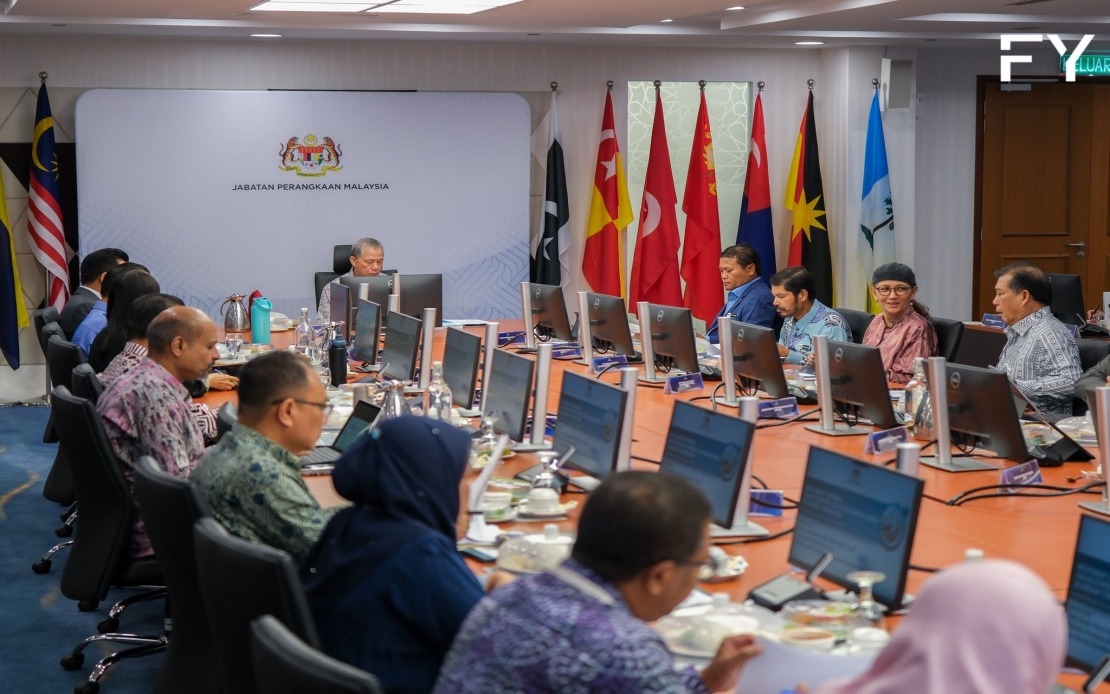
Deputy Prime Minister Datuk Seri Fadillah Yusof has outlined how robust data infrastructure and artificial intelligence adoption will serve as essential pillars underpinning Malaysia's development agenda over the 13th Malaysia Plan period from 2026 to 2030. Speaking after chairing a high-level session of the National Statistics and Data Council (MSDN), Fadillah stressed that the government intends to progressively enhance the National Statistical System while broadening the application of data analytics and AI technologies throughout its administrative decision-making framework.
The emphasis on data-driven governance reflects a global shift in how governments approach policymaking, particularly in an environment characterised by economic volatility, shifting geopolitical alignments, rapid digitalisation, climate-related risks and unprecedented technological change. For Malaysia, constructing a more sophisticated statistical apparatus becomes not merely a technical exercise but a strategic imperative, enabling officials to navigate these interlocking challenges with greater clarity and precision.
Fadillah articulated that quality, reliable and timely statistical information can no longer be regarded simply as administrative information. Instead, these assets function as strategic national resources capable of substantially amplifying the efficiency of public services while simultaneously fortifying broader economic and social resilience. The framing reflects a sophisticated understanding that competitive advantage in the modern global economy increasingly depends upon the quality of decisions informed by comprehensive, real-time data rather than institutional inertia or precedent alone.
The successful execution of the 13th Malaysia Plan hinges critically upon having access to superior-grade data and statistical frameworks that underpin policy development, operational rollout, continuous monitoring and rigorous assessment processes. Without such foundations, even well-intentioned policies risk achieving suboptimal outcomes or missing unintended consequences that might have been anticipated through better analytical capacity. Fadillah's statement emphasises that the government recognises this dependency and has committed institutional resources toward closing any existing gaps.
Malaysia's recent economic trajectory provides empirical support for this data-centric philosophy. The nation recorded gross domestic product expansion of 5.4 per cent during the first quarter of 2026, a performance Fadillah attributed directly to development initiatives formulated on solid statistical and analytical foundations. This positive result illustrates that when policymakers ground decisions in reliable information rather than assumption or ideology, economic outcomes tend to improve materially.
The National Statistics and Data Council meeting assembled key figures spanning multiple portfolio areas, including Works Minister Datuk Seri Alexander Nanta Linggi, Deputy Health Minister Datuk Hanifah Hajar Taib, Deputy Communications Minister Teo Nie Ching, Deputy Digital Minister Datuk Wilson Ugak Kumbong, Deputy Economy Minister Datuk Mohd Shahar Abdullah, and chief statistician Datuk Seri Dr Mohd Uzir Mahidin. This cross-ministerial representation underscores that strengthening statistical systems requires coordinated effort across government rather than isolated action by any single department.
Progressively integrating data from disparate sources while maintaining security, ethical standards and analytical rigour constitutes perhaps the central technical challenge in contemporary governance. Fadillah identified this capacity—the ability to synthesise information from multiple origins into coherent, actionable intelligence—as absolutely fundamental to accelerating governmental decision-making and developing sophisticated comprehension of emerging societal challenges. For Malaysia specifically, mastering this integration becomes increasingly vital as the nation pursues ambitious targets across energy transition, climate adaptation and sustainable development.
The ministry also emphasised constructing integrated databases, expanding sophisticated big data analytical capabilities and deploying artificial intelligence systems to amplify national productivity, foster innovation and strengthen competitive standing in regional and global markets. These technological tools, when properly implemented, enable analysts to identify patterns and relationships within complex datasets that would remain invisible to conventional statistical methods, thereby revealing opportunities for efficiency gains or policy interventions that might otherwise escape attention.
Particular focus has been directed toward critical sectors including energy transition, climate change, water resource transformation and sustainable development objectives. Each domain requires comprehensive data support to ensure that substantial investments of public and private capital generate measurable improvements in living standards and environmental outcomes rather than becoming consumed by implementation inefficiency or structural misalignment with actual needs. The government recognises that climate change adaptation and the energy transition demand especially rigorous analytical foundations given the scale of required investments and the stakes involved.
The council also reviewed multiple strategic initiatives aimed at standardising Malaysia's official statistical standards, strengthening governance frameworks around data utilisation, combining administrative information from various government sources, constructing a database focused on science and technology talent, channelling data resources toward youth development programmes, and systematising information regarding national transportation infrastructure. Individually, each initiative addresses specific administrative needs; collectively, they comprise components of a more comprehensive national data ecosystem designed around integration, integrity and orientation toward development outcomes.
Fadillah's dual responsibility as Minister of Energy Transition and Water Transformation shapes his particular emphasis on data's role within these critical infrastructure domains. The energy transition constitutes perhaps Malaysia's most consequential policy challenge over the coming decade, requiring coordinated shifts across generation, distribution, industrial consumption patterns and consumer behaviour. Water sector transformation similarly demands sophisticated understanding of supply patterns, demand trajectories, climate impacts on precipitation and consumption across agricultural, industrial and residential users. Neither transition succeeds without exceptional data foundations supporting every major decision.
The institutional architecture for strengthening Malaysia's statistical system extends beyond government itself. Fadillah emphasised that ministries, federal agencies, state governments, commercial enterprises, universities and research organisations must collaborate strategically to enhance the National Statistical System. This multi-stakeholder approach recognises that comprehensive data ecosystems emerge through coordination among public and private entities rather than government action alone, and that academic and research institutions bring analytical capabilities and independence that strengthen overall data quality and interpretation.
For Malaysian readers and the broader Southeast Asian region, this governmental commitment to data-driven governance and AI integration signals an intention to position Malaysia as a technically sophisticated economy capable of sustaining competitive advantage through superior decision-making rather than relying upon lower-cost production or resource extraction. This orientation aligns with the nation's aspirations toward upper-middle-income status and high-technology industrialisation, suggesting that officials recognise data infrastructure as essential infrastructure for modern economic competition.