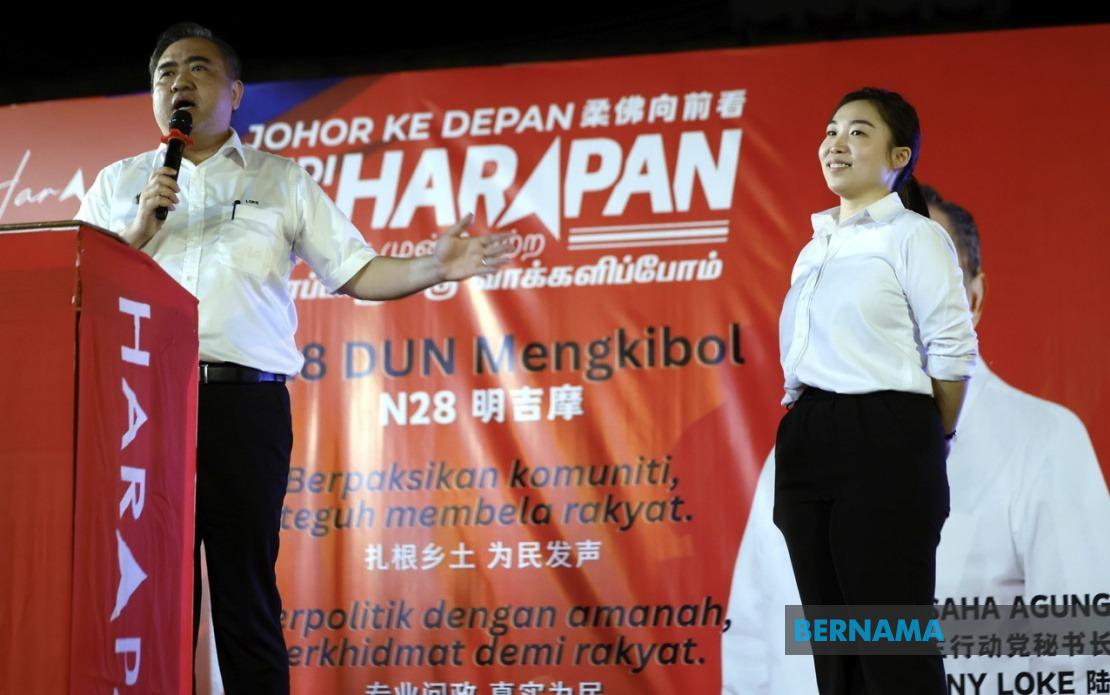
The Democratic Action Party has moved to refresh its political lineup in Johor by nominating 33-year-old lawyer Chu Poh Yee as its candidate for the Mengkibol state assembly seat, marking a strategic transition that will see the current incumbent pursue a higher political office. The announcement, made in Kluang on June 18, signals the party's commitment to grooming younger talent while simultaneously repositioning experienced representatives for expanded responsibilities at the federal level.
Chew Chong Sin, who has represented Mengkibol across two consecutive terms, will step aside from the state contest to make room for Chu's candidacy. However, his departure from the state arena does not signal a diminishment of his political trajectory. Party secretary-general Anthony Loke revealed that Chew is being considered for the Labis parliamentary seat in the next General Election, a development contingent on incumbent MP Pang Hok Liong's decision not to contest again. This succession arrangement reflects a common practice within Malaysian political parties, where state assemblymen are periodically elevated to parliamentary representation as vacancies emerge.
Loke's detailed explanation of the succession strategy underscores the DAP's methodical approach to candidate selection. He framed Chew's transition as recognition of his "potential to be fielded as a parliamentary candidate," suggesting that the party views Labis as an attainable seat within its portfolio. The availability of the seat following Pang's anticipated retirement creates a natural opening for capable representatives already embedded within Johor's political structure. This approach minimises risk by fielding candidates with established track records and existing constituency connections.
Chu's selection for Mengkibol reflects several contemporary considerations within Malaysian electoral politics, particularly the growing emphasis on gender inclusivity at the candidate level. The DAP leadership unanimously endorsed her nomination, a unanimous decision that suggests internal alignment around her suitability for the position. Loke specifically highlighted her background in legal practice, noting her substantial experience in assisting elected representatives with legal aid matters—a specialisation that resonates with grassroots concerns about access to justice and government accountability. This positioning frames Chu not merely as a symbolic candidate but as someone with demonstrable expertise in areas directly relevant to constituent welfare.
Language proficiency and educational credentials formed central pillars of the party's justification for Chu's candidacy. Loke emphasised her multilingual abilities, a practical asset in Johor's ethnically diverse constituencies where effective communication across communities remains essential for electoral success. Her strong educational background similarly positions her as a credible voice on policy matters, potentially countering opposition narratives that seek to characterise DAP candidates as lacking substantive qualifications. In Malaysia's competitive political environment, such credentials frequently determine how swiftly a candidate gains traction within their constituency.
The DAP's explicit invocation of its commitment to "providing greater opportunities for women candidates" reveals the party's broader strategic pivot. Chinese-majority opposition parties in Malaysia have long sought to differentiate themselves through appeals to progressive governance principles, and gender representation has become an increasingly visible metric by which voters assess a party's modernisation credentials. By fielding Chu and presumably other female candidates across Johor, the DAP attempts to broaden its electoral coalition beyond traditional demographic strongholds while simultaneously signalling ideological alignment with contemporary social movements.
Chu's documented ties to Mengkibol itself constitute another strategic advantage. Loke specifically referenced her "close ties to the Mengkibol constituency," a statement suggesting that she possesses pre-existing relationships with community networks and stakeholders. In Malaysian electoral contests, such local embeddedness often proves decisive, particularly in state-level races where voter behaviour tends to reflect personal familiarity with candidates alongside party affiliation. This factor may prove especially consequential if the constituency experiences any demographic shifts or increased electoral competition from other parties.
The broader Johor electoral strategy outlined by the DAP extends well beyond the Mengkibol nomination. Loke confirmed that the party's selection committee has completed its candidate roster for all seventeen state seats the DAP intends to contest. This figure comprises ten currently held seats (including Mengkibol), four previously lost seats that the party seeks to reclaim, and three additional seats representing territory the party views as potentially winnable. This composition reveals tactical calculations about which seats the DAP considers core strongholds requiring experienced defenders and which territories might prove susceptible to strategic advances through new candidates or alternative campaign messaging.
The phased announcement schedule that Loke outlined demonstrates careful orchestration of the candidate disclosure process. Four additional candidates for the seats of Tiram, Johor Jaya, Senai and Bukit Permai would be announced separately on the following Saturday, while the remaining slots would be revealed in coordination with other Pakatan Harapan partners through a centralised announcement led by the Prime Minister. This sequencing allows the DAP to generate successive waves of media attention while ensuring that its broader coalition maintains unified messaging around candidate quality and electoral readiness.
The involvement of Johor DAP chairman Teo Nie Ching in the announcement ceremony signals organisational unity around the decision. Party leadership presence at such events typically indicates that candidate selections enjoy consensus among regional power brokers, reducing the likelihood of internal contestation that could undermine campaign cohesion. For voters observing Malaysian political dynamics, such unified presentations often signal that parties have resolved internal disagreements before presenting their public face.
For Malaysia's broader political landscape, the Mengkibol selection exemplifies how established opposition parties manage succession challenges and generational transitions. Rather than treating state assembly seats as permanent individual fiefdoms, the DAP's approach treats them as positions within a hierarchical structure where capable performers advance to higher office. This system creates incentives for legislative performance and constituent service, as assembly members understand that competence and popularity may lead to promotion rather than indefinite tenure in one seat.
The Johor election context itself remains significant for Malaysian politics. As one of the country's largest and most politically contested states, Johor performance substantially influences national political momentum. The DAP's careful management of its candidate selection in this context suggests that the party views the Johor contest as consequential to its broader federal political prospects. Strong performance here could demonstrate electoral viability ahead of eventual General Election timing, while disappointing results might necessitate strategic recalibration.

%22%2F%3E%3C%2Fpattern%3E%3C%2Fdefs%3E%3Crect%20width%3D%22100%25%22%20height%3D%22100%25%22%20fill%3D%22url(%23ph3j096g)%22%2F%3E%3Crect%20width%3D%22100%25%22%20height%3D%22100%25%22%20fill%3D%22url(%23ph3j096p)%22%2F%3E%3Ctext%20x%3D%2250%25%22%20y%3D%2250%25%22%20text-anchor%3D%22middle%22%20dominant-baseline%3D%22central%22%20fill%3D%22rgba(255%2C255%2C255%2C0.95)%22%20font-family%3D%22Georgia%2C%20'Times%20New%20Roman'%2C%20serif%22%20font-weight%3D%22700%22%20font-size%3D%22320%22%20letter-spacing%3D%22-0.02em%22%3EGRS%3C%2Ftext%3E%3C%2Fsvg%3E)